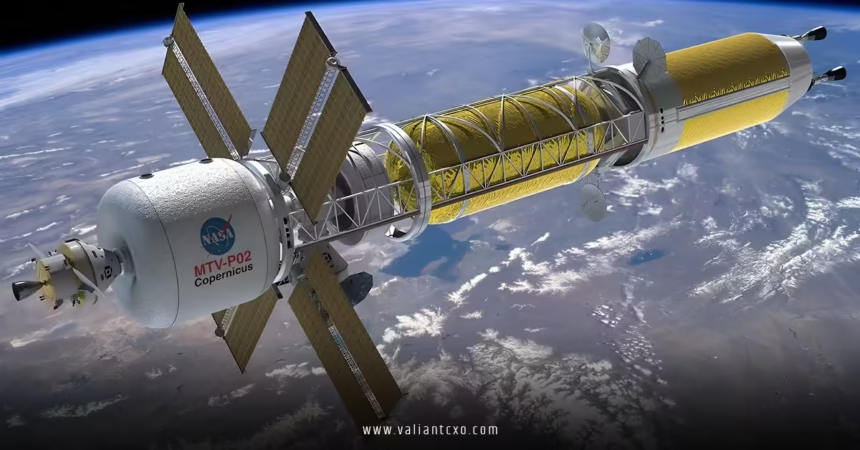
Nuclear propulsion systems in space travel are the rocket fuel of tomorrow—literally igniting our wildest dreams of zipping across the solar system without the drag of chemical rockets. Picture this: instead of slogging six to nine months to Mars, you’re there in three, dodging cosmic rays like a pro gamer evading bullets. As of December 2025, these systems aren’t just lab fantasies; they’re hitting milestones that could redefine how we explore the stars. Drawing from cutting-edge space exploration technologies and innovations, nuclear propulsion promises efficiency, speed, and sustainability. In this article, we’ll blast through the basics, breakthroughs, and big-picture impacts, all while keeping it real for anyone who’s ever stared at the night sky and wondered, “What if we could go there—fast?”
The Evolution of Nuclear Propulsion Systems in Space Travel
Let’s kick things off with a quick backstory, because nothing cool happens in a vacuum—well, except space itself. Nuclear propulsion systems in space travel trace their roots to the Cold War era, when the U.S. and Soviet Union eyed atoms not just for bombs, but for boosting rockets. Project Orion in the 1950s? Wild idea: nuke-powered pulses exploding behind a ship for thrust. It fizzled due to treaties and sanity checks, but the seed was planted.
Fast-forward to the 1960s: NASA’s NERVA (Nuclear Engine for Rocket Vehicle Application) tested ground prototypes that heated hydrogen propellant with a fission reactor, achieving specific impulses twice that of chemical engines—think twice the mileage per “gallon” of fuel. By the ’70s, budgets axed it, but the dream lingered. Why? Chemical rockets guzzle propellant like a sports car on a joyride; nuclear ones sip, using fission’s heat to supercharge exhaust. Today, with Mars beckoning and private players like SpaceX pushing reusability, nuclear propulsion systems in space travel are back with a vengeance. The 2025 landscape? NASA’s Space Nuclear Propulsion project leverages fission for “unlimited energy,” per their updates, fueling everything from lunar hops to outer planet jaunts.
What flipped the switch? Climate urgency and deep-space ambitions. Traditional propulsion hits walls: limited thrust for heavy payloads, endless refueling stops. Nuclear flips the script, offering high thrust and efficiency hybrids. Rhetorical question: If we’ve tamed the atom for power plants, why not hitch it to a starship? Ohio State researchers in September 2025 highlighted how these systems could unlock “the farthest reaches of the solar system,” blending history with hyperdrive potential. It’s evolution, baby—not revolution, but a turbocharged sequel.
Types of Nuclear Propulsion Systems in Space Travel
Diving deeper, nuclear propulsion systems in space travel aren’t one-size-fits-all; they’re a family of techs tailored for different gigs. At the core? Fission reactors splitting uranium atoms to release heat, no fusion fireworks yet—that’s the holy grail for later. Two main flavors dominate: Nuclear Thermal Propulsion (NTP) and Nuclear Electric Propulsion (NEP). Each has its superpower, and together, they’re the dynamic duo for tomorrow’s missions.
Nuclear Thermal Propulsion: The High-Thrust Heavyweight
NTP is the muscle car of nuclear propulsion systems in space travel—raw power for quick getaways. Here’s how it rolls: A reactor heats propellant (usually hydrogen) to scorching temps, around 2,500 Kelvin, then blasts it out a nozzle for thrust. Specific impulse? Up to 900 seconds, double chemical rockets’ 450. That means less fuel mass, more payload—like hauling a Mars habitat instead of extra tanks.
DARPA’s DRACO program, wrapping up in 2025, nailed this with a flight demo slated for 2027. Collaborating with NASA, they’re flight-qualifying a uranium-fueled NTR that boasts a thrust-to-weight ratio 10,000 times electric alternatives. Benefits? Slash Mars trips by 25%, cutting crew radiation exposure—crucial since solar flares turn space into a microwave. Challenges? Reactor weight and heat management; it’s like packing a mini-sun without melting the ship. But Lockheed Martin’s tweaks promise safer, compact designs. Analogy: NTP’s your express elevator to orbit—fast, but you feel the G-forces.
In 2025, ESA echoed this, noting NTP’s edge for “fast transits to distant destinations,” outpacing chemical or solar-electric setups. For crewed missions, it’s gold: shorter trips mean happier astronauts, less bone loss from zero-G marathons.
Nuclear Electric Propulsion: The Efficient Cruiser
Shift gears to NEP, the Prius of nuclear propulsion systems in space travel—steady, sippy-cup efficient for long hauls. The reactor generates electricity to power ion thrusters, zapping propellant like xenon into plasma for gentle, continuous push. Specific impulse? Sky-high at 5,000+ seconds, but thrust’s a whisper—great for probes, not launches.
NASA’s eyeing NEP for outer planets, where sunlight’s too dim for solar panels. A 2025 Physics Today piece details how these systems enable “sustained lunar presence and crewed Mars propulsion,” with reactors churning megawatts sans sunlight. Pros: Ultra-fuel efficient, ideal for cargo slings to asteroids. Cons: Low thrust means slow starts; pair it with chemical kicks for hybrids.
Indian researchers in May 2025 crunched numbers, finding NEP slashes costs for deep-space fission missions, balancing logistics with reliability. Metaphor: If NTP’s a sprint, NEP’s the ultramarathon—wins by endurance, not speed. Emerging hybrids? Bimodal systems toggling thermal and electric modes, per ESA’s bimodal circuit concepts.
Emerging Hybrids and Fusion Teasers
Don’t sleep on hybrids blending NTP and NEP for versatility—think Swiss Army knife for space. And fusion? ESA’s ACT division dreams of impulses over 10,000 seconds, but 2025’s still fission-focused. Space Ambition’s May rundown spotlights these as “primary approaches,” with fusion as the wildcard. Why care? These evolutions make nuclear propulsion systems in space travel modular, scalable for everything from Moon bases to Jupiter tours.
Advantages of Nuclear Propulsion Systems in Space Travel
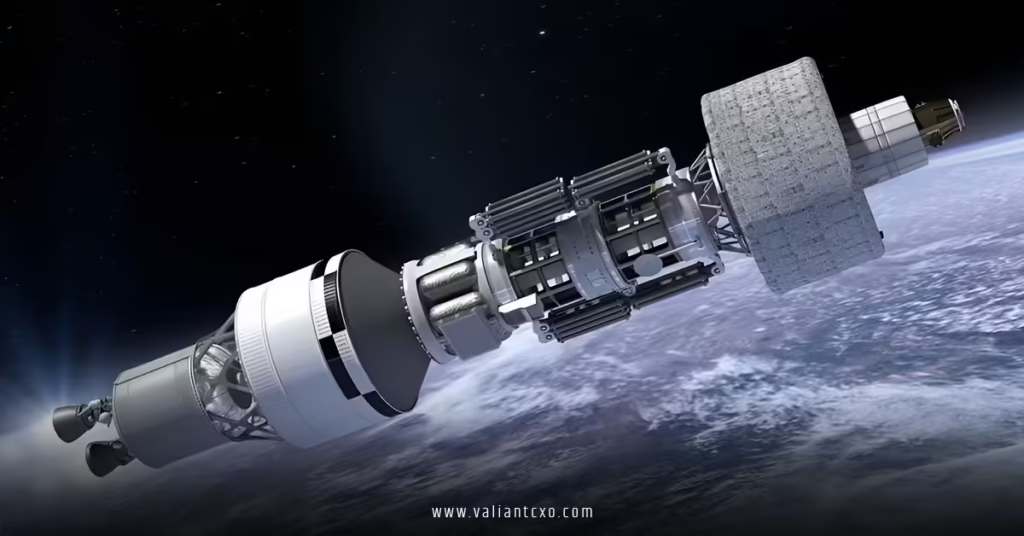
Why bet big on nuclear propulsion systems in space travel? Efficiency tops the list—ESA pegs it as “multiple times more efficient than chemical propulsion,” freeing mass for science gear or habitats. Speed’s next: That 25% Mars shave isn’t hype; it’s math saving lives from radiation baths.
Sustainability shines too—fewer launches mean less debris, greener orbits. For deep space, NEP’s power independence trumps solar limits, per NASA’s 2025 pushes. Economically? A Universe Today analysis shows fission cuts long-mission costs, democratizing exploration. Personal hook: Imagine your data beaming from a Pluto probe that got there in years, not decades. That’s the thrill—nuclear unlocks the solar system’s backyard.
Challenges and Safety in Nuclear Propulsion Systems in Space Travel
No free lunch, right? Nuclear propulsion systems in space travel pack hurdles. Radiation’s the elephant: Shielding adds weight, and launch accidents could scatter fallout—hence ground tests in deserts. Regulatory red tape? Treaties like the Outer Space one demand non-weaponization, slowing demos.
Tech snags: High temps corrode materials; DRACO’s tackling with advanced ceramics. Cost? Billions upfront, but a 2025 SpaceNews report warns steady DoD/NASA funding’s key to breakthroughs. ESA flags electric limits from power constraints, but nuclear’s heat mastery flips that.
Mitigations? Low-enriched uranium reduces proliferation risks, and AI-monitored reactors for failsafes. Rhetorical nudge: Scary? Sure, but we’ve flown fission RTGs on Voyager since ’77 without drama. Progress tempers peril.
Current Projects and 2025 Milestones in Nuclear Propulsion Systems in Space Travel
2025’s buzzing. DRACO’s inking reactor designs for ’27 flight, partnering NASA for Mars enablers. NASA’s NTP push targets lunar ops by 2030, per Issues in Science reports. A September Reddit-buzzed report urges end-decade action on space nukes.
Popular Mechanics spills on solid-uranium NTR launches by ’27, revolutionizing travel. ESA’s nuclear engine studies for Moon/Mars fast-tracks align, eyeing 2030s ops. Burst of excitement: These aren’t pipe dreams; they’re prototypes humming in labs, countdown ticking.
The Future Impact of Nuclear Propulsion Systems in Space Travel
Peering ahead, nuclear propulsion systems in space travel could spawn multi-planetary norms by 2040. Mars colonies? Viable with three-month hops. Outer worlds? NEP fleets mining asteroids for rare earths, fueling Earth’s green shift.
Broader ripples: Tech spin-offs like efficient reactors for remote power. A 2025 WEF-adjacent vibe? Nuclear enables sustainable space exploration technologies and innovations, tying back to global challenges. Challenges persist—funding dips could stall—but momentum’s nuclear-strong. What if your kids crew a Saturn slingshot? These systems script that story.
Conclusion
We’ve rocketed through the highs, heats, and hurdles of nuclear propulsion systems in space travel—from NTP’s fiery thrust to NEP’s silent glide, all backed by 2025’s bold strides like DRACO and NASA blueprints. These aren’t just engines; they’re enablers, slashing distances and risks to make the cosmos less lonely. As we stand in late 2025, the fuse is lit—grab your metaphorical spacesuit and cheer on the ignition. The stars? They’re closer than ever, thanks to atoms doing the heavy lifting.
Frequently Asked Questions (FAQs)
1. What makes nuclear propulsion systems in space travel more efficient than chemical rockets?
They harness fission heat for higher specific impulses—up to 900 seconds for NTP—meaning way less propellant for the same punch. It’s like swapping a gas-guzzler for an electric with infinite range.
2. How do nuclear propulsion systems in space travel reduce Mars mission risks?
By cutting travel to three months, they limit radiation and microgravity woes, keeping crews healthier. Projects like DRACO are testing this for real-world wins.
3. Are there safety concerns with nuclear propulsion systems in space travel?
Yes, radiation and launch risks exist, but low-enriched fuels and shielding mitigate them. We’ve safely used nuclear tech in space for decades without incidents.
4. When can we expect the first flight of nuclear propulsion systems in space travel?
DARPA/NASA aim for 2027 demos via DRACO, with lunar ops by 2030. 2025’s groundwork is accelerating timelines.
5. How do nuclear propulsion systems in space travel fit into broader space exploration technologies and innovations?
They supercharge efficiency for deep missions, complementing reusables and AI—key pillars in pushing humanity multi-planetary.