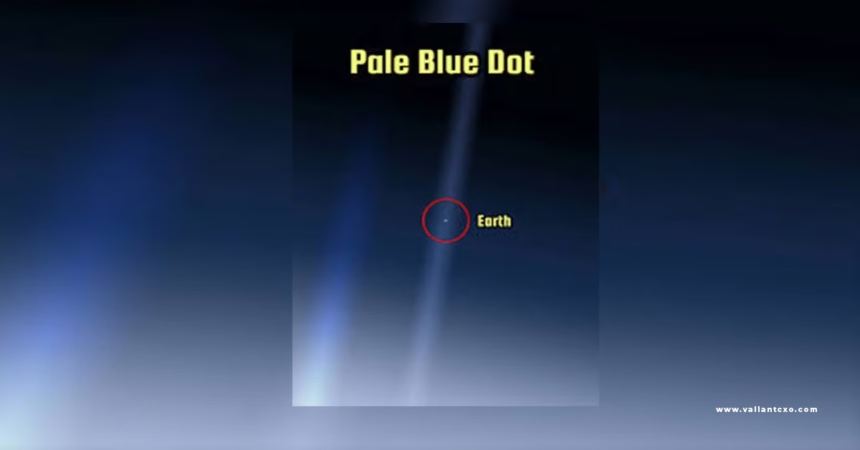
Pale Blue Dot photo explained in plain English: it’s a picture of Earth, taken by NASA’s Voyager 1 on February 14, 1990, from about 6 billion kilometers (3.7 billion miles) away. Here’s the short version:
- What it is: One frame from a 60-image mosaic called the “Family Portrait” of the solar system.
- How small is Earth in it? Less than a single pixel, about 0.12 of one.
- Why it matters: It’s the farthest anyone has ever photographed our home.
- The twist: It was never part of the mission plan, and the cameras shut off for good minutes later.
What You’re Actually Looking At
Open the image and you’ll see almost nothing. Darkness. A few streaks of pale light. And a faint bluish speck sitting inside one of those streaks.
That speck is every person, city, ocean, and war you’ve ever heard of.
The streaks are scattered sunlight bouncing around inside the camera, not a glow from Earth. Earth just happened to land inside one of those beams. Here’s the thing: that accident is a big part of why the picture works. A lone dot suspended in a ray of light looks almost deliberate, like a stage spotlight on the smallest actor in the room.
NASA describes it as a narrow-angle color image built from three filters (violet, blue, and green) recombined into one view. The agency’s JPL notes it’s technically a false-color version, since those filter images were mapped to red, green, and blue.
The Story Behind the Shot
Voyager 1 launched on September 5, 1977. Its job was Jupiter and Saturn. After those flybys, the cameras were basically done.
Then Carl Sagan pushed.
According to NASA’s list of things you might not know about the Pale Blue Dot, neither the Family Portrait nor the Earth frame was in the original mission plan. Sagan lobbied for the idea, engineers worried about the risks, and the team eventually went ahead anyway.
Why the hesitation? Pointing a sensitive camera back toward the Sun can damage it. And power was limited. The spacecraft was a decade into its flight, running on a fading nuclear generator.
The mosaic of 60 frames was captured on that Valentine’s Day. Earth, Venus, Jupiter, Saturn, Uranus, and Neptune made it into the portrait. Mercury, Mars, and Pluto didn’t. Just 34 minutes later, Voyager 1 shut its cameras off forever.
Pale Blue Dot Photo Explained by the Numbers
Numbers make the scale concrete. This table compares Voyager 1 then and now.
| Measure | February 14, 1990 | November 18, 2026 |
|---|---|---|
| Distance from Earth | About 6 billion km (3.7 billion miles) | About 25.9 billion km (16.1 billion miles) |
| One-way signal time | Roughly 5.5 hours | 24 hours |
| Spacecraft age | About 12 years | 49 years |
| Cameras | Active, then shut off after the portrait | Off since 1990 |
| Earth’s size in the frame | About 0.12 pixel | Not photographed |
Look at that third column. The probe is now more than four times farther away than when it took the portrait. If you want the full story on that later milestone, here’s the breakdown of Voyager 1 one light-day from Earth November 2026.
Why Carl Sagan Made It Famous
The photo had a second life in print. In 1994, Sagan published Pale Blue Dot: A Vision of the Human Future in Space, and the image gave the book its title.
His most-quoted line asks readers to look again at the dot: “That’s here. That’s home.” Four short sentences, and they did more for the picture’s fame than any press release.
I’ve seen this pattern in content for years. The pieces that outlive their news cycle usually pair a hard fact with a feeling. Sagan found the best pairing in the business. A photo of nothing, framed as everything.
Pale Blue Dot Photo Explained: The 2020 “Revisited” Version
For the 30th anniversary, NASA released an updated version. A JPL engineer reprocessed the original data with modern software and techniques, while trying to respect what the data and the original team intended. JPL’s “Pale Blue Dot Revisited” page lays out the details.
Is it a different photograph? No. Same raw frames. Better cleanup.
Think of it like restoring an old painting. You’re not repainting. You’re lifting decades of grime so the colors read the way the artist saw them.
Step-by-Step: How to Understand the Pale Blue Dot Photo as a Beginner
You don’t need an astronomy degree. Try this routine.
- Find a high-resolution copy. Pull up the NASA or JPL version, not a cropped social media repost.
- Locate Earth. It sits inside the rightmost sunbeam. Take your time.
- Zoom in until the dot gets blurry. That blur is the point. Earth really is that small to the camera.
- Read Sagan’s passage. Search for the full text of his reflection and read it slowly.
- Compare it to the Revisited version. Notice what changed, and what didn’t.
- Read the story of the other planets. The Planetary Society’s page on the image notes Voyager 1 shot from about 32 degrees above the plane of the planets, which explains the angle.
What usually happens is people skip step 3. Don’t. That’s where the photo stops being an image and starts being an idea.

Common Mistakes (and How to Fix Them)
Mistake 1: Thinking it’s a normal picture of Earth.
It’s a single dot. Fix: remember there are no oceans, continents, or clouds in the frame, just light.
Mistake 2: Crediting the sunbeam to Earth.
The streaks come from scattered light in the camera system. Fix: think “lens artifact,” not “planetary glow.”
Mistake 3: Assuming it was the mission’s grand finale by design.
It was a late, almost-didn’t-happen add-on. Fix: treat it as a bonus shot, not the plan.
Mistake 4: Believing Voyager 1 can take new pictures.
Its cameras went dark in 1990. The probe still sends other science data, but no new photos. Fix: when someone says “Voyager’s latest photo,” check the date.
Mistake 5: Assuming one picture shows the whole solar system.
The Family Portrait was a 60-frame mosaic, and Mercury, Mars, and Pluto are missing. Fix: call it a portrait, not a census.
What the Pale Blue Dot Photo Explained Means for Us Today
Here’s my honest take, labeled as opinion: the image isn’t a science result. It’s a perspective tool.
A 2025-era world drowns in noise. Feeds, alerts, arguments. Then this picture arrives, and none of it fits inside the frame. Does that make your problems smaller? Maybe. Or maybe it makes the people around you feel more worth protecting.
If I were advising a teacher or parent, I’d print it big and hang it somewhere visible. Pair it with the modern milestone. Voyager 1 is still out there, flying farther every day, as covered in the piece on Voyager 1 one light-day from Earth November 2026.
Key Takeaways
- The Pale Blue Dot was taken by Voyager 1 on February 14, 1990, from about 6 billion kilometers away.
- Earth occupies roughly 0.12 of a pixel in the frame.
- It’s one image from a 60-frame “Family Portrait” mosaic of the solar system.
- Carl Sagan pushed for it, and it wasn’t part of the original mission plan.
- The sunbeam-like streaks are scattered light inside the camera, not Earth’s glow.
- Voyager 1 shut off its cameras about 34 minutes after the shot and never took another picture.
- A 2020 “Revisited” version reprocessed the original data without changing the underlying frames.
- Voyager 1 is now more than four times farther away than when it took the picture.
Final Thoughts
One speck. Six billion kilometers. Thirty-six years of people still looking at it.
Next step: pull up the original image on NASA’s site, zoom in until you find the dot, and spend two quiet minutes with it. Then share it with someone who’s never really looked.
FAQs
When was the Pale Blue Dot photo taken, and by what?
NASA’s Voyager 1 spacecraft took it on February 14, 1990. The Pale Blue Dot photo explained simply: the probe turned its camera back toward home from billions of kilometers away.
Is the Pale Blue Dot a real photograph or a computer image?
It’s real data. The color version combines three filtered frames (violet, blue, and green), and JPL notes it’s technically false-color. The 2020 update reprocessed the same original frames.
Can Voyager 1 take another Pale Blue Dot photo today?
No. Its cameras were switched off in 1990. For anyone looking for the Pale Blue Dot photo explained alongside Voyager’s current status, the probe still operates other instruments, and is now more than 25 billion kilometers from Earth.