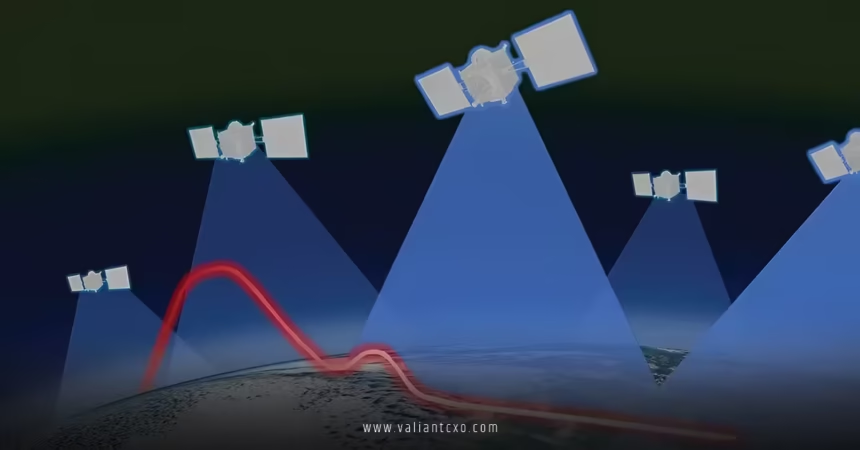
Proliferated Warfighter Space Architecture is transforming how the U.S. military operates in space, shifting from a few vulnerable satellites to hundreds of agile ones that can withstand threats and deliver real-time advantages to troops on the ground. Imagine a vast web in low-Earth orbit (LEO), where satellites talk to each other, track missiles zooming at hypersonic speeds, and relay data faster than ever— that’s the essence of Proliferated Warfighter Space Architecture. As part of the broader U.S. Space Force satellite defense strategy 2026 modernization plans, this program is the backbone of making space resilient and warfighter-focused.
You might wonder, why all the buzz around Proliferated Warfighter Space Architecture right now? Well, space isn’t the quiet vacuum it used to be. Adversaries are testing anti-satellite weapons, jamming signals, and launching cyber attacks daily. The U.S. Space Force (USSF) and its Space Development Agency (SDA) are countering that with PWSA, a layered constellation designed to outpace threats. In this article, we’ll unpack the Proliferated Warfighter Space Architecture, from its origins to 2026 updates, technologies, challenges, and why it’s a game-changer for national security.
The Origins and Evolution of Proliferated Warfighter Space Architecture
Let’s start at the beginning. The Proliferated Warfighter Space Architecture didn’t just appear out of thin air—it’s the brainchild of the SDA, established in 2019 to speed up space tech development. Think of it as the military’s answer to commercial constellations like Starlink, but beefed up for combat. The idea? Proliferate—meaning deploy lots of smaller, cheaper satellites—in LEO to make the system harder to knock out. If one gets hit, the network keeps humming.
Early concepts drew from lessons in Ukraine and other conflicts, where satellite comms proved vital but fragile. By 2020, PWSA was formalized as a multi-layer architecture. The Transport Layer handles data relay, zipping info between satellites and ground forces like a super-fast postal service. The Tracking Layer spots missiles early, giving warfighters precious seconds to react. Other layers cover battle management, custody (tracking targets), and more. This ties directly into the U.S. Space Force satellite defense strategy 2026 modernization plans, which emphasize resilience over reliance on a few “exquisite” birds.
Fast-forward to today, in early 2026, and PWSA is hitting milestones. The first Tranche 1 satellites launched successfully in September 2025, marking the shift from demos to operational capability. With budgets soaring— the FY26 request includes billions for SDA— Proliferated Warfighter Space Architecture is on track to field hundreds of satellites by the end of the decade.
Key Layers and Technologies Driving Proliferated Warfighter Space Architecture
What makes Proliferated Warfighter Space Architecture tick? It’s all about those interconnected layers, each solving a piece of the puzzle in contested space.
The Transport Layer: Backbone of Data Flow in Proliferated Warfighter Space Architecture
Picture this: Troops in a remote battlefield need instant intel, but traditional satellites are jammed. Enter the Transport Layer of Proliferated Warfighter Space Architecture—a mesh of optical crosslinks that beam data at light speed. Using laser comms, these satellites connect without relying on ground stations, reducing latency to milliseconds.
In 2026, updates include requests for information (RFIs) on space-to-air optical terminals. SDA wants aircraft like fighters or drones to link directly to PWSA, bypassing vulnerable relays. Companies like AST SpaceMobile snagged a $30 million deal in February 2026 for tactical SATCOM demos, testing how commercial tech integrates. This layer isn’t just tech—it’s a lifeline, ensuring comms stay up even under attack, aligning with the U.S. Space Force satellite defense strategy 2026 modernization plans for protected networks.
Tracking Layer Innovations in Proliferated Warfighter Space Architecture
Missiles don’t wait, and neither does the Tracking Layer. This part of Proliferated Warfighter Space Architecture uses infrared sensors on LEO satellites to detect and track hypersonic threats globally. Unlike geostationary systems that stare at one spot, PWSA’s proliferated setup provides persistent coverage—think eyes everywhere.
Recent GAO reports in January 2026 called for better risk planning in this pricey layer, noting costs could balloon if tech hurdles aren’t addressed. But progress is real: Tranche 1 includes tracking prototypes, with Tranche 2 aiming for advanced fire-control quality data by 2027. It’s like upgrading from a single spotlight to a swarm of flashlights—harder to blind, and it feeds into missile defense systems seamlessly.
Emerging Layers: Battle Management and Beyond in Proliferated Warfighter Space Architecture
Don’t stop at transport and tracking. Proliferated Warfighter Space Architecture plans for Battle Management, Command, Control, and Communications (BMC3) layers to orchestrate it all. Software-defined networks let satellites reconfigure on the fly, using AI to prioritize threats.
Custody and Ground layers handle target handoff and user terminals. In 2026, demos focus on integrating with existing USSF assets, like Next-Gen OPIR. L3Harris, a key player, provides mission-critical tech, ensuring PWSA scales. This modularity is crucial for the U.S. Space Force satellite defense strategy 2026 modernization plans, allowing quick adaptations to new threats.

Challenges Facing Proliferated Warfighter Space Architecture in 2026
No revolution is smooth. Proliferated Warfighter Space Architecture faces hurdles that could make or break its success.
Budget battles are fierce. While Congress restored Tranche 3 funding in December 2025, adding $1.2 billion to Space Force R&D, portions of the LEO constellation are on hold for acquisition reviews as of February 2026. GAO critiques highlight the need for “more realistic” risk assessments, especially in the Tracking Layer, where tech maturity lags.
Integration is another beast. Merging PWSA with legacy systems requires seamless handoffs—imagine syncing a smartwatch with an old flip phone. Cyber threats loom large; proliferated means more entry points for hackers. SDA’s response? Rigorous testing and partnerships with industry to harden designs.
Workforce and supply chain issues persist. Building hundreds of satellites demands skilled labor and reliable parts. Yet, with agile acquisition—grouping buys into tranches—PWSA aims to deliver every two years, outpacing adversaries.
The Strategic Impact of Proliferated Warfighter Space Architecture on U.S. Defense
Why bet big on Proliferated Warfighter Space Architecture? It’s about deterrence and dominance. In a world where China tests ASAT missiles and Russia deploys space weapons, PWSA ensures U.S. forces aren’t blinded.
For warfighters, it means beyond-line-of-sight comms, precise targeting, and early warnings that save lives. Economically, it spurs innovation—commercial firms like SpaceX and Blue Origin contribute, lowering costs. By 2026, expect more on-orbit demos, proving PWSA’s worth in exercises.
Tying back, Proliferated Warfighter Space Architecture is a cornerstone of the U.S. Space Force satellite defense strategy 2026 modernization plans, enabling resilient ops in contested domains. It’s not just satellites; it’s strategic superiority.
Future Horizons for Proliferated Warfighter Space Architecture
Looking ahead, Proliferated Warfighter Space Architecture evolves with Tranche 3 planning, incorporating advanced prototypes like airborne optical links. GAO’s push for better planning could refine approaches, making PWSA more efficient.
International alliances matter too—sharing PWSA data with allies strengthens coalitions. As space commercializes, hybrid military-commercial models will dominate, reducing taxpayer burdens.
In essence, Proliferated Warfighter Space Architecture redefines space as an enabler, not a vulnerability. By proliferating assets, it disperses risk and amplifies capability, ensuring the U.S. stays ahead.
To wrap it up
Proliferated Warfighter Space Architecture stands as a bold leap in military space tech, blending proliferation, advanced layers, and rapid deployment to counter threats. From Transport to Tracking, it’s building a resilient network that empowers warfighters. As we navigate 2026’s challenges and milestones, this architecture not only safeguards assets but reimagines warfare. If you’re into defense tech or national security, dive deeper—PWSA is shaping the future, and it’s exciting to watch. Stay curious, because space is where the next battles will be won or lost.
FAQs
What is the core purpose of Proliferated Warfighter Space Architecture?
The Proliferated Warfighter Space Architecture aims to create a resilient LEO satellite network for missile tracking, secure comms, and data relay, making U.S. military space ops harder to disrupt in contested environments.
How does Proliferated Warfighter Space Architecture integrate with broader USSF strategies?
Proliferated Warfighter Space Architecture is integral to the U.S. Space Force satellite defense strategy 2026 modernization plans, providing proliferated systems that enhance resilience and tie into missile defense and protected SATCOM.
What are the main challenges in developing Proliferated Warfighter Space Architecture in 2026?
In 2026, Proliferated Warfighter Space Architecture faces budget reviews, tech risks in layers like Tracking, and integration hurdles, as highlighted by GAO reports urging more realistic planning.
Which companies are involved in Proliferated Warfighter Space Architecture?
Key players in Proliferated Warfighter Space Architecture include L3Harris for mission tech, AST SpaceMobile for SATCOM demos, and others responding to SDA RFIs for optical comms.
When will Proliferated Warfighter Space Architecture achieve full operational capability?
Proliferated Warfighter Space Architecture targets incremental capabilities with Tranche 1 operational in 2026, building toward full maturity by the late 2020s through ongoing tranches.