Most of us experience radiology in brief, almost anonymous moments. You step into a machine, hold your breath, and later find a short paragraph in your medical portal summing up what someone saw inside your body. The report may be clear or confusing, reassuring or unsettling, but the process behind it usually remains a mystery.
RDG Imaging was founded to illuminate that hidden process. The group, a team of physician-radiologists based in Israel, works with a pace and method more often found in academic hospitals than in private imaging services. Their model is built on a simple but rarely implemented principle: an image deserves to be read by the person best equipped to understand it.
Subspecialty Reading as the Working Philosophy
At RDG, images do not arrive in a general queue; they are directed with intention. A brain MRI lands with a neuroradiologist who spends every day studying subtle shifts in white matter or cranial nerves. A pelvic MRI goes to a radiologist accustomed to the complexities of endometriosis or gynecologic tumors. Cardiac CT is handled by specialists who interpret coronary flow patterns on a daily basis. PET-CT is read not by one expert but by two, one from diagnostic radiology and one from nuclear medicine.
For many patients, this level of specificity is new. They often come to RDG after receiving reports that seemed vague, contradictory, or disconnected from their symptoms. The difference they encounter is not only technical. It is interpretive. A specialist sees not just what is on the screen but the patterns of disease that come from long familiarity with a particular field.
Double reading is a natural extension of this mindset, as a feature but as a habit shaped by academic practice. When two senior readers interpret a PET-CT independently, both the areas of agreement and the points of divergence matter. Often, the most important clinical insight is found by examining where those perspectives differ.
Reports Meant to Be Understood, Not Just Filed
RDG’s reports look different from the concise summaries that many clinics produce. They are structured to reflect reasoning rather than simply conclusions. Instead of moving immediately to the impression, the radiologist explains how the interpretation developed. Key findings are described in context. Measurements are included when they change the meaning of what is being seen. Ambiguities are noted rather than smoothed away.
This is not verbosity. It is clarity. Surgeons, oncologists, and primary physicians make decisions based on these words, and patients feel the results of those decisions. For people who want a direct and simplified explanation, RDG provides a plain-language summary. It reads more like a conversation than a technical document, and helps patients understand what the radiologist saw, how confident they are, and what questions might be worth asking next.
Where AI Fits, and Where It Does Not
RDG is frequently described as an early adopter of imaging AI. The group uses AI for tasks that benefit from consistency and precision rather than interpretation.
In cardiac imaging, AI calculates calcium scores and evaluates blood flow patterns that are challenging to estimate manually. Neuroimaging software measures brain regions involved in dementia or multiple sclerosis with a level of consistency that supports long-term comparison. In abdominal and musculoskeletal imaging, AI quantifies liver fat, spinal curvature, or bone density. These are tasks where precise measurements, provide real value.
Helping Patients Navigate Decisions, Not Just Diagnoses
Imaging often marks the beginning of a pathway that leads to treatment. Many patients receive a scan that hints at a possible intervention, such as an ablation, an embolization, or a targeted pain procedure. Yet they rarely understand what these options entail or whether they are appropriate.
RDG offers consultations with interventional radiologists to help bridge this gap. The group does not perform the treatments itself, which allows the conversations to remain focused on information rather than persuasion. The specialist reviews the images, outlines what is possible, and helps the patient decide whether pursuing a procedure makes sense and which experts to approach if it does.
A similar approach shapes RDG’s private tumor board, a service that is common in academic centers but rare in the private sector. A multidisciplinary panel meets online to discuss complex cancer cases, combining radiology, oncology, surgery, and interventional expertise. Many patients seek this review not to overturn an existing plan but to confirm that it is grounded in current evidence and shared understanding.
The Vision Behind the Practice
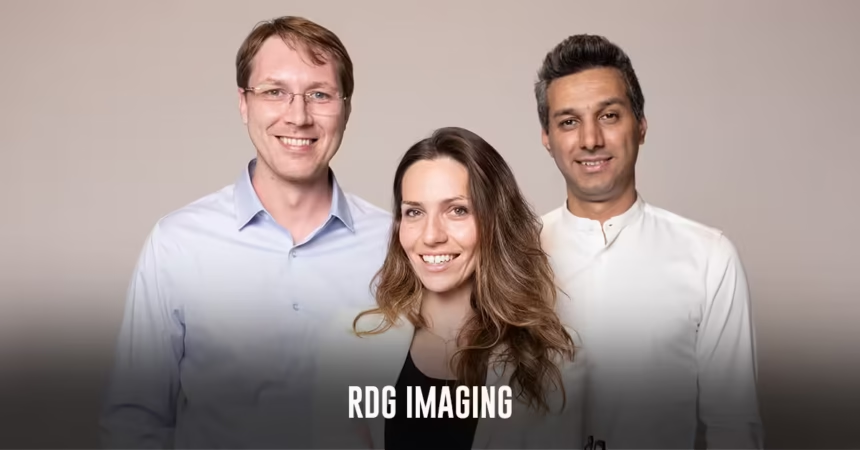
RDG Imaging is shaped not by a single perspective but by three founders who built the practice together and continue to jointly steer it. At the helm is Dr. Anatoly Budylev, RDG’s Chief Executive Officer and a senior neuroradiologist at Assuta and Tel Aviv Medical Center (Ichilov). Alongside him are Dr. Lilian Atlan, the Chief Medical Officer and a neuroradiologist with deep expertise in clinical AI, and Dr. Rabeeh Fares, the Chief Technology Officer and a specialist in musculoskeletal and breast imaging.
Together, they integrate academic precision, subspecialty expertise, and technological innovation into daily practice. Their joint creation of Israel’s first AI Radiology Hub captures their shared philosophy: advanced tools should support and refine expert clinical judgment, not imitate it.
Under Dr. Budylev’s leadership, RDG has become something unusual in private radiology: a place where subspecialty experience, careful interpretation, and modern tools coexist without rushing the process. It is a model built not only on efficiency but on the belief that good imaging interpretation can change the course of a patient’s care.
“We offer a detailed explanation service to ensure that you understand the results of your imaging findings with clarity and peace of mind, and offer services in multiple languages.”