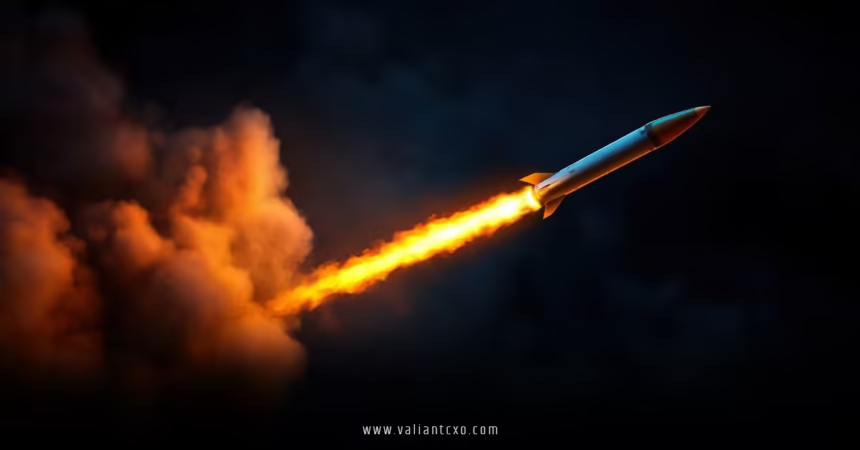
SpaceX Falcon 9 rocket launch—a spectacle that’s turned science fiction into everyday reality. As I sit here, coffee in hand, reflecting on how this beast of a machine has reshaped our reach for the stars, I can’t help but feel a thrill. It’s not just a launch; it’s a promise that space isn’t some elite club anymore. It’s accessible, repeatable, and yeah, even affordable in the grand scheme of cosmic adventures.
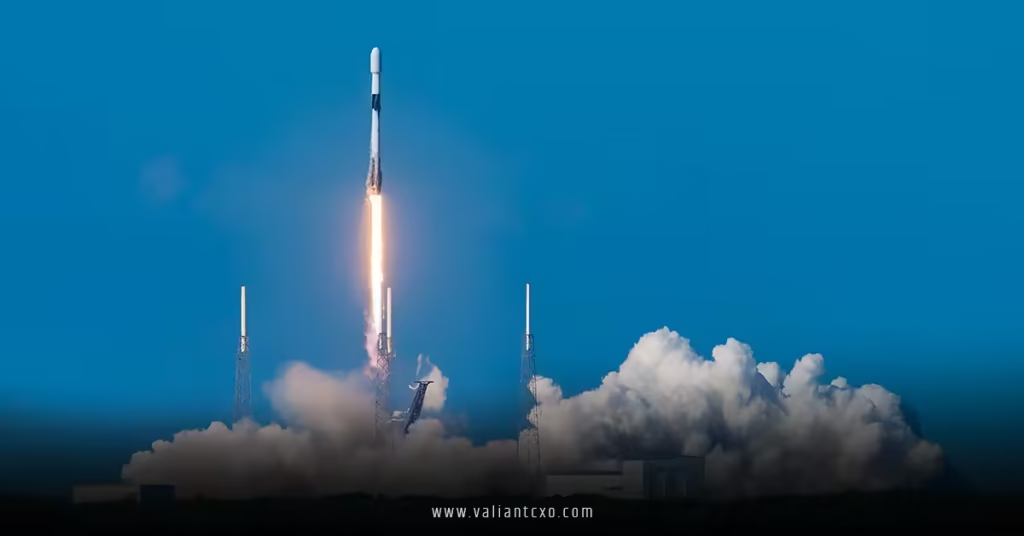
Picture this: a towering cylinder of white and black, standing over 70 meters tall, humming with the quiet menace of nine Merlin engines primed for ignition. The SpaceX Falcon 9 rocket launch isn’t your grandpa’s Apollo-era fireworks. It’s a ballet of engineering precision, where fire meets fuel in a controlled inferno that propels satellites, astronauts, and dreams into orbit. Since its debut over a decade ago, this rocket has become the workhorse of the cosmos, clocking in hundreds of flights while landing its boosters back on Earth like a falcon returning to its perch. In this deep dive, we’ll unpack everything from its gritty origins to the heart-pounding mechanics that make it tick. Buckle up— we’re about to launch into the details.
The Evolution of the SpaceX Falcon 9 Rocket Launch: From Dream to Dominance
Let’s rewind the clock a bit, shall we? The story of the SpaceX Falcon 9 rocket launch starts in the wild, ambitious mind of Elon Musk back in 2002. Fresh off selling PayPal, Musk poured his fortune into SpaceX with a audacious goal: make humanity multi-planetary. But dreams need hardware, and that’s where Falcon 9 enters the scene. Announced in 2005 as a “fully reusable heavy-lift launch vehicle,” it skipped the middling Falcon 5 concept and went straight for the jugular— a medium-lift powerhouse capable of hauling 22,800 kg to low Earth orbit.
By 2010, the first SpaceX Falcon 9 rocket launch lit up the skies from Cape Canaveral, Florida, on June 4. It was a nail-biter: the Dragon capsule test flight splashed down safely, but early days were rough. Three of the first five v1.0 flights faced hiccups, including a second-stage failure that turned a Dragon cargo run into a fiery lesson. Yet, like a phoenix from the ashes, SpaceX iterated furiously. The v1.1 upgrade in 2013 beefed up the thrust by 60%, stretched the tanks, and rearranged those Merlin engines into an “Octaweb” pattern—think of it as giving the rocket a more efficient engine room, cutting manufacturing time and boosting power.
Fast forward to the Full Thrust era in 2015, and reusability became the game-changer. That December 21 launch? The first successful booster landing on land, a grainy video of legs deploying like a sci-fi tripod that had the world buzzing. By 2018, Block 5—the current champ—rolled out with hyped-up engines and grid fins tough enough for multiple flights. Today, as of late 2025, the Falcon family has notched 551 launches, with a 99.46% success rate that’s the envy of every aerospace engineer. It’s not just numbers; it’s a revolution. Where old-school rockets were tossed like yesterday’s trash, Falcon 9 boosters now routinely fly 20+ missions, slashing costs from hundreds of millions to around $67 million per pop.
What blows my mind is how this evolution mirrors human grit. Early failures? Sure, like the 2015 CRS-7 explosion that rained debris over the Atlantic. But each setback fueled upgrades—better avionics, cryogenic propellants chilled to -183°C for denser fuel. Now, the SpaceX Falcon 9 rocket launch feels routine, yet every countdown stirs that childlike awe. It’s proof that bold risks pay off, turning a startup into the king of launches.
Key Milestones in SpaceX Falcon 9 Rocket Launch History
No epic tale skips the highlight reel. Here’s a quick hit of those “whoa” moments that define the SpaceX Falcon 9 rocket launch journey:
- 2010: Maiden Voyage – First flight carries a dummy Dragon, proving the two-stage design works.
- 2012: ISS Rendezvous – CRS-1 delivers cargo, though a thruster glitch strands a secondary payload—partial win, full lesson.
- 2015: Reusability Dawn – Flight 20 lands the booster upright, the first of its kind for an orbital rocket.
- 2017: Reflight First – SES-10 reuses a booster, proving you can fly, land, and fly again without breaking the bank.
- 2020: Human Leap – Demo-2 sends NASA astronauts Bob Behnken and Doug Hurley to the ISS, the first commercial crewed SpaceX Falcon 9 rocket launch.
- 2024: Record Breaker – 134 Falcon flights in a year, over half of all global orbital launches.
- 2025: Reuse Royalty – Booster B1067 hits 30 flights, a record that makes Shuttle boosters look lazy.
These aren’t just dates; they’re stepping stones. Imagine the engineers high-fiving after that 2015 landing—exhaustion mixed with ecstasy. It’s stories like these that make the SpaceX Falcon 9 rocket launch more than tech; it’s inspiration on steroids.
Inside the Beast: How a SpaceX Falcon 9 Rocket Launch Actually Works
Alright, let’s geek out. Ever wondered what makes the SpaceX Falcon 9 rocket launch roar to life? It’s a symphony of physics and wizardry, starting with that countdown clock ticking like a heartbeat. At T-0, those nine Merlin 1D engines ignite in a staged sequence to avoid the whole “kaboom” scenario. Liquid oxygen (LOX) and RP-1 kerosene mix in a fiery tango, producing 1.7 million pounds of thrust—enough to hurl 549,000 kg skyward at 28,000 km/h.
The rocket’s two-stage setup is genius. The first stage, that beefy booster with its Octaweb engines, does the heavy lifting for the first 2.5 minutes, reaching Mach 6 and 80 km altitude. Then—bam—stage separation. Explosive bolts and pneumatics push the stages apart, like uncoupling train cars mid-air. The second stage, with its single Merlin Vacuum engine (tuned for the thin air of space), takes over, firing for up to six minutes to inject payloads into orbit. It’s all controlled by redundant avionics, sipping hypergolic igniters to spark without a match.
But the real showstopper? Reusability. Post-separation, the booster flips using cold-gas thrusters, then performs a boost-back burn to reverse course. Grid fins—those metallic wings—steer it like a kite in a storm, while three sea-level engines relight for the entry burn, slowing from orbital speeds to a gentle 1 m/s touchdown. Land on a droneship like “Of Course I Still Love You” or a concrete pad? Either way, legs deploy, and it sticks the landing 99% of the time. Fairings, those nose-cone halves, parachute into the ocean for fishing boats to snag and reuse too.
Think of it as a boomerang with brains. The whole sequence unfolds in under 10 minutes from liftoff to splashdown, monitored by teams in Hawthorne, California. Safety’s baked in—redundant systems, abort options for Crew Dragon atop. Yet, risks linger; a 2024 upper-stage hiccup grounded flights briefly, reminding us space is unforgiving. Still, the SpaceX Falcon 9 rocket launch’s reliability? It’s like your trusty pickup truck, but one that conquers gravity.
Step-by-Step Breakdown of a Typical SpaceX Falcon 9 Rocket Launch
Want the play-by-play? Here’s how it unfolds, second by second:
- Ignition and Liftoff (T+0 to T+3s): Engines throttle up, hold-down clamps release. The rocket claws through max-Q (peak aerodynamic stress) around T+1:15.
- First Stage Flight (T+3s to T+2:30): Accelerates to 2 km/s, MECO (main engine cut-off) at 70 km.
- Stage Separation and Flip (T+2:35): Second stage ignites, booster flips 180°.
- Booster Return (T+2:40 to T+8:30): Entry burn, landing burn—touchdown!
- Second Stage to Orbit (T+2:40 to T+8:30): SECO-1 places payload; optional restarts for GTO.
- Payload Deployment (T+8:30+): Satellites spin free, fairings jettison earlier.
It’s poetry in motion, right? One glitch in timing, and it’s chaos—but SpaceX’s simulations nail it 99 times out of 100.
Why Reusability in SpaceX Falcon 9 Rocket Launch is a Game-Changer
Here’s where it gets juicy: reusability. Before Falcon 9, rockets were disposable divas—build once, fly once, discard. Cost a fortune, literally. The SpaceX Falcon 9 rocket launch flips that script, landing and refurbishing boosters for pennies on the dollar. That first 2015 landing? Skeptics scoffed, but now, with 511 successful landings out of 524 tries, it’s old hat. Boosters like B1067, with 30 flights under its belt by mid-2025, prove the hardware lasts.
Economically, it’s a knockout punch. Launch prices plummeted from $60 million to under $70 million, undercutting rivals like ULA’s Vulcan. Environmentally? Fewer launches mean less debris, less fuel burned. And for missions? It enables rapid turnaround—three flights in 13 hours, anyone? But it’s not flawless; refurbishing takes weeks, and anomalies like the 2025 fuel leak tip-over highlight wear-and-tear battles.
Metaphor time: Imagine airlines ditching planes after one trip. Insane, right? Falcon 9 makes space like aviation—routine, scalable. It’s democratizing orbit, letting startups like yours truly dream big without billionaire bucks.
The Tech Behind Reusable SpaceX Falcon 9 Rocket Launch Boosters
Dive deeper: Those grid fins? Titanium wonders, pivoting via hydraulics for pinpoint control. Legs? Carbon fiber, deploying in 10 seconds with sensors for auto-leveling. Propellant reserves—3% held back—fuel the returns. Post-landing, cranes haul boosters to hangars for inspections: engines swapped if needed, tanks pressure-tested. It’s like a pit stop in Formula 1, but for starships.
Recent Thrills: SpaceX Falcon 9 Rocket Launch Highlights from 2025
2025’s been a banner year for the SpaceX Falcon 9 rocket launch—123 flights by September, on track for 175-180 total. Starlink dominates, with batches like Group 10-61 on September 18 deploying 28 V2 Mini sats from Cape Canaveral at dawn. That sunrise glow? Chef’s kiss. Vandenberg saw 24 sats on September 26, booster splashing on OCISLY.
Milestones? The 500th Falcon flight in June, with B1067 nailing its 29th reuse. Transporter-14 in June rode-shared 70 payloads to SSO, from NASA’s IMAP probe to NOAA birds. Crew-10 splashed astronauts to ISS in March. Anomalies? A February reentry scare over Poland grounded checks, but FAA cleared quick. Pace is blistering—15 in September alone—fueled by Starlink’s global beam.
It’s exhilarating chaos. Watching a SpaceX Falcon 9 rocket launch live, that rumble through your chest? Pure adrenaline. These aren’t distant events; they’re our bridge to tomorrow.
The Future Awaits: What’s Next for SpaceX Falcon 9 Rocket Launch and Beyond
Peering ahead, the SpaceX Falcon 9 rocket launch isn’t fading—it’s evolving. With Starship looming, Falcon bridges the gap, launching Starlink until the big guy’s ready. Expect 150+ flights yearly, integrating DTC sats for phone beaming. But Starship’s the heir: fully reusable, 100-tonne lifts. Kennedy’s LC-39A gets Starship pads by 2026, Florida launches ramping.
Challenges? Supply chains, regs—FAA delays irk Musk. Yet, optimism reigns. Falcon 9 could hit 1,000 flights by 2030, paving Mars roads. It’s the reliable sidekick in SpaceX’s saga, ensuring we keep reaching.
In wrapping this cosmic ride, the SpaceX Falcon 9 rocket launch stands as a testament to ingenuity—reusable, relentless, revolutionary. From humble 2010 beginnings to 2025’s record smashes, it’s slashed costs, boosted access, and ignited imaginations. Whether you’re a starry-eyed newbie or a hardened fan, it reminds us: the stars aren’t just for looking; they’re for going. So next time you catch a glow on the horizon, tip your hat to Falcon 9. What’s your next launch watch party? The universe is calling—answer it.
Frequently Asked Questions (FAQs)
What makes the SpaceX Falcon 9 rocket launch so reliable?
The SpaceX Falcon 9 rocket launch boasts a 99.46% success rate thanks to redundant systems, rigorous testing, and iterative upgrades like Block 5’s durable components. It’s like a well-oiled machine that’s learned from every tumble.
How often does a SpaceX Falcon 9 rocket launch happen in 2025?
In 2025, SpaceX is averaging 14-15 SpaceX Falcon 9 rocket launches per month, with over 123 by September—mostly Starlink missions, but room for crew and cargo too.
Can the SpaceX Falcon 9 rocket launch carry humans?
Absolutely! The SpaceX Falcon 9 rocket launch has ferried astronauts to the ISS since 2020 via Crew Dragon, with missions like Crew-10 proving its human-rated chops.
What’s the cost of a SpaceX Falcon 9 rocket launch?
A standard SpaceX Falcon 9 rocket launch runs about $67 million, but reusability keeps it way below competitors—think economy class to orbit.
How does reusability work in a SpaceX Falcon 9 rocket launch?
During a SpaceX Falcon 9 rocket launch, the first stage separates, flips, and lands via grid fins and engine burns on a droneship or pad, ready for quick refurb and relaunch.
Read More:valiantcxo.com