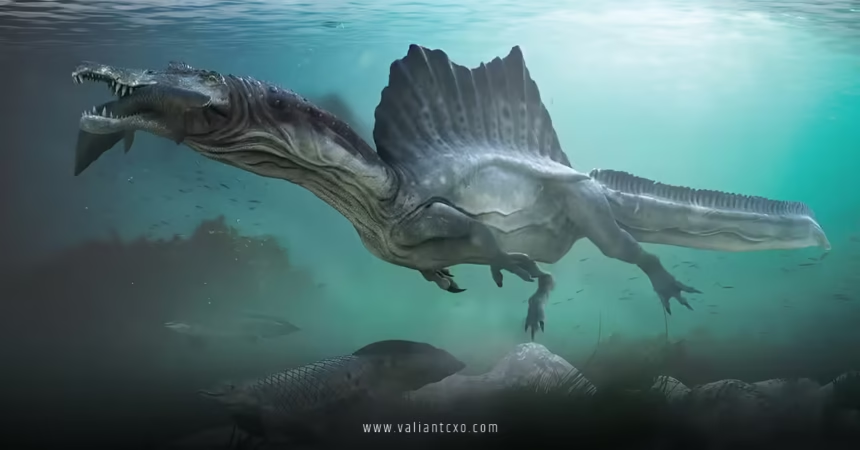
The Spinosaurus aquatic adaptations debate has kept paleontologists arguing for years. Picture a dinosaur longer than a T. rex, with a crocodile snout, conical teeth like fish hooks, dense bones, a massive sail on its back, and—most controversially—a paddle-like tail fin. Was this beast a full-time swimmer chasing prey underwater like a prehistoric crocodile? Or just a giant wader that dipped into rivers for snacks, more like a supersized heron? The question isn’t settled, and recent finds keep stirring the pot.
This debate exploded in the 2010s with new fossils from North Africa. But the Spinosaurus mirabilis new species discovery Niger 2026 has thrown fresh fuel on the fire. Announced in February 2026, this inland specimen from Niger’s Farak Formation challenges extreme swimming ideas and pushes many toward a semi-aquatic, shoreline lifestyle. Let’s break down the key arguments, evidence, and why this topic refuses to die.
Why Spinosaurus Sparks So Much Controversy
Spinosaurus isn’t your typical theropod. Discovered over a century ago, it vanished in WWII bombings, then re-emerged with dramatic new bones. Unlike land-roaming T. rex or speedy Velociraptor, Spinosaurus shows weird traits that scream “water.” Long, narrow jaws for snaring slippery fish. Conical teeth that interlock like a trap. Short hind limbs that look awkward for sprinting. A neural sail taller than a person. And that tail—flexible, finned, perfect for propulsion?
The core question: How aquatic was it really? Fully aquatic (diving, pursuing prey like ichthyosaurs)? Semi-aquatic (wading and ambushing like crocs)? Or mostly terrestrial with occasional river visits? No consensus exists because evidence pulls in different directions.
Key Evidence Supporting Strong Aquatic Adaptations
Pro-swimming researchers, like Nizar Ibrahim’s team, point to several smoking guns.
First, the tail. A 2020 Nature study revealed tall neural spines forming a flexible, fin-like structure. Robotic models showed it could generate powerful sideways thrusts, similar to a crocodile or newt tail. This suggests active swimming, not just floating.
Then come the bones. Dense, compact limb bones (like penguins or hippos) act as ballast, helping counter buoyancy for submersion. A 2022 study reinforced this: heavy bones optimized for diving, not land speed.
Jaws and teeth scream fish-eater. Interlocking cones trap slippery prey—seen in crocs, ichthyosaurs, even pterosaurs. Combined with a long snout, it’s built for grabbing underwater.
Body proportions add intrigue. Short hind legs reduce drag in water, while a forward-shifted center of mass aids stability when submerged. Some models place Spinosaurus in the “highly aquatic” category, spending most time underwater.
These traits fuel the idea of Spinosaurus as a pursuit predator in rivers or shallows, lunging after coelacanths or lungfish.
Arguments Against Full Aquatic Lifestyle
Skeptics, including Paul Sereno, counter that Spinosaurus wasn’t built for deep diving or fast swimming.
Buoyancy tests show the animal too buoyant to submerge easily—requiring massive force its tail couldn’t deliver. A 2022 eLife paper by Sereno argued it’s unstable underwater, awkward as a surface swimmer at best. The sail creates drag when submerged, and short legs limit propulsion.
Hind limbs, though short, support bipedal stance on land. Quadrupedal ideas (slow on land) don’t hold up in reconstructions.
Inland fossils matter hugely. Many Spinosaurus bones come from river deposits far from ancient coasts. The Spinosaurus mirabilis new species discovery Niger 2026 seals this: found 500–1000 km inland in forested river valleys, not coastal zones. Large active aquatic hunters (mosasaurs, ichthyosaurs) stick to marine environments. An inland giant suggests wading specialist, not deep diver.
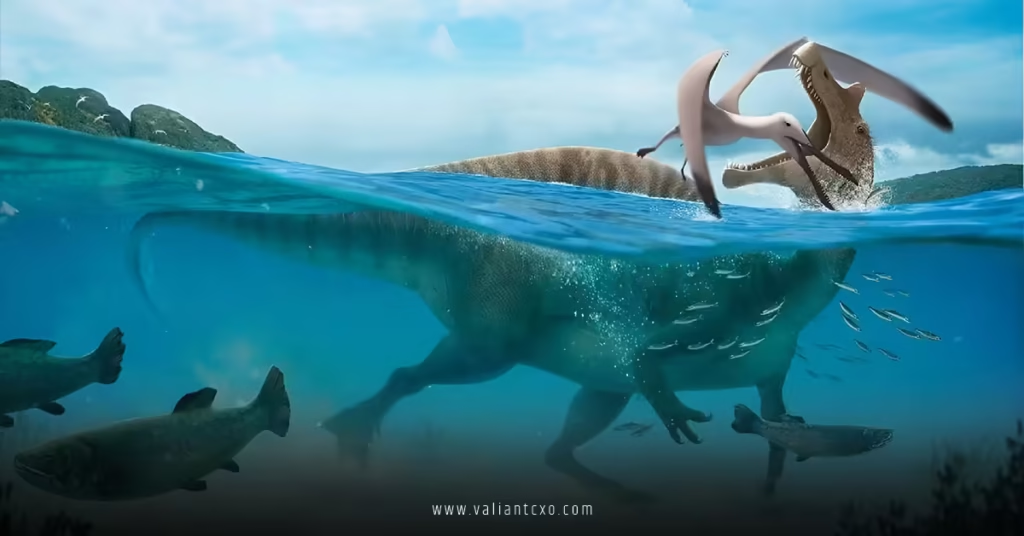
Sereno describes it as a “hell heron”—wading into 2-meter depths but stalking shallows most of the time.
How the Spinosaurus mirabilis New Species Discovery Niger 2026 Shifts the Debate
Enter Spinosaurus mirabilis new species discovery Niger 2026, published in Science. This new species shares core traits with S. aegyptiacus but boasts a taller, scimitar-shaped cranial crest—likely for display, not hydrodynamics.
Found at Jenguebi in fluvial (river) sediments alongside new sauropods, it lived in wooded inland basins crisscrossed by rivers. No marine influence nearby.
The paper argues spinosaurids evolved in phases: early fish-snaring skulls, then Tethys Sea dominance, finally giants like mirabilis as wading shoreline predators. The inland habitat, display crests, and PCA analysis (placing it between divers and waders) favor “aquaphilic” (water-loving) but not fully aquatic.
This find revives the debate. Extreme swimmers lose ground when a close relative thrived far inland without needing pursuit swimming. It supports ambush piscivory in shallows over chasing in open water.
Comparing Spinosaurus to Modern Analogs
Think Nile crocodile: ambushes from shallows, lunges for prey. Or heron: wades patiently, strikes fast.
Pro-swim side sees croc-like pursuit. Anti-swim side leans heron—wading, stabbing, retreating to shore. The Spinosaurus mirabilis new species discovery Niger 2026 bolsters the heron view: sturdy legs for wading, display features for signaling in riverside forests.
Neither side claims zero swimming. Everyone agrees it entered water often, hunted fish expertly. The fight is over degree: occasional dipper or near-constant swimmer?
What This Means for Dinosaur Paleontology
The Spinosaurus aquatic adaptations debate highlights how incomplete fossils lead to wild ideas. New finds like mirabilis remind us dinosaurs colonized diverse niches—including water edges.
It also shows science evolves. Early views dismissed aquatic dinos; 2020s evidence flipped that; now inland fossils pull back. Future discoveries—more tails, limbs, trackways—could tip the scale.
For now, Spinosaurus remains the weirdest theropod: part croc, part heron, all mystery.
Dive deeper: Check the Natural History Museum’s Spinosaurus overview for basics. Read the original 2026 paper via Science journal. Follow updates from Paul Sereno at University of Chicago.
Conclusion
The Spinosaurus aquatic adaptations debate boils down to interpreting a bizarre mix of features: fish-trapping jaws, dense bones, paddle tail, sail, short legs. Evidence supports water affinity—strong for shallows, weaker for deep pursuit. The Spinosaurus mirabilis new species discovery Niger 2026 strengthens the semi-aquatic wader side, showing inland life far from coasts. Spinosaurus loved water, hunted fish brilliantly, but probably ambushed from shorelines rather than chased underwater like a dino-whale. This ongoing puzzle keeps paleontology exciting—what new bone will rewrite the story next? Keep watching the Sahara; answers hide in the sand.
FAQs
What started the Spinosaurus aquatic adaptations debate?
It kicked off with 2014 fossils showing dense bones, short legs, and a fish-eating skull, plus 2020 tail evidence suggesting swimming propulsion.
Does the Spinosaurus mirabilis new species discovery Niger 2026 support full swimming?
No—it favors wading in inland rivers, challenging deep-diving ideas with its far-from-coast habitat and display-focused crest.
What aquatic features does Spinosaurus have?
Conical interlocking teeth, long snout, dense bones for ballast, flexible paddle tail, and short hind limbs to reduce drag.
Why do some experts say Spinosaurus wasn’t a strong swimmer?
Buoyancy models show it’s too floaty to dive easily, the sail adds drag, and inland fossils suggest shoreline ambushing over pursuit.
How does Spinosaurus compare to modern animals in the aquatic adaptations debate?
Pro-swim views liken it to crocodiles pursuing prey; others see a giant heron wading and striking in shallows.