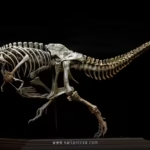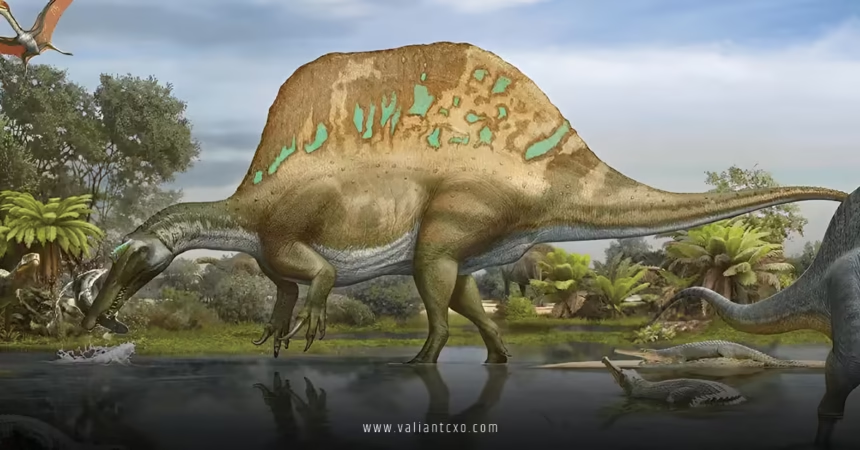
Spinosaurus mirabilis facts have exploded onto the scene following the groundbreaking Spinosaurus Real Skeleton Discovery Update that revealed this “astonishing” dinosaur to the world in February 2026. If you’ve been following dinosaur news, you know Spinosaurus already holds the crown for weirdest theropod—think massive sail, crocodile snout, and fish-eating habits. But Spinosaurus mirabilis takes that eccentricity to another level with its dramatic scimitar-shaped head crest. Picture a T. rex-sized predator wading through ancient rivers, sporting what looks like a curved sword on its head. Wild, right? In this deep dive, we’ll unpack the most fascinating Spinosaurus mirabilis facts, from its anatomy to its lifestyle, all tied back to the recent Spinosaurus Real Skeleton Discovery Update.
What Is Spinosaurus Mirabilis? Key Basics
Spinosaurus mirabilis, meaning “astonishing Spinosaurus” in Latin, represents the first indisputable new species in the Spinosaurus genus since the original Spinosaurus aegyptiacus was named over a century ago in 1915. This beast lived about 95 million years ago during the Late Cretaceous period in what is now the central Sahara Desert of Niger.
Unlike its better-known cousin, which hailed from near-coastal or delta environments in Egypt and Morocco, Spinosaurus mirabilis thrived in inland riparian habitats—think lush river systems winding through forested landscapes far from the sea. This inland setting adds a fresh twist to Spinosaurus mirabilis facts, showing these dinosaurs weren’t limited to watery edges but adapted to diverse riverine ecosystems.
The discovery stems directly from the Spinosaurus Real Skeleton Discovery Update led by University of Chicago paleontologist Paul Sereno. His team excavated at the remote Jenguebi site, hauling back 55 tons of fossils in 2022 after initial finds in 2019. Published in the journal Science, this find caps a “stepwise radiation” of spinosaurids, highlighting three evolutionary phases from Jurassic roots to their peak in Africa and South America.
The Standout Feature: The Scimitar-Shaped Head Crest
One of the most jaw-dropping Spinosaurus mirabilis facts is its massive cranial crest. Rising about 20 inches (50 cm) tall, this bony structure curves like a scimitar—a curved sword from ancient warriors. It’s the tallest head crest known in any meat-eating dinosaur, formed from hypertrophied nasal and prefrontal bones.
Researchers believe the crest was sheathed in keratin, similar to a cassowary’s casque or a guinea fowl’s helmet, making it even taller and likely brightly colored in life. Vascular canals inside the bone suggest it was vascularized for display purposes. Imagine this dinosaur silhouetted against a riverbank, the crest catching sunlight like a beacon—perfect for signaling mates or intimidating rivals.
This crest sets Spinosaurus mirabilis apart from Spinosaurus aegyptiacus, which had smaller or different cranial ornaments. In the Spinosaurus Real Skeleton Discovery Update, three crests were recovered, confirming it’s no fluke. The feature supports the idea that visual display was crucial for spinosaurids, much like peacocks today flaunt tails.
Size, Build, and Comparisons to Other Dinosaurs
How big was this thing? Spinosaurus mirabilis facts point to a colossal predator roughly the size of a school bus—estimated 10 to 14 meters (33 to 46 feet) long and weighing several tonnes, comparable to Tyrannosaurus rex in bulk.
Its body plan mirrors Spinosaurus aegyptiacus: elongated crocodile-like snout, conical interlocking teeth ideal for snaring slippery fish like coelacanths, powerful arms with huge claws, and that iconic neural-spined sail along the back. However, limb proportions (like a longer tibia relative to dentary length) suggest slightly longer legs, perhaps better suited for wading in shallower waters.
Compared to other spinosaurids like Baryonyx or Suchomimus, Spinosaurus mirabilis stands out for its extreme adaptations. It’s one of the last-surviving members of its family, appearing just before the final phase of spinosaurid evolution when they became specialized shallow-water ambush hunters.
Lifestyle and Habitat: Wader, Not Deep Diver?
A hot debate in dinosaur circles is whether Spinosaurus was primarily aquatic or terrestrial. Spinosaurus mirabilis facts lean toward the “wading shoreline predator” camp. Found in fluvial (river-deposited) sediments alongside long-necked sauropods, it lived in riparian zones—forested river valleys crisscrossed by waterways.
Paul Sereno describes it as a “hell heron”—a demonic, supersized version of modern herons stalking shallows for fish. The interlocking teeth trapped prey like a natural net, while the crest and sail likely aided in display rather than hydrodynamics. This inland habitat challenges ideas of Spinosaurus as a deep swimmer, suggesting more of an ambush specialist in rivers.
This aligns with broader Spinosaurus Real Skeleton Discovery Update insights, painting spinosaurids as adaptable predators dominating circum-Tethyan regions before their decline.
Evolutionary Significance and Why It Matters
Spinosaurus mirabilis facts reveal evolutionary patterns. The paper outlines three phases:
- Jurassic origins with fish-snaring skulls.
- Early Cretaceous dominance in Tethys habitats.
- Late Cretaceous peak with giants like mirabilis in isolated basins.
As one of the final spinosaurids, it shows how these dinosaurs maximized size and specialization amid shifting continents and oceans. The discovery underscores Africa’s role as a hotspot for dinosaur diversity and how remote sites still hold secrets.
For paleontology fans, this updates our view of theropod evolution—proving even “famous” genera like Spinosaurus had hidden diversity.
Discovery Story: From Desert Surprise to Scientific Breakthrough
The tale behind Spinosaurus mirabilis facts is pure adventure. In 2019, during a Niger expedition, the team spotted odd black bones on the surface. One curved piece baffled them—too weird for a vertebra. Returning in 2022 with a 20-person crew, they found more crests and jaws, realizing they’d hit jackpot.
Sereno called it “emotional”—the sudden realization of a new species. The remote Jenguebi site, untouched for decades, yielded treasures in harsh Sahara conditions. This grit mirrors why the Spinosaurus Real Skeleton Discovery Update captivates: real exploration uncovers history.
Spinosaurus Mirabilis in Pop Culture and Future Research
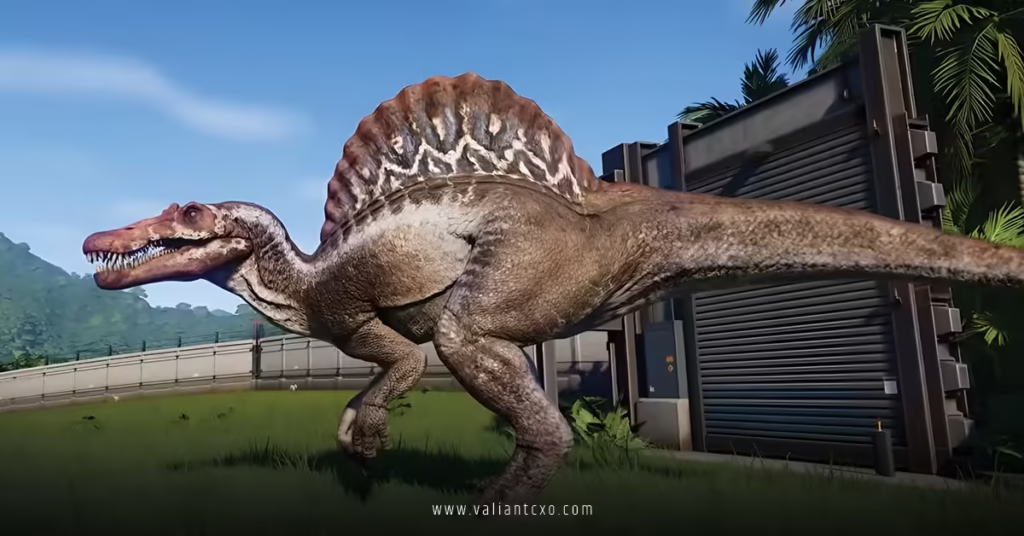
Though fresh, Spinosaurus mirabilis could reshape media portrayals. Forget Jurassic Park’s version—this “astonishing” crest adds flair. Museums may soon feature replicas, inspiring kids.
Future digs in the Sahara could reveal more, settling locomotion debates or uncovering relatives. Protecting these sites amid climate challenges is key.
Conclusion: Why Spinosaurus Mirabilis Facts Keep Us Hooked
Spinosaurus mirabilis facts showcase nature’s creativity—a river-wading giant with a sword-like crest, fish-trapping jaws, and a sail-backed silhouette. Tied to the exciting Spinosaurus Real Skeleton Discovery Update, this species refreshes our prehistoric picture, proving dinosaurs still surprise us. Whether you’re a dino nerd or casual fan, these details remind us Earth’s history is full of astonishing creatures. Dive deeper into paleontology— who knows what the next desert wind uncovers?
FAQs
What makes Spinosaurus mirabilis different from other Spinosaurus species?
Its massive scimitar-shaped head crest, taller than any theropod’s, plus inland river habitat set it apart from coastal Spinosaurus aegyptiacus.
How was Spinosaurus mirabilis discovered?
Through expeditions in Niger’s Sahara at Jenguebi, starting in 2019, with major finds in 2022, as detailed in the Spinosaurus Real Skeleton Discovery Update.
What was the lifestyle of Spinosaurus mirabilis?
Likely a wading, shoreline ambush predator hunting fish in rivers, dubbed a “hell heron” for its heron-like stalking in shallows.
How big was Spinosaurus mirabilis?
Around 10-14 meters long, school-bus sized, and comparable to T. rex in mass—among the largest carnivorous dinosaurs.
Where can I read more about Spinosaurus mirabilis facts?
Where can I read more about Spinosaurus mirabilis facts?
Check the original Science paper or coverage from Sci.News, Phys.org, and National Geographic for in-depth insights linked to the Spinosaurus Real Skeleton Discovery Update.