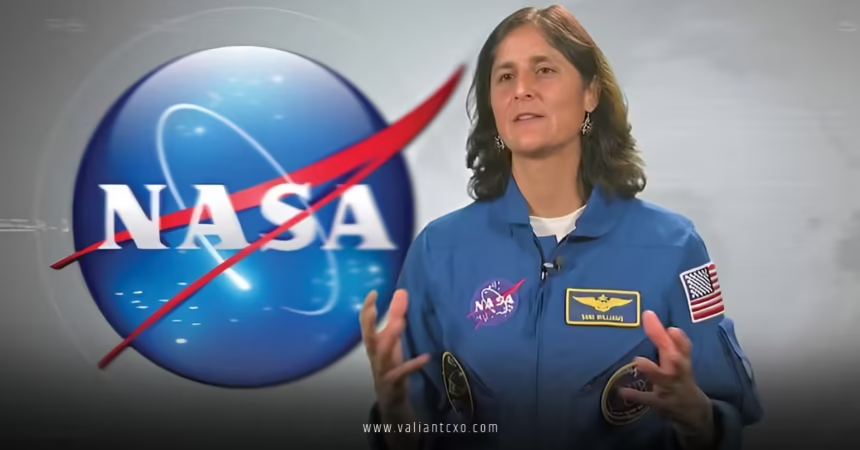
Sunita Williams retires from NASA after 27-year career with record 608 days in space and most spacewalk hours by a woman. Yes, that’s the headline that’s been buzzing across the globe, marking the end of an era for one of the most iconic astronauts of our time. Imagine spending more than 600 days orbiting Earth, floating weightlessly while gazing down at our beautiful blue planet – it’s the stuff dreams are made of, right? But for Suni Williams, as she’s affectionately known, this wasn’t just a dream; it was her reality over three groundbreaking missions.
When we talk about Sunita Williams retires from NASA after 27-year career with record 608 days in space and most spacewalk hours by a woman, we’re not just recounting a retirement announcement. We’re celebrating a trailblazer who shattered barriers, inspired millions, and pushed the boundaries of human exploration. Let’s dive into her story – from her humble beginnings to her stellar achievements – because her journey is one that reminds us all to reach for the stars.
Early Life and the Path to the Stars
Born on September 19, 1965, in Euclid, Ohio, Sunita “Suni” Williams grew up with a unique blend of cultures that would later fuel her global appeal. Her father, Deepak Pandya, hailed from Gujarat, India, while her mother, Bonnie Pandya, has Slovenian roots. Growing up in Needham, Massachusetts, Suni was always drawn to adventure. Can you picture a young girl fascinated by flight, dreaming of soaring higher than anyone else?
She graduated from the U.S. Naval Academy in 1987 with a bachelor’s degree in physical science and later earned a master’s in engineering management from the Florida Institute of Technology. As a U.S. Navy officer, she became a decorated pilot, logging over 4,000 flight hours in more than 40 aircraft. Helicopters, jets – you name it, she flew it. This military background built her resilience, the kind that’s essential when you’re hurtling into space at 17,500 miles per hour.
In 1998, NASA selected her as an astronaut candidate. Little did she know that this would kickstart a 27-year odyssey culminating in the news that Sunita Williams retires from NASA after 27-year career with record 608 days in space and most spacewalk hours by a woman.
Joining NASA: The Beginning of a Legendary Career
Entering NASA’s Astronaut Office was like stepping into a new universe for Suni. She trained rigorously, mastering everything from space station systems to survival skills. Her early roles included working on the International Space Station (ISS) program and even participating in NEEMO – NASA’s underwater missions simulating extreme environments.
Why does this matter in the context of Sunita Williams retires from NASA after 27-year career with record 608 days in space and most spacewalk hours by a woman? Because these foundational years honed her into the leader she became. She served as deputy chief of the Astronaut Office and later directed operations in Star City, Russia. These experiences weren’t just resume builders; they were the building blocks for her record-breaking feats.
First Space Mission: Breaking Records from the Start
Suni’s first launch came in December 2006 aboard the space shuttle Discovery (STS-116). She joined Expeditions 14/15 as a flight engineer, spending months on the ISS. During this mission, she completed four spacewalks – a then-record for women – totaling over 29 hours outside the station.
Think about that: floating in the void of space, tethered only by a suit, performing intricate repairs while Earth spins below. It’s like being a mechanic on the ultimate high-rise, but with zero gravity and cosmic radiation as your coworkers. This mission alone set the tone for her career, showcasing her endurance and skill.
By the time she returned on STS-117, Suni had already etched her name in history books.
Second Mission: Commanding the ISS and Running a Marathon
Fast forward to 2012. Suni launched from Baikonur Cosmodrome in Kazakhstan for Expeditions 32/33. This time, she took command of the ISS during Expedition 33 – only the second woman to do so.
She performed three more spacewalks, fixing critical issues like a leaking radiator and power components. But here’s a fun highlight: Suni became the first person to run a marathon in space! She completed the Boston Marathon on a treadmill aboard the ISS, orbiting Earth multiple times while pounding out 26.2 miles.
It’s moments like these that make you wonder: What can’t she do? Her second mission added significantly to her cumulative time in space, building toward that impressive 608-day record.

The Third Mission: Challenges, Leadership, and Extended Stays
Now, let’s talk about her most recent – and longest – adventure. In June 2024, Suni and Butch Wilmore launched on Boeing’s Starliner for a crew flight test. What was supposed to be a short mission turned into a 286-day epic due to technical glitches with the spacecraft.
They integrated into Expeditions 71/72, with Suni commanding Expedition 72. She conducted two more spacewalks, pushing her total to nine and her EVA time to a record 62 hours and 6 minutes for a woman.
Returning in March 2025 via SpaceX Crew-9, this mission solidified her cumulative 608 days in space – second only among NASA astronauts. The challenges? They tested her like never before, but her calm leadership shone through.
When Sunita Williams retires from NASA after 27-year career with record 608 days in space and most spacewalk hours by a woman, this extended stay stands out as a testament to adaptability in the face of uncertainty.
Key Achievements and Records Broken
Unpacking the Records in Sunita Williams Retires from NASA After 27-Year Career with Record 608 Days in Space and Most Spacewalk Hours by a Woman
Suni’s stats are mind-blowing:
- 608 days in space: Second-most for any NASA astronaut.
- 62 hours and 6 minutes in spacewalks: The most by any woman, fourth overall.
- Nine EVAs: A feat that demands incredible physical and mental stamina.
- First marathon runner in orbit.
- Tied for sixth-longest single U.S. spaceflight at 286 days.
These aren’t just numbers; they’re milestones that paved the way for future explorers, especially women and minorities in STEM.
Leadership and Contributions Beyond Flying
Suni wasn’t just a flyer. She helped develop training for Artemis Moon landings, using helicopters in Colorado mountains to simulate lunar ops. Her work bridged the ISS era to deep space exploration.
Why Now? Reflecting on the Retirement Decision
Though NASA didn’t detail specific reasons, after three missions and nearly two years total in space, it’s natural to turn the page. At 60, Suni expressed excitement about watching NASA head to the Moon and Mars. In her words, space is her “absolute favorite place,” but she’s grateful for the support that made her 27 years amazing.
Sunita Williams retires from NASA after 27-year career with record 608 days in space and most spacewalk hours by a woman feels bittersweet – an end, but also a beginning for new chapters.
Legacy and Inspiration: What Sunita Williams Leaves Behind
Suni’s story is a beacon for dreamers everywhere. As an Indian-American woman in a male-dominated field, she broke glass ceilings – or should I say, atmosphere layers? She’s inspired countless girls to pursue science, engineering, and adventure.
Her pride in her heritage shone during visits to India, where she connected with students and shared her experiences. Rhetorically, who better to show that the sky isn’t the limit?
NASA Administrator Jared Isaacman called her a “trailblazer,” and he’s spot on. Her contributions to commercial spaceflight, ISS science, and Artemis lay groundwork for humanity’s multi-planetary future.
The Impact on Future Space Exploration
With Sunita Williams retires from NASA after 27-year career with record 608 days in space and most spacewalk hours by a woman, the torch passes to newer astronauts. But her records and leadership will guide missions to the Moon, Mars, and beyond. Commercial partnerships like Boeing and SpaceX owe partly to pioneers like her.
Imagine the next generation citing Suni as their reason for suiting up. That’s true legacy.
Conclusion: A Stellar Career Comes Full Circle
Sunita Williams retires from NASA after 27-year career with record 608 days in space and most spacewalk hours by a woman, closing a chapter filled with awe-inspiring achievements, unbreakable records, and boundless inspiration. From her Navy days to commanding the ISS multiple times, Suni embodied resilience, curiosity, and grace under pressure.
Her 608 days in orbit, record-breaking spacewalks, and pioneering spirit remind us that human potential knows no bounds. As she steps into retirement, let’s celebrate her contributions and get excited for what’s next – not just for her, but for all of us dreaming big. If Suni’s journey teaches anything, it’s this: Aim high, work hard, and you might just touch the stars. What’s your next big dream?
FAQs
1. When did Sunita Williams officially retire from NASA?
Sunita Williams retires from NASA after 27-year career with record 608 days in space and most spacewalk hours by a woman became effective on December 27, 2025, as announced by the agency.
2. What are Sunita Williams’ most notable space records?
Among her feats as Sunita Williams retires from NASA after 27-year career with record 608 days in space and most spacewalk hours by a woman, she holds 608 cumulative days in space (second for NASA astronauts) and the most spacewalk hours by a woman at 62 hours and 6 minutes over nine EVAs.
3. How many missions did Sunita Williams fly before retiring?
Before the announcement that Sunita Williams retires from NASA after 27-year career with record 608 days in space and most spacewalk hours by a woman, she completed three missions to the International Space Station, including commanding two expeditions.
4. What challenges did Sunita Williams face on her last mission?
On her final flight, which contributed to the legacy of Sunita Williams retires from NASA after 27-year career with record 608 days in space and most spacewalk hours by a woman, technical issues with Boeing’s Starliner extended her stay to 286 days, testing her adaptability.
5. How has Sunita Williams inspired future generations?
As Sunita Williams retires from NASA after 27-year career with record 608 days in space and most spacewalk hours by a woman, her role as a trailblazing Indian-American female astronaut continues to motivate women and minorities in STEM fields worldwide.