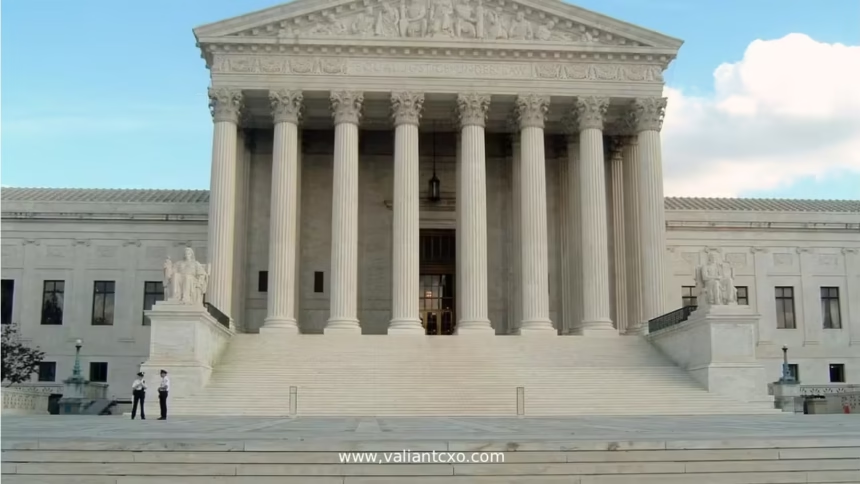
Supreme Court collegiality in polarized times faces real tests. Justices disagree fiercely on law, yet they share one workplace for life. Recent events—like the April 2026 public flap between Justice Sonia Sotomayor and Justice Brett Kavanaugh—show how quickly personal tone can spill into public view, even when legal disagreements run deep.
In a 6-3 conservative-majority Court handling high-stakes Trump administration cases on immigration, executive power, and more, maintaining professional respect matters. Sharp dissents are normal. Personal jabs at a colleague’s background? Rare and risky. Here’s what’s happening behind the robes, why it matters for the institution, and how the justices themselves talk about it.
What Supreme Court collegiality actually means
Collegiality here isn’t forced friendship or watered-down opinions. It means treating colleagues with basic professional courtesy while fighting hard on the merits of cases. You can call an argument flawed, poorly reasoned, or dangerous to rights—without implying the other justice lacks real-world understanding or comes from a sheltered bubble.
Justice Amy Coney Barrett put it plainly in a March 2026 Library of Congress appearance: “Collegiality is an act of will. You have to decide it and try.” She stressed that losing a case disappoints, but daily effort to maintain relationships keeps the Court functional.
Justice Ketanji Brown Jackson echoed this in February 2026 remarks, noting the justices “get along well” and serve as a “model for learning how to disagree without being disagreeable.”
These aren’t empty PR lines. The nine justices conference privately, assign opinions, and negotiate language. Poisoned personal relations make that harder.
The recent test case: reactions to Sotomayor apology to Kavanaugh Supreme Court
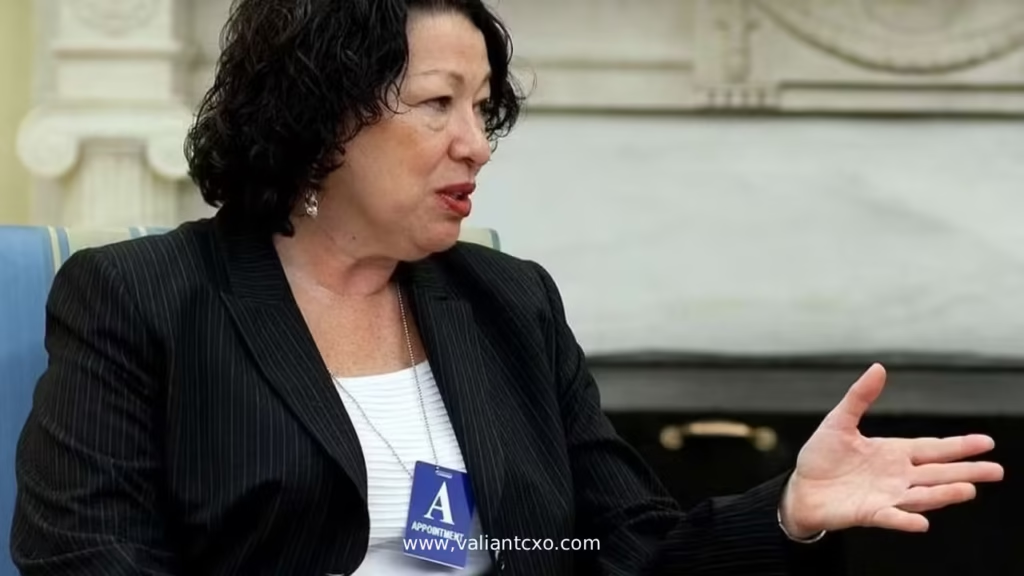
In early April 2026, Justice Sotomayor spoke at the University of Kansas School of Law. She critiqued a 2025 Kavanaugh concurrence in an emergency immigration case involving ICE stops in Los Angeles. Without naming him directly at first, she suggested his view—that such stops are “typically brief”—reflected someone whose parents were professionals and who might not know hourly workers’ realities.
The remark landed hard. Days later, Sotomayor issued a short public statement: “I made remarks that were inappropriate. I regret my hurtful comments. I have apologized to my colleague.”
This episode became a flashpoint for discussions on Supreme Court collegiality in polarized times. Conservatives saw it as overdue accountability for crossing into personal territory. Liberals split—some defended highlighting real-world impacts on working people, others welcomed the walk-back to protect institutional norms. Institutional watchers noted the unusual public nature of both the critique and the quick apology.
The underlying legal fight stayed intact: liberals worried about profiling and disruption for vulnerable communities; Kavanaugh emphasized reasonable suspicion standards under existing precedent. Only the delivery crossed a line in many eyes.
This wasn’t the first sign of strain. Justice Clarence Thomas, speaking around the same time at the University of Texas, lamented rising incivility, social media-fueled name-calling, and fears it could “infect” the judiciary. He recalled joining a Court that handled differences “as friends” with mutual respect.
Why polarization makes collegiality harder now
Data and observers point to growing ideological distance. SCOTUSblog analysis from late 2025 showed declining overall agreement rates over two centuries, with modern pairs of justices sometimes agreeing far less than in earlier eras. The current 6-3 split, combined with fast-moving shadow docket cases on Trump-era policies, amplifies pressure.
Public trust sits low. Partisan sorting means many Americans view Court decisions through a team lens rather than neutral law. When justices appear in public, audiences expect red meat—or at least sharp elbows.
Yet the justices themselves keep pushing back. Barrett, Jackson, and others repeatedly highlight personal relationships surviving ideological fights. Thomas worries about long-term erosion from broader societal trends.
Here’s a simple comparison of past versus present dynamics:
| Aspect | Earlier Eras (e.g., Ginsburg-Scalia) | Current Polarized Times (2025-2026) |
|---|---|---|
| Public tone in speeches | Fiery on law, warm personally | Occasional personal framing slips |
| Private conferencing | Frequent negotiation and compromise | Still occurs, but ideological blocs tighter |
| Media/social amplification | Limited | Instant outrage cycles |
| Justice comments on civility | Occasional | Frequent emphasis on “act of will” |
| Examples | Opera outings, shared laughs | Public apologies, warnings on incivility |
The table shows continuity in the ideal, but real friction under pressure.
Practical realities justices face
Lifetime tenure helps. No reelection campaigns mean less incentive to grandstand for bases. But external forces—death threats, protest pressure, partisan media—make isolation tempting. Thomas cited security concerns forcing remote appearances.
Social circles have also sorted. Federalist Society and American Constitution Society events create separate professional ecosystems. Clerks often come from aligned lower-court judges. These patterns don’t doom collegiality, but they reduce natural mixing.
What I’ve seen over years watching these patterns: the strongest justices separate legal critique from personal assumption. Attack the reasoning. Question the precedent. Highlight practical consequences. But skip speculating on someone’s upbringing or life experience unless directly relevant to the record.
It’s like a championship sports team. Teammates can trash-talk strategy in the huddle, but they still run the same plays and cover each other on defense. Let personal resentment leak, and the whole unit suffers.
Common mistakes that erode collegiality (and quick fixes)
- Mistake: Framing legal disagreement as evidence of personal blind spots or privilege.
Fix: Stick to the opinion’s text and precedent. Ask what the law requires, not what the justice “must not understand.” - Mistake: Letting public audiences push for more dramatic rhetoric.
Fix: Remember the audience includes future clerks, lower-court judges, and citizens watching for models of disagreement. - Mistake: Assuming silence equals agreement or weakness.
Fix: Strong dissents or concurrences can be respectful yet forceful. History remembers both the substance and the tone. - Mistake: Over-relying on emergency docket (shadow docket) without full briefing and argument.
Fix: Push for regular process where possible to reduce perceptions of rushed, partisan outcomes.
Avoid these, and the Court models something valuable: adults with deep differences who still produce coherent law.
Action plan: How to evaluate Supreme Court collegiality as a citizen or student
- Read the actual opinions — Not just headlines. Look for respectful language even in sharp dissents.
- Track public statements — Note when justices emphasize relationships versus when tone slips.
- Compare across cases — Does a justice maintain consistent civility regardless of which side wins?
- Check institutional signals — Unanimous or near-unanimous decisions often reflect compromise and collegial negotiation.
- Consider the long game — One awkward public moment doesn’t collapse the Court. Patterns over years do.
- Demand better from commentators — Call out both sides when they reduce complex rulings to “team wins” or personal attacks.
Follow this and you’ll cut through spin faster.
Key takeaways on Supreme Court collegiality in polarized times
- Collegiality requires deliberate effort—“an act of will”—even amid 6-3 ideological splits.
- Recent example: Sotomayor’s April 2026 apology for personal remarks about Kavanaugh highlighted the line between tough legal critique and personal framing.
- Justices across the spectrum (Barrett, Jackson, Thomas) publicly stress respect and warn against broader societal incivility infecting the bench.
- Polarization shows in voting patterns and public perception, but private conferencing and opinion-writing still demand cooperation.
- Personal attacks erode public trust faster than strong dissents ever could.
- History shows the Court has weathered deep divisions before; tone and process help it endure.
- Citizens benefit when justices model mature disagreement—the alternative is louder shouting, weaker legitimacy.
- Maintaining collegiality protects the institution’s ability to deliver stable, reasoned law over decades.
Conclusion
Supreme Court collegiality in polarized times isn’t nostalgia for a gentler era. It’s a practical necessity for nine smart, strong-willed people who must produce binding decisions on the nation’s toughest questions. The Sotomayor-Kavanaugh episode reminded everyone that words matter, even (especially) from the bench.
The justices keep choosing—day after day—to treat each other as colleagues rather than enemies. That choice doesn’t eliminate fierce fights over law or policy. It just keeps the fights productive instead of destructive.
Next step: Pick one recent opinion and read both the majority and a dissent. Notice where respect holds and where rhetoric heats up. You’ll see collegiality in action, or its absence.
The Court will keep facing polarized pressures. How the justices—and we—respond to those pressures will shape its legitimacy for years.
FAQs on Supreme Court collegiality in polarized times:
What is judicial collegiality on the Supreme Court?
Collegiality refers to the norm of mutual respect, civility, and cooperation among justices despite ideological differences. It includes traditions like the pre-argument handshake and enables productive deliberation even in divided cases.
Is the Supreme Court truly collegial despite polarization?
Justices across ideologies (e.g., Ruth Bader Ginsburg, Amy Coney Barrett, Sonia Sotomayor) describe the Court as highly collegial internally — more so than many workplaces. They agree more often than they disagree, though the public focuses on 5-4 splits.
How does polarization challenge collegiality?
Increased partisan sorting in appointments, media scrutiny, and high-stakes ideological cases have made the Court appear more divided externally. This risks eroding public trust, even as justices maintain respectful internal norms and “sharp but civil” disagreements.
Why does collegiality matter in polarized times?
It helps justices listen, persuade, and reach better decisions together. Without it, the Court could struggle to fulfill its constitutional role. Justices often highlight it as a model for civil discourse in a divided America.
What traditions support collegiality today?
Practices like the judicial handshake, joint appearances by ideological opposites (e.g., Sotomayor and Barrett), and emphasis on duty over personal feelings help sustain relationships “like an arranged marriage” — grounded in shared purpose rather than agreement.