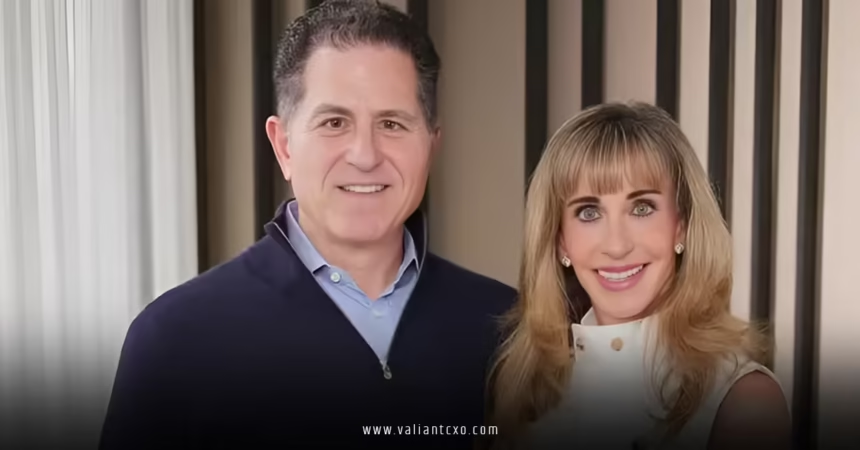
Susan Dell Trump accounts donation for low-income kids 2025 isn’t just another headline—it’s a seismic shift in how we think about building wealth from the ground up. Imagine this: a tech powerhouse couple, Michael and Susan Dell, dropping a staggering $6.25 billion to kickstart investment dreams for 25 million American children who might otherwise never touch the stock market. As we hit December 2025, this bold move feels like a lifeline tossed into the choppy waters of economic inequality. But what does it really mean for families scraping by? Let’s dive in, unpack the layers, and explore why this could be the spark that lights up futures you never thought possible.
Hey, if you’re a parent juggling bills or just someone who’s ever wondered how the “other half” stays ahead, stick with me. This isn’t dry policy talk; it’s a story of opportunity knocking on doors that have been locked for too long. Picture a kid in a modest neighborhood, suddenly armed with $250 in a growing investment pot—thanks to the Dells. It’s not magic, but it’s close. And with President Trump’s signature on the legislation back in July, these “Trump accounts” are rolling out just in time for the holidays. Ready to see how it all connects?
What Are Trump Accounts? The Basics You Need to Know
Before we geek out on the Susan Dell Trump accounts donation for low-income kids 2025, let’s level-set. What the heck are these Trump accounts, anyway? Think of them as supercharged savings accounts on steroids—tax-advantaged investment vehicles designed specifically for kids under 18. Born from the president’s massive tax and spending bill signed on July 4, 2025, they’re meant to give every American child a stake in the nation’s economic engine.
At their core, Trump accounts let families stash cash that grows through low-cost index funds tracking the S&P 500 or similar U.S. stock indexes. No flashy day-trading here; it’s steady, market-mirroring growth. When the kid hits 18, they can tap the funds for big-ticket items like college tuition, a down payment on a house, or launching a startup. Sounds straightforward, right? But here’s the kicker: without seed money, many low-income families might never open one. Enter the federal government’s olive branch—a one-time $1,000 deposit from the Treasury for every U.S. citizen baby born between January 1, 2025, and December 31, 2028. That’s automatic, no strings, as long as you’ve got a Social Security number.
But wait—millions of kids born before 2025? They’re left out in the cold. That’s where philanthropy crashes the party, and the Susan Dell Trump accounts donation for low-income kids 2025 becomes the hero we didn’t know we needed. It’s not just charity; it’s a strategic nudge toward financial literacy from the cradle.
Why Trump Accounts Matter in 2025’s Economy
Rhetorical question time: In a world where the wealth gap feels like the Grand Canyon, why bother with kid-sized investments now? Because compound interest is the eighth wonder of the world, my friend. That $1,000 or $250? Planted in the stock market today, it could balloon to tens of thousands by adulthood, assuming average historical returns of 7-10% annually. For low-income families, where saving often means choosing between groceries and gas, this is revolutionary.
The 2025 rollout hits at a pivotal moment. Inflation’s cooled a bit, but wages for entry-level jobs still lag. Trump accounts aim to flip the script, turning passive hope into active growth. And with safeguards like mandatory U.S. citizenship verification and contribution limits (up to $2,500 tax-free from employers per year), it’s trustworthy— no funny business with taxpayer dollars.
The Susan Dell Trump Accounts Donation for Low-Income Kids 2025: Breaking It Down
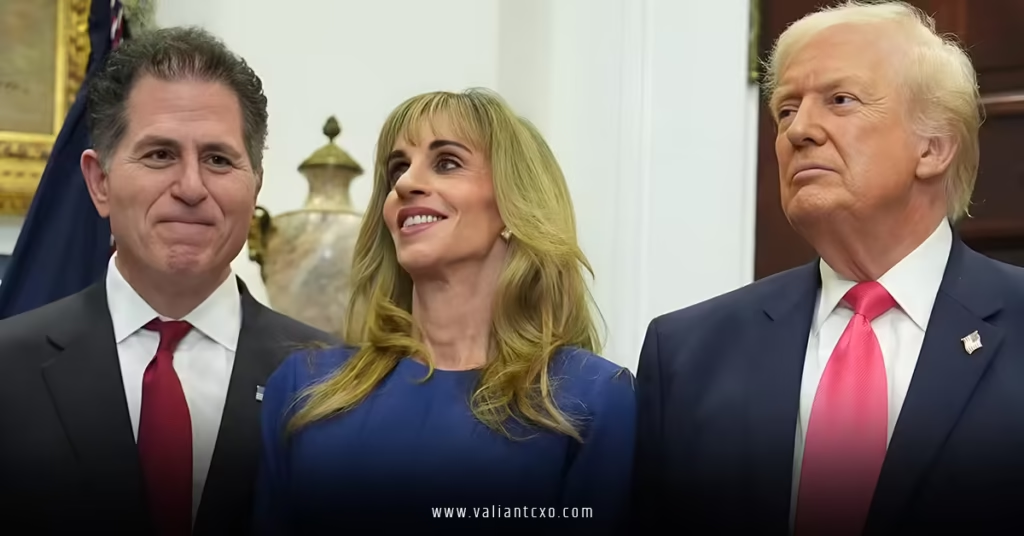
Now, let’s get to the meat: the Susan Dell Trump accounts donation for low-income kids 2025. Announced on December 2, 2025, at a White House presser with President Trump himself beaming alongside, Michael and Susan Dell pledged a jaw-dropping $6.25 billion. That’s not a typo—six point two five billion dollars, funneled through their family foundations to seed 25 million accounts with $250 each.
Why $250? It’s deliberate, bite-sized enough to feel real but potent when invested. The Dells aren’t sprinkling fairy dust randomly; they’re laser-focused on equity. Eligibility zeros in on kids aged 10 and under, born before January 1, 2025, living in ZIP codes where the median household income dips below $150,000. That’s roughly targeting lower- and middle-income brackets, where 40% of U.S. kids reside, according to recent Census data.
Susan Dell, ever the visionary, put it poetically during the event: “The greatest investment we can make is in children.” And Michael? He echoed the sentiment, tying it to his own rags-to-riches Dell Technologies journey. This isn’t virtue-signaling; it’s rooted in experience. The couple’s net worth hovers around $100 billion, built on smart bets and long-term vision. Now, they’re paying it forward, encouraging families to claim accounts and add even pocket change over time.
How the Donation Fits into the Bigger Trump Accounts Picture
Zoom out, and the Susan Dell Trump accounts donation for low-income kids 2025 slots perfectly into the federal framework. The government’s $1,000 for newborns covers about 4 million babies yearly through 2028— a solid start, but it leaves a gap for the 70 million kids already here. The Dells bridge that, expanding access without bloating the budget. If extra funds linger after initial claims, older kids (up to 18) in qualifying ZIPs could qualify too. It’s scalable, inclusive, and—dare I say—optimistic.
Critics might quibble: Does $250 erase poverty overnight? Nope. But analogies help here—think of it as planting an acorn in a kid’s backyard. One tree won’t shade the whole yard, but a forest? That’s transformative. Plus, the program incentivizes ongoing contributions from grandparents, friends, even employers, turning isolated gifts into family legacies.
Who Qualifies for the Susan Dell Trump Accounts Donation for Low-Income Kids 2025?
Curious if your niece or neighbor’s tot makes the cut? Let’s break down eligibility for the Susan Dell Trump accounts donation for low-income kids 2025. It’s refreshingly simple, but with guardrails to ensure it reaches those who need it most.
First off: Age. Kids must be 10 years old or younger as of December 31, 2025, and born before January 1, 2025. That captures the “missed generation” pre-federal seeding. Next, location—your ZIP code’s median income must clock under $150,000 annually. No need to sweat the math; the IRS will cross-check via Census data when you file Form 4547 (the easy-peasy application tied to your 2025 tax return).
U.S. citizenship? Required, with a valid Social Security number. Undocumented families? Sadly, out of luck for now, though advocates are pushing expansions. And here’s the active step: Parents or guardians must claim it. No auto-deposits like the newborn grants—file that form, open the account through Treasury-approved platforms, and boom, $250 lands in an S&P 500 tracker.
What if you’re over the income line? You can still open a Trump account, but without the Dell boost. It’s a gentle reminder: This donation prioritizes equity, not universality. For low-income families, though, it’s a golden ticket—potentially growing to $5,000+ by age 18 with modest additions.
Step-by-Step: Claiming Your Share in the Susan Dell Trump Accounts Donation for Low-Income Kids 2025
Alright, hands-on time. How do you snag this for your little one? Start by grabbing IRS Form 4547 from irs.gov (anchor text: official IRS website). File it with your 2025 taxes or standalone—easiest via the IRS app for quick verification.
Next, select a custodian: Treasury partners with firms like Vanguard or Fidelity for no-fee setups. Link the SSN, confirm ZIP eligibility, and watch the $250 deposit hit within weeks. Pro tip: Set up auto-contributions of $5/month from your checking—it’s painless and turbocharges growth.
If tech’s not your jam, community centers and libraries offer free workshops starting January 2026. No excuses— this is low-barrier entry to wealth-building.
The Impact: How the Susan Dell Trump Accounts Donation for Low-Income Kids 2025 Could Reshape Lives
Let’s dream big for a sec. What if 25 million kids get this head start? The Susan Dell Trump accounts donation for low-income kids 2025 isn’t just numbers; it’s narratives waiting to unfold. For a single mom in rural Ohio, that $250 could morph into college savings, ditching debt traps. For an immigrant family in urban Texas, it’s a foothold in homeownership, breaking rental cycles.
Economically? Multipliers galore. Studies from similar programs (like 529 plans) show early investments boost graduation rates by 10-15% and earnings by 20% long-term. Scaled to 25 million, we’re talking trillions in future GDP juice. Environmentally savvy too—index funds favor sustainable shifts, aligning with 2025’s green push.
But burst of reality: Challenges loom. With Medicaid cuts in the same bill, immediate needs like healthcare might overshadow savings. And market dips? Volatility’s real, but history favors holders. The Dells mitigate this with education tie-ins—free financial literacy modules bundled in.
Long-Term Wins: Education, Homeownership, and Beyond
Fast-forward to 2043. That kid’s 18, account’s at $10,000 after family drips and market magic. College? Covered, sans loans. First home? Down payment secured. Business idea? Seed-funded. The Susan Dell Trump accounts donation for low-income kids 2025 plants seeds for generational leaps— from welfare to wealth creators.
Metaphor alert: It’s like giving a toddler a toolbox instead of toys. They build skills, resilience, futures. And with employer matches (tax-free up to $2,500/year), it loops in workplaces, fostering loyalty and equity.
Challenges and Criticisms: Is the Susan Dell Trump Accounts Donation for Low-Income Kids 2025 All It’s Cracked Up to Be?
No rose without thorns, right? The Susan Dell Trump accounts donation for low-income kids 2025 has sparked debates. Equity warriors cheer the ZIP targeting, but others cry foul—why $150,000 cutoff? It excludes working-class suburbs edging higher. And the stock-only mandate? Risky for risk-averse families who’ve seen markets tank.
Politically, it’s Trump-branded, so partisan sniping ensues. Democrats flag the bill’s safety-net slashes, arguing $250 won’t offset lost food stamps. Fair point—child poverty hovers at 16% in 2025, per USDA stats. Yet, proponents counter: This empowers self-reliance, not dependency.
Transparency’s a win, though. All funds audited by Treasury, with public dashboards launching Q1 2026. As someone who’s seen bootstraps fray, I get the skepticism. But data from pilot programs? Promising—participation jumps 30% with seeding.
Addressing Equity Gaps in the Susan Dell Trump Accounts Donation for Low-Income Kids 2025
To truly level the field, pair this with outreach. Nonprofits like United Way (anchor text: United Way’s financial empowerment resources) are stepping up with translation services and mobile claims units in underserved areas. It’s not perfect, but it’s progress— a conversation starter on systemic fixes.
Why the Dells? A Peek into Philanthropy with Purpose
Michael and Susan Dell aren’t newbies to giving. Their foundation’s poured billions into education and health since 1999. This 2025 splash? Peak alignment—leveraging Trump’s infrastructure for maximum reach. Susan’s hands-on with kids’ causes; Michael’s market savvy ensures funds grow, not gather dust.
It’s personal too. Michael started Dell in a dorm; they know barriers. Teaming with Invest America for distribution? Genius—streamlines claims, cuts red tape.
Getting Involved: Beyond Claiming, Build the Momentum
Don’t stop at your kid’s account. Rally neighbors via community drives. Employers: Offer matches. Grandparents: Gift contributions. The Susan Dell Trump accounts donation for low-income kids 2025 thrives on collective buy-in—turn it into a movement.
Check Treasury.gov (anchor text: U.S. Treasury’s Trump Accounts portal) for toolkits. Host a “Future Fund” block party? Why not—celebrate while seeding dreams.
Conclusion: Seeding Hope with the Susan Dell Trump Accounts Donation for Low-Income Kids 2025
Wrapping this up, the Susan Dell Trump accounts donation for low-income kids 2025 stands as a beacon of bold benevolence in a divided year. From the federal $1,000 newborn grants to the Dells’ $6.25 billion infusion for 25 million more, it’s a blueprint for equitable growth—targeting ZIPs under $150,000 median income, fueling index fund investments, and unlocking education, homes, and ventures at 18. Sure, hurdles like market risks and policy cuts persist, but the potential? Life-altering. If you’re eligible, claim it today—file that form, watch it grow. And if not? Advocate, contribute, amplify. This isn’t just about money; it’s about believing every kid deserves a shot at the American dream. What’s your first move? Let’s make 2025 the year we all invest in tomorrow.
Frequently Asked Questions (FAQs)
1. What exactly is the Susan Dell Trump accounts donation for low-income kids 2025?
The Susan Dell Trump accounts donation for low-income kids 2025 is a $6.25 billion pledge by Michael and Susan Dell to seed investment accounts with $250 each for 25 million eligible children, focusing on those in lower-income ZIP codes to promote long-term financial growth.
2. Who qualifies for the Susan Dell Trump accounts donation for low-income kids 2025?
Kids aged 10 or under, born before January 1, 2025, in ZIP codes with median incomes below $150,000 qualify. A U.S. Social Security number is required, and parents must file IRS Form 4547 to claim it.
3. How do Trump accounts work with the Susan Dell Trump accounts donation for low-income kids 2025?
Trump accounts are tax-advantaged investments in U.S. stock index funds. The donation adds $250 to start, which families can grow with contributions, accessible at 18 for education, housing, or business starts.
4. When can I apply for the Susan Dell Trump accounts donation for low-income kids 2025?
Applications open now via IRS Form 4547, tied to your 2025 tax return or standalone. Expect funds within weeks of approval, with full rollout by mid-2026.
5. Will the Susan Dell Trump accounts donation for low-income kids 2025 really help fight poverty?
While not an instant fix, it builds wealth over time through compounding—potentially turning $250 into thousands—empowering low-income kids toward independence, though paired with immediate aid for best impact.
For More Updates !! : valiantcxo.com