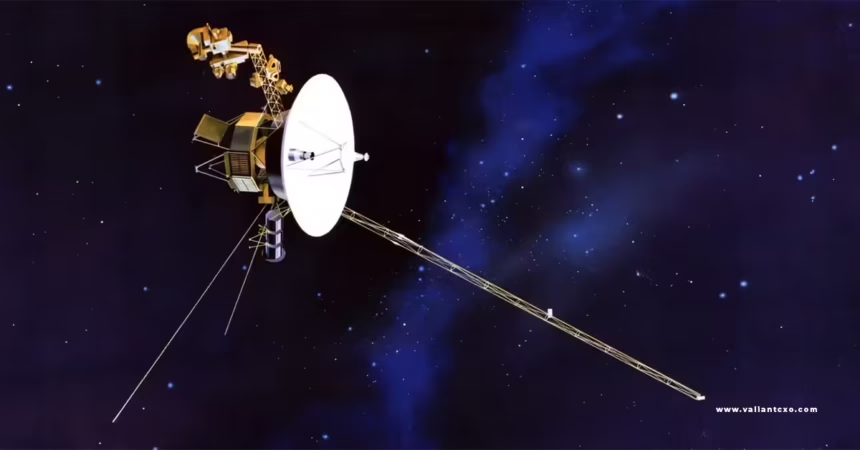
Voyager 1 one light-day from Earth November 2026 marks the moment humanity’s farthest machine finally outruns a full day of light. On November 18, 2026, at 5:16:07 a.m. EST, NASA’s Voyager 1 will sit roughly 16.1 billion miles (25.9 billion kilometers) from home—the exact distance light travels in 24 hours. No other human-made object has ever been that far.
Here’s the quick read:
- On November 18, 2026, Voyager 1 reaches one light-day from Earth—about 16.1 billion miles away.
- A radio signal will take a full 24 hours to arrive and another 24 hours to return.
- The probe has been flying since September 1977 and entered interstellar space in 2012.
- It still returns science data while its power supply slowly fades.
- The milestone is pure human measurement; the spacecraft itself notices nothing.
Think of it like this: if light is a sprinter who never tires, Voyager 1 is the stubborn long-distance runner who has been pounding the track for nearly half a century just to match one of that sprinter’s daily jogs. The gap keeps widening. What does that do to the way we talk to our own hardware?
What a Light-Day Actually Means for Voyager 1 one light-day from Earth November 2026
A light-day is distance, not time. Light covers about 186,000 miles every second. In 24 hours that adds up to 16,094,799,096 miles. NASA has timed the exact second Voyager 1 hits that mark.
From that moment on, every command the Deep Space Network sends takes a full day to reach the spacecraft. Every reply takes another full day to come home. A simple “how are you doing?” exchange becomes a two-day affair. The probe keeps coasting at roughly 38,000 miles per hour relative to the Sun, but the conversation lag is now permanent.
Voyager 1 crossed the heliopause—the boundary where the solar wind gives way to interstellar plasma—back in August 2012. It has been sampling the space between the stars ever since. Instruments still measure cosmic rays, magnetic fields, and plasma waves, though several systems have been powered down to stretch the remaining plutonium. The Golden Record continues its silent ride outward, a 1977 time capsule of Earth sounds and images that will outlast every living person who helped build the mission.
Why the Timing of Voyager 1 one light-day from Earth November 2026 Matters
Forty-nine years, two months, and eleven days. That is how long it took to cover a distance light finishes before lunch. The number is almost comical. It also highlights how slowly we still move through the solar system.
Earth’s own orbit adds a small wobble to the distance. In early November 2026 the gap sits just under the threshold. By the 18th it locks in permanently. After that date the one-way light time never drops below 24 hours again.
The practical upside? Engineers already plan commands weeks in advance. The milestone simply makes the lag official. In my experience tracking deep-space missions, teams that treat latency as a design constraint rather than a nuisance keep these old birds flying longest. What would you do if every message you sent took a day to arrive?
Step-by-Step Action Plan for Following the Milestone
Beginners can track the event without a radio telescope. Here’s the practical sequence I recommend:
- Bookmark NASA’s official Voyager pages and the live distance trackers that pull from JPL Horizons data.
- Set a calendar reminder for November 17–19, 2026, with the exact 5:16 a.m. EST timestamp.
- Check the one-way light time daily in the week leading up to the 18th; it will climb past 23 hours 50 minutes.
- Read the short NASA explainer on light-days so the units make sense when headlines start flying.
- After the date, look for any updated power or instrument status reports—those usually appear within a few weeks.
- If you want the next layer, pull the raw Horizons ephemeris yourself and plot distance versus time for a week on either side of the crossing.
That sequence keeps you current without drowning in technical papers.
Common Mistakes & How to Fix Them
People mix up light-day with light-year all the time. A light-year is 365 times farther. One light-day is still inside the neighborhood on the galactic scale. Fix: remember the Moon is 1.3 light-seconds away; the Sun is 8.3 light-minutes; Neptune is a bit more than four light-hours. One light-day sits well beyond that.
Another frequent slip: assuming the spacecraft “feels” the milestone. It does not. No instrument registers a boundary. The change is only in the radio clock. Fix: treat it as a human calendar event, not a physical one.
Some headlines claim the probe is “leaving the solar system” again. It already did that in 2012. The one-light-day mark is simply farther out. Stick to the NASA distance numbers and you stay accurate.
Distance and Signal Comparison Table
| Location or Object | Approximate Distance from Earth | One-Way Signal Time |
|---|---|---|
| Moon | 239,000 miles | 1.3 seconds |
| Sun | 93 million miles | 8.3 minutes |
| Mars (average) | 140 million miles | 4–22 minutes |
| Neptune | 2.8 billion miles | ~4 hours |
| Voyager 1 on Nov 18, 2026 | 16.1 billion miles | 24 hours |
| Proxima Centauri | 25 trillion miles | 4.24 years |
The jump from Neptune to Voyager 1 already feels enormous. The next jump to the nearest star is another 1,500 times larger still.
Looking Ahead After Voyager 1 one light-day from Earth November 2026
Power remains the limiting factor. The radioisotope thermoelectric generators lose a few watts every year. Controllers have already turned off non-essential instruments to keep the remaining ones alive as long as possible. Communication windows through the Deep Space Network will continue, just with longer planning horizons.
Voyager 2 trails on a different trajectory and is expected to hit the same one-light-day mark around November 2035. Both craft will eventually fall silent, but the Golden Records will keep drifting for billions of years. In the meantime the data still flowing back tells us the interstellar medium is denser and more structured than many models predicted.
If I were advising a new space enthusiast right now, I would say this: treat the November 18 date as a checkpoint, not a finish line. Use it to dig into the actual plasma and cosmic-ray measurements. Those numbers matter more than the round-number distance.
Key Takeaways
- Voyager 1 reaches one light-day from Earth on November 18, 2026, at 5:16 a.m. EST.
- Distance equals roughly 16.1 billion miles or 25.9 billion kilometers.
- Radio commands and replies each take a full day after that date.
- The spacecraft entered interstellar space in 2012 and continues limited science operations.
- Power conservation, not distance, will ultimately end the mission.
- Voyager 2 follows the same distance milestone about nine years later.
- The event is a human calendar marker, not a physical boundary the probe detects.
- Tracking tools and NASA updates let anyone follow the exact second without specialized equipment.
The real payoff sits in the quiet continuity. A machine built before most of today’s engineers were born still answers—slowly—from farther than any other object we have ever sent. That answer is getting quieter and more delayed, yet it remains our clearest signal that the interstellar medium is not empty. Check the distance trackers on the 18th, then keep watching the data. The next useful numbers will arrive on their own two-day schedule.
FAQs
When exactly does Voyager 1 one light-day from Earth November 2026 occur?
NASA calculates the crossing at 5:16:07 a.m. EST on Wednesday, November 18, 2026. At that instant the Earth-to-spacecraft range hits 16,094,799,096 miles.
Does the one-light-day mark change anything for the spacecraft itself?
No. Instruments register no boundary. The only practical shift is the permanent 24-hour one-way light time for radio signals.
How does Voyager 1 one light-day from Earth November 2026 compare to future milestones?
Voyager 2 reaches the same distance around November 2035. Both probes will eventually lose contact as their power supplies dwindle, long before they approach any nearby star.