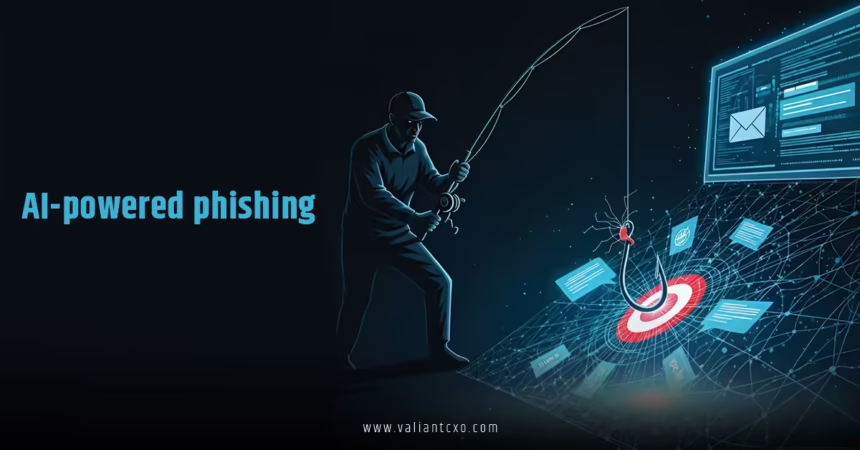
What is AI-powered phishing in 2026? It’s the scary evolution of those old-school scam emails you used to laugh off—now supercharged by artificial intelligence to feel eerily personal, flawless, and almost impossible to spot. Imagine getting an email from your boss that nails their exact writing style, drops in details about last week’s meeting, and casually asks you to approve a wire transfer. Or a voice call from a “family member” in distress that sounds identical to them. That’s not a glitch in the matrix; that’s AI-powered phishing dominating the cyber threat landscape right now in 2026.
Gone are the days of typos, weird phrasing, or generic “Dear Customer” greetings. Today, cybercriminals use generative AI—like advanced large language models—to craft attacks at lightning speed, personalize them using scraps of your public data, and even branch into voice cloning or deepfakes. The result? Phishing isn’t just common; it’s the top cyber threat, outpacing ransomware and costing billions. Let’s dive deep into what is AI-powered phishing in 2026, why it’s exploding, and how you can stay one step ahead.
The Basics: Understanding What is AI-Powered Phishing in 2026
At its core, what is AI-powered phishing in 2026? It’s traditional phishing—tricking people into revealing sensitive info like passwords, credit card details, or company secrets—turbocharged by AI tools. Attackers feed AI vast amounts of data (from social media, LinkedIn profiles, leaked emails, or public records) to generate hyper-realistic messages.
Think of it like this: Old phishing was like casting a wide net hoping to catch a few fish. AI-powered phishing is spearfishing with a laser-guided harpoon. The AI analyzes your online footprint, mimics tones, references real events, and even predicts what might make you click urgently.
In 2026, reports show over 80% of phishing emails incorporate some AI-generated content. Click-through rates have skyrocketed—sometimes four times higher than human-crafted ones—because these messages lack the classic red flags. No more “urgent prince inheritance” nonsense; it’s subtle, professional, and tailored.
How AI Has Transformed Phishing Attacks by 2026
What is AI-powered phishing in 2026 if not a game-changer in speed and scale? Generative AI lets attackers create thousands of unique emails in minutes. What once took hours of manual tweaking now happens automatically.
AI scrapes public data to personalize: your job title, recent posts, company news. It copies writing styles so perfectly that even close colleagues might not spot the fake. And it’s not limited to email anymore.
Key Ways AI Powers Phishing in 2026
- Hyper-Personalized Emails and Spear-Phishing — AI generates messages that feel like they come from inside your circle. Imagine an email from “HR” referencing your recent promotion and asking for updated bank details for payroll.
- Voice Cloning for Vishing (Voice Phishing) — With just seconds of audio from your social media or a podcast, AI clones voices. Scammers call pretending to be your CEO or a loved one in crisis, demanding immediate action.
- Deepfake Videos and Multimodal Attacks — Real-time deepfakes combine cloned voices with fake video for video calls. One infamous case saw a company lose millions when an employee “video-called” their CFO—who was actually a deepfake.
- QR Code Phishing (Quishing) and Smishing — AI designs convincing QR codes in emails or texts that lead to fake login pages, or crafts SMS that mimic bank alerts.
- Polymorphic and Adaptive Campaigns — AI rewrites attacks on the fly to evade filters, testing variations to find what works best.
This evolution exploded after tools like ChatGPT went mainstream. Phishing volumes surged dramatically, with some reports noting increases over 1,000% tied to generative AI.
Why 2026 Marks the Tipping Point for AI-Powered Phishing
So, what is AI-powered phishing in 2026 that’s making experts call it a “tipping point”? It’s the year when AI became infrastructure for cybercriminals, not just a nice-to-have.
Cybercrime losses are projected to hit staggering figures, with AI scams driving much of it. Organizations report being hit hard by cyber-enabled fraud, and individual consumers aren’t safe either. AI lowers the barrier: even low-skill attackers can rent phishing-as-a-service kits packed with AI personalization.
It’s democratized evil. No need for elite hackers; anyone with access to cheap AI tools can launch sophisticated campaigns. And with more people relying on AI agents for shopping or work, blending good and bad bots creates new chaos.
Have you ever wondered why your spam folder feels cleaner but you’re still getting tricked? That’s because legacy filters can’t keep up with AI’s adaptability.
Real-World Examples of AI-Powered Phishing in Action
To really grasp what is AI-powered phishing in 2026, look at real cases.
One engineering firm lost over $25 million to a deepfake video call where fraudsters impersonated executives. The cloned voices and faces were so convincing that staff wired funds without double-checking.
Voice cloning scams target families too—think a “grandchild” calling grandma in panic, sounding exactly like them, needing bail money fast.
Business Email Compromise (BEC) emails, now often 40%+ AI-generated, trick finance teams into fake transfers by mimicking internal threads perfectly.
Romance scams? AI maintains long-term “relationships” with deepfake photos and scripted chats, building trust before the ask.
These aren’t hypotheticals; they’re happening daily, with attacks occurring every few seconds in some networks.
The Impact: Why You Should Care About What is AI-Powered Phishing in 2026
The stakes are huge. Financial losses run into billions annually, but it’s more than money—it’s trust erosion. Companies face data breaches, reputational damage, and regulatory headaches. Individuals lose savings, identities, or peace of mind.
In enterprises, AI-powered phishing tops threat lists, outpacing other vectors. It exploits the human element—no patch fixes gullibility.
And it’s escalating: As AI gets smarter, attacks get sneakier. By 2026, we’re seeing polymorphic phishing that changes to dodge detection in real time.
How to Protect Yourself from AI-Powered Phishing in 2026
Knowing what is AI-powered phishing in 2026 is half the battle—now arm yourself.
First, slow down. Urgency is the scammer’s best friend. Verify requests independently—call back using known numbers, not the one provided.
Use multi-factor authentication (MFA) that’s phishing-resistant, like hardware keys, not SMS.
Train your brain: Question emails asking for sensitive actions, even if they look perfect. Hover over links, check sender domains closely.
On the tech side, adopt AI-powered defenses—behavioral analysis tools that spot anomalies beyond keywords.
For voice calls, use code words with family or colleagues for emergencies.
Stay updated: Follow credible sources and run regular security awareness sessions.
Conclusion: Staying Vigilant in the Age of AI-Powered Phishing
What is AI-powered phishing in 2026? It’s the weaponization of our own tech advancements against us—making scams faster, smarter, and scarily convincing. From hyper-personalized emails to voice-cloned calls and deepfake videos, this threat has evolved from annoying spam to a high-stakes danger costing billions and shattering trust.
But knowledge is power. By understanding these tactics, slowing down on urgent requests, verifying everything, and layering defenses, you can fight back. Don’t let AI scammers win—stay skeptical, stay informed, and protect what’s yours. The future of cybersecurity depends on all of us being a little more cautious in this AI-driven world.
For more on emerging threats:
- Learn about deepfake detection strategies from IBM.
- Explore phishing trends in the World Economic Forum’s Global Cybersecurity Outlook.
- Check AI scam insights from Vectra AI.
FAQs About What is AI-Powered Phishing in 2026
1. What is AI-powered phishing in 2026 exactly?
It’s the use of artificial intelligence, like large language models and voice cloning, to create highly personalized and convincing phishing attacks across email, voice, video, and more—making them far harder to detect than traditional scams.
2. How does AI make phishing more dangerous in 2026?
AI enables scale (thousands of unique messages quickly), personalization (using your public data), and realism (perfect grammar, voice clones, deepfakes), boosting success rates dramatically.
3. Can AI-powered phishing in 2026 clone my voice or create fake videos of me?
Yes—attackers need only seconds of audio or photos from social media to clone voices or generate deepfakes, often used in vishing calls or video impersonations.
4. What are the best ways to spot AI-powered phishing in 2026?
Look beyond surface level: Verify requests via separate channels, watch for subtle urgency, check URLs carefully, and use tools that analyze behavior rather than just patterns.
5. Is AI-powered phishing in 2026 only targeting businesses or individuals too?
Both—enterprises face massive BEC and wire fraud losses, while consumers deal with romance scams, family emergency vishing, and fake shopping bots.