What is the Mathematical Constant Pi At its core, it’s the ratio of a circle’s circumference to its diameter—a number that starts 3.14159… and keeps going forever without repeating. Simple in concept, yet endlessly fascinating, Pi has captivated mathematicians, scientists, and curious minds for thousands of years. Whether you’re a student encountering it for the first time or someone who loves the beauty of numbers, understanding what the mathematical constant Pi truly is opens a door to deeper appreciation of math and the world around us.
In this article, we’ll explore everything from its definition and historical discovery to its unique properties, real-world uses, and cultural impact—including how it inspired the beloved History of Pi Day celebrations.
Defining Pi: The Basics of the Mathematical Constant Pi
What is the Mathematical Constant Pi Imagine drawing a perfect circle. No matter how big or small it is, if you measure its circumference (the distance around it) and divide by its diameter (the distance across through the center), you always get the same number. That number is Pi, denoted by the Greek letter π.
What is the mathematical constant Pi in practical terms? It’s approximately 3.14159, but it’s an irrational number, meaning it can’t be expressed as a simple fraction and its decimal goes on infinitely without repeating. The first few digits—3.1415926535—are enough for most everyday calculations, but mathematicians have computed trillions of digits just because they can.
Why does this matter? Pi is fundamental to any calculation involving circles, spheres, or periodic phenomena. From designing wheels to understanding planetary orbits, Pi is everywhere.
The Ancient Origins of the Mathematical Constant Pi
The story of what the mathematical constant Pi is begins long before anyone called it “Pi.” Ancient civilizations needed practical approximations for building and measuring.
- Babylonians (around 2000 BCE): Used a rough value of 3.125—close enough for construction.
- Egyptians (around 1650 BCE): The Rhind Papyrus suggests they used (16/9)² ≈ 3.1605.
- Archimedes of Syracuse (287–212 BCE): The first to rigorously bound Pi. By inscribing and circumscribing polygons around a circle, he proved Pi lies between 3 1/7 (≈3.1429) and 3 10/71 (≈3.1408). His method of exhaustion laid the groundwork for modern calculus.
Later, Chinese mathematician Zu Chongzhi (429–500 CE) calculated Pi to seven decimal places—between 3.1415926 and 3.1415927—using a 12,288-sided polygon. His value was the most accurate for nearly a thousand years.
The Symbol and Naming of the Mathematical Constant Pi
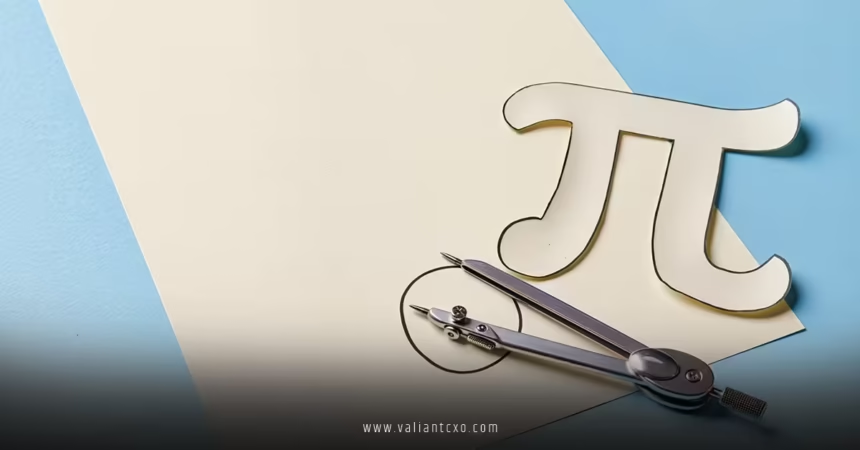
What is the Mathematical Constant Pi The Greek letter π was first used in 1706 by William Jones, but it was Leonhard Euler’s adoption in 1737 that made it standard. The symbol comes from the Greek word “peripheria” (perimeter), fitting for a number tied to circles.
Before that, people called it “the constant” or “Archimedes’ number.” Euler’s influence cemented π as the universal symbol, and today it’s instantly recognizable worldwide.
Key Properties That Make the Mathematical Constant Pi Special
What is the mathematical constant Pi that makes it so unique? Two big properties stand out:
- Irrationality: Proven by Johann Lambert in 1768, Pi cannot be expressed as a ratio of integers. Its decimals never end and never repeat.
- Transcendence: In 1882, Ferdinand von Lindemann proved Pi is transcendental—it’s not the root of any polynomial equation with rational coefficients. This proof also showed you can’t “square the circle” with compass and straightedge, settling a debate that lasted over 2,000 years.
Pi is also suspected (but not proven) to be normal—meaning every sequence of digits appears with equal frequency. If true, somewhere in Pi’s digits is your phone number, birthday, and every book ever written encoded in decimal.
How We Calculate the Mathematical Constant Pi Today
Early methods relied on polygons with more and more sides. As computers arrived, everything changed.
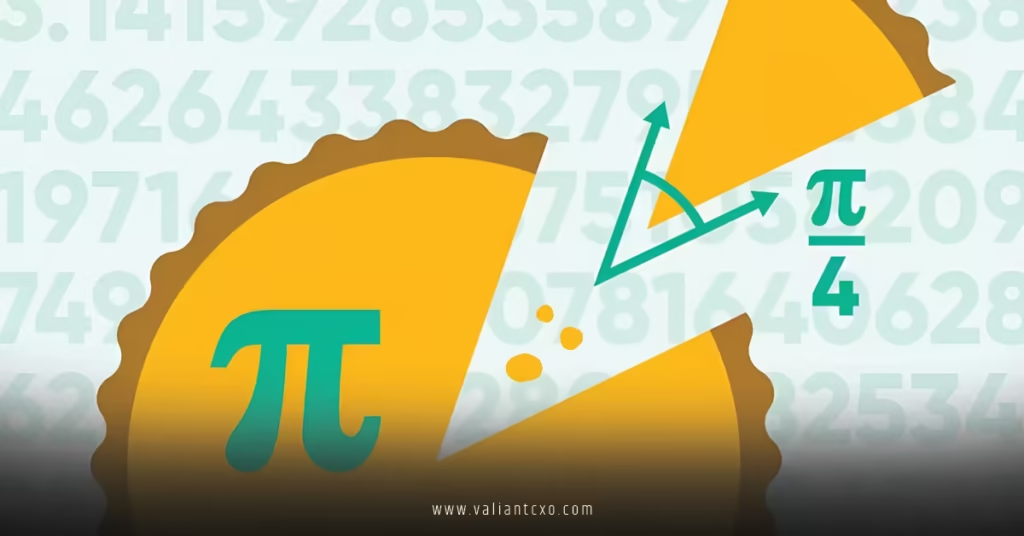
- Infinite series: The Leibniz formula (π/4 = 1 – 1/3 + 1/5 – 1/7 + …) converges slowly but elegantly.
- Machin-like formulas: Enabled faster calculations.
- Chudnovsky algorithm: Currently the champion for speed, used in most record-breaking computations.
As of 2025, the record stands at over 200 trillion digits, achieved using highly optimized software and massive computing clusters. Yet for almost all practical purposes, NASA uses just 15 digits to calculate interplanetary trajectories.
Real-World Applications of the Mathematical Constant Pi
Pi isn’t just theoretical—it’s everywhere:
- Engineering and Architecture: Wheels, gears, arches, and domes all rely on circle calculations.
- Physics: Wave equations, pendulum motion, Einstein’s field equations—all contain Pi.
- Statistics: The Bell curve (normal distribution) has Pi in its formula.
- Computer Science: Random number generation, graphics rendering, and signal processing use Pi extensively.
- Nature: Pi appears in river meanders, plant branching patterns, and even the spiral of DNA.
Whenever there’s rotational symmetry or oscillation, Pi is likely involved.
Fun Facts About the Mathematical Constant Pi
- Mnemonics (Piem): “How I need a drink, alcoholic of course, after the heavy lectures involving quantum mechanics” – each word’s letters give a digit of Pi.
- Pi in Pop Culture: Appears in movies like Life of Pi, Pi (1998), and even The Simpsons.
- March 14 Celebrations: Pi Day (3/14) has become a global event with pie-eating and math contests. Curious how it started? Dive into the History of Pi Day celebrations.
- Pi Approximation Day: July 22 (22/7) is celebrated in some places because 22/7 is a popular fraction for Pi.
Why the Mathematical Constant Pi Continues to Inspire
What is the Mathematical Constant Pi beyond a number? It’s a symbol of infinity, precision, and human curiosity. It reminds us that some truths are universal—true for every circle in the universe, no matter who measures it.
From ancient scribes scratching approximations on clay tablets to supercomputers churning through trillions of digits, our relationship with Pi reflects our drive to understand the world more deeply.
Conclusion
What is the Mathematical Constant Pi It’s far more than 3.14—it’s a bridge between simple geometry and the deepest mysteries of mathematics. Irrational, transcendental, infinite, and endlessly useful, Pi has shaped human knowledge for millennia. Whether you’re using it to calculate a circle’s area or simply enjoying a slice of pie on March 14, Pi connects us all through shared wonder. Next time you see a circle, remember: Pi is in there, quietly doing its infinite work.
Frequently Asked Questions
What exactly is the mathematical constant Pi?
Pi is the ratio of a circle’s circumference to its diameter, approximately 3.14159, and an irrational, transcendental number.
Who discovered the mathematical constant Pi?
No single person discovered Pi—it was approximated by ancient civilizations. Archimedes provided the first rigorous bounds, and the symbol π was popularized by Euler.
Why is the mathematical constant Pi irrational?
Its decimal expansion never ends or repeats, proven by Johann Lambert in 1768.
How many digits of the mathematical constant Pi do we need?
For most real-world uses, 10–15 digits are plenty. NASA uses about 15 for space calculations.
How is the mathematical constant Pi used outside mathematics?
It appears in physics (wave equations), engineering (design), statistics (normal distribution), and even nature (river bends, plant patterns).