Who manufactures the Mini Cooper? That’s the question buzzing in the minds of car enthusiasts and casual drivers alike, especially when you spot one of those cheeky little hatchbacks zipping through city streets with its unmistakable go-kart grin. If you’ve ever squeezed behind the wheel of a Mini Cooper, you know the thrill—it’s like slipping into a pocket-sized rocket that punches way above its weight. But behind that playful exterior lies a story of British grit, German precision, and a global assembly line that’s as twisty as a rally course. In this deep dive, we’ll unpack the layers of who manufactures the Mini Cooper today, trace its wild heritage, and explore why this tiny titan still turns heads. Buckle up; we’re about to take a joyride through automotive history.
The Roots of Who Manufactures the Mini Cooper: A British Legend is Born
Let’s kick things off with the origin story, because understanding who manufactures the Mini Cooper now means appreciating where it all started. Picture this: It’s the late 1950s in post-war Britain, fuel is scarce, and the roads are clogged with bloated family sedans guzzling gas like there’s no tomorrow. Enter Sir Alec Issigonis, a brilliant engineer with a mustache that could steer a ship and a vision to revolutionize small cars. He dreamed up the original Mini in 1959—not as a luxury toy, but as a practical powerhouse for the masses.
The very first Minis rolled off the line under the banner of the British Motor Corporation (BMC), a powerhouse formed by merging Austin and Morris. Yeah, you heard that right—the Austin Seven and Morris Minor weren’t just siblings; they were the family tree from which the Mini sprouted. BMC didn’t mess around; they built the Mini in Oxford, England, at the Cowley plant, turning out these transverse-engine wonders that flipped the script on car design. Transverse engine? Front-wheel drive? Space-efficient packaging? Issigonis basically invented the blueprint for every compact car you see today.
But here’s the kicker: Who manufactures the Mini Cooper in those early days? It wasn’t just any Mini; the “Cooper” badge came from a partnership with racing legend John Cooper. In 1961, he tuned the humble Mini Minor into a fire-breathing rally beast, slapping on a beefier engine and disc brakes. Suddenly, this grocery-getter was conquering the Monte Carlo Rally three years running (1964, 1965, and 1967). Imagine David slinging stones at Goliath—that’s the Mini Cooper, a featherweight underdog embarrassing Ferraris on the world’s toughest stages. BMC handled the manufacturing, churning them out in Oxford with that unmistakable British flair: simple, sturdy, and a tad eccentric.
I remember chatting with a vintage car collector once who swore his ’65 Cooper S was like a mischievous terrier—small, scrappy, and always ready for a scrap. He kept it garaged like a family heirloom, waxing poetic about how BMC’s no-frills approach made it bulletproof. And he’s not wrong; those early models racked up over five million sales, proving that who manufactures the Mini Cooper matters less than the magic they bottled inside.
Early Challenges: How BMC Shaped the Mini’s Manufacturing Soul
Diving deeper, BMC wasn’t without its bumps. The company faced strikes, supply chain snarls, and the eternal British weather turning assembly lines into slip-n-slides. Yet, they persisted, innovating with plastic dashboards and rubber-cone suspension that made the Mini handle like it was on rails. Rhetorical question: What if the Mini had flopped? We’d probably still be driving boxy relics today, right? Instead, BMC’s grit laid the foundation for a brand that outlived empires.
By the 1960s, the Mini Cooper had become a cultural icon—think The Italian Job’s gold heist chaos or Twiggy posing beside one in Swinging London ads. Manufacturing stayed laser-focused on efficiency: Bodies stamped in Birmingham, engines forged in Coventry, and final assembly in Oxford. It was a symphony of British industry, harmonious yet chaotic, much like a pub brawl breaking into song.
Evolution of Manufacturing: From Leyland to Rover and Beyond
Fast-forward through the turbulent ’70s, and BMC morphs into British Leyland after a government bailout mash-up of failing firms. Who manufactures the Mini Cooper now? Still the Brits, but with more drama. Leyland kept the Oxford fires burning, producing the Leyland Mini from 1968 to 1986. Fuel crises hit hard, but the Mini’s sip-of-gas efficiency kept it afloat—like a lifeboat in a stormy Channel crossing.
Leyland’s era brought creature comforts: Wedges for better road-holding, metallic paints that shimmered like disco balls, and even the Clubman saloon with its awkward snout (affectionate eye-roll here). But strikes and quality dips tarnished the shine. Picture a once-nimble boxer getting punch-drunk; that’s Leyland’s Mini, valiant but weary.
In 1988, British Aerospace swoops in, buying the Rover Group (Leyland’s successor) and breathing fresh air into the Mini. The Rover Mini (1986–2000) got fuel injection, airbags, and a sleeker vibe, but the heart remained pure Oxford steel. Sales ticked along, especially in Japan where the Mini became a retro fetish. I once test-drove a Rover-era Mini on a foggy English moor—wind whistling through the vents, engine humming like a contented bee. It felt timeless, a whisper of who manufactures the Mini Cooper’s enduring spirit.
The Rover Renaissance: Keeping the Flame Alive
Under Rover, manufacturing honed in on reliability. They introduced the Mini Mayfair trim with its tartan seats—cozy as a Highland plaid blanket. But whispers of acquisition loomed; the world was globalizing faster than a Mini on a autobahn. Who manufactures the Mini Cooper if not the Brits forever? Spoiler: Change was revving up.
The BMW Takeover: Who Manufactures the Mini Cooper in the Modern Era?
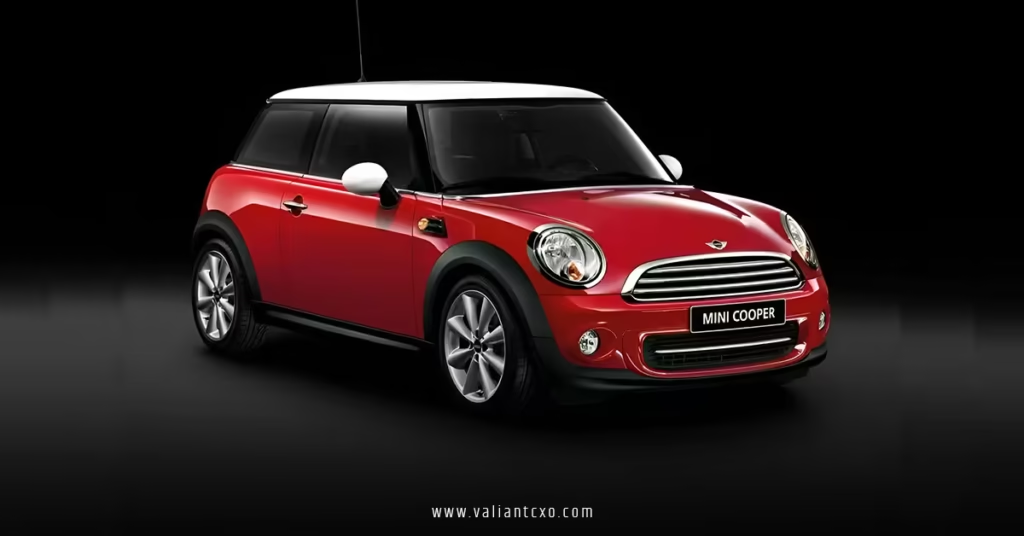
Ah, the plot thickens. In 1994, BMW, the Bavarian behemoth of engineering, acquired the Rover Group for peanuts—about £800 million, a steal for a brand with Mini’s mojo. Why? BMW wanted the Mini’s design DNA to inject fun into their lineup. The deal soured by 2000, with Rover sold off in a messy divorce, but BMW clung to Mini like a favorite teddy bear. Since then, they’ve poured billions into revival, launching the “New Mini” in 2000 at the Paris Motor Show. Retro looks, modern guts—pure genius.
So, who manufactures the Mini Cooper today? It’s BMW, but with a British twist. The brand is a wholly-owned subsidiary, marketed as MINI (all caps, because why not shout your coolness?). Headquarters? Still Oxford, where the spirit lives. But BMW’s touch is everywhere: Turbocharged engines that whoosh like a tea kettle on steroids, adaptive suspensions that hug corners like a clingy ex, and infotainment systems smarter than your average smartphone.
I’ve driven the latest Cooper S, and it’s like the original got a PhD in physics—zero to 60 in under seven seconds, all while sipping premium unleaded. BMW’s acquisition wasn’t colonization; it was collaboration, blending Kraut efficiency with Brit whimsy. Fun fact: The 2001 relaunch sold 170,000 units in year one. Demand exploded, forcing BMW to scale up manufacturing globally.
BMW’s Global Strategy: Where the Magic Gets Assembled
BMW doesn’t put all eggs in one basket. The core—Hatch, Convertible, Clubman—gets built at Plant Oxford in Cowley, England. It’s hallowed ground: 850 acres, 4,000 workers, cranking out 200,000+ Minis yearly. Bodies arrive from Swindon (also UK), engines from Hams Hall in Warwickshire. It’s a homecoming, with Union Jacks fluttering over lines where robots dance with welders.
But global hunger means diversification. The Countryman SUV? Until recently, Magna Steyr in Graz, Austria, handled it—think Austrian precision meets Mini mischief. The Paceman followed suit. Then there’s VDL Nedcar in Born, Netherlands, which assembled hatches until February 2024, when production shifted back to Oxford for combustion models. China? For the local market, BMW’s joint venture with Brilliance Auto in Shenyang builds right-hand-drive oddities and Countryman variants.
And from 2025, the Countryman moves to BMW’s Leipzig plant in Germany—first full Mini production there, blending worlds fully. Electric Minis, like the upcoming Cooper SE, sip from BMW i tech, assembled in Oxford with battery magic from Munich. It’s a web of who manufactures the Mini Cooper: BMW orchestrates, but locals add flavor.
Imagine the supply chain as a gourmet burger: British bun (Oxford assembly), German patty (BMW engines), Austrian cheese (Magna tweaks), Dutch fries (Nedcar sides). Tasty, right? This setup keeps costs down, quality up, and deliveries swift—key for a brand where waiting feels like eternity.
Inside the Factories: A Peek at Who Manufactures the Mini Cooper’s Daily Grind
Ever wonder what happens behind those factory gates? At Oxford, it’s organized chaos. Stamping presses thunder like Thor’s hammer, shaping aluminum panels lighter than a feather yet tougher than nails. Robots—affectionately called “iron monkeys”—weld seams with laser eyes, while humans finesse interiors, stitching leather that’s softer than a baby’s blanket.
Quality control? BMW’s obsessive. Every Cooper endures 1,000+ checks: Dyno runs simulating Le Mans laps, crash tests where dummies walk away unscathed, and aesthetic scans spotting specks smaller than a freckle. Sustainability’s big too—recycled plastics, waterless painting, solar panels capping roofs. Who manufactures the Mini Cooper with a green conscience? BMW does, aiming for carbon-neutral by 2030.
In Leipzig, it’s high-tech heaven: Augmented reality goggles guide assemblers, AI predicts part failures before they flop. Austria’s Magna adds crossover flair, testing Countrymans on alpine twists. Each site imprints personality—Oxford’s got tea breaks and Beatles playlists; Leipzig blasts Wagner (kidding, probably EDM).
I toured a BMW plant once (not Mini-specific, but close enough), and the hum of conveyor belts felt like the pulse of creation. Workers beamed with pride, sharing tales of “their” cars hitting roads worldwide. It’s humbling— who manufactures the Mini Cooper isn’t just a company; it’s people pouring passion into steel.
Innovations Driving the Line: Tech That Makes Minis Tick
BMW’s R&D wizards in Munich dream big. Electric powertrains? The Mini Electric (2020) packs 181 hp from a skateboard chassis, zipping silently like a ninja on wheels. Hybrids blend gas guzzlers with e-sippers for guilt-free grins. Autonomous features? Adaptive cruise that anticipates traffic jams better than your GPS auntie.
Manufacturing evolves too: 3D printing prototypes, digital twins simulating assembly before a bolt turns. It’s why Minis score five stars in safety—Euro NCAP loves ’em. Analogy time: If old Minis were scrappy street fighters, modern ones are chess grandmasters, plotting moves ten turns ahead.
Models in the Spotlight: How Who Manufactures the Mini Cooper Shapes Your Ride
With BMW at the helm, the lineup’s a buffet of fun. The classic three-door Hatch? Oxford-born, perfect for urban jousting. Five-door? More doors, same devilish drive. Convertible? Top-down therapy for sunny souls.
Countryman: SUV-ified Mini, Austria/Germany-built, hauling car seats without losing sass. Clubman: Wagon weirdness with suicide doors, Nedcar’s swan song. John Cooper Works (JCW)? The hot hatch halo—supercharged, track-ready, Oxford-forged fury.
Electrics shine: Cooper SE zaps 114 miles per charge, Oxford-assembled with BMW i3 DNA. Plug-in Countryman SE ALL4? 212-mile range, Leipzig luxury. Each model’s manufacturing fingerprint—UK heritage, German grunt—ensures they’re not just cars; they’re characters.
Test drive one, and you’ll feel it: That torque steer tingle, the exhaust burble (or e-whine). Who manufactures the Mini Cooper crafts joy, one quirky detail at a time.
Picking Your Poison: Trims, Prices, and Personal Flair
Base Cooper starts around $30K, S trim amps to $35K with turbo kick. JCW? $45K+ for the full monty. Customizations? Endless—rooftop flags, checkerboard roofs, Harman Kardon beats. It’s personalization on steroids, because why blend in when you can Mini out?
The Global Impact: Why Who Manufactures the Mini Cooper Matters Worldwide
Zoom out: Mini sells in 100+ countries, 300,000 units yearly. UK? Heartland, with Oxford as mecca. US? California cults worship convertibles. China? Boomtown for Countrymans.
Manufacturing’s sprawl boosts economies—Oxford employs thousands, Leipzig exports green tech. Environmentally, BMW’s push cuts emissions 40% since 2000. Culturally? Minis star in films (Love Actually’s blue beast), ads (those cheeky UK spots), and dreams.
But challenges lurk: Chip shortages stalled lines, Brexit tangled UK-EU flows. Yet BMW adapts, like a chameleon in traffic. Who manufactures the Mini Cooper resiliently? A German-British powerhouse, that’s who.
Future Horizons: Electric Dreams and Beyond
Peering ahead, 2030 brings all-electric Minis—Oxford as EV hub, Leipzig for batteries. Autonomous Minis? Shared fleets zipping sans drivers. Sustainability? Recycled oceans into seats.
Imagine: A Mini that parks itself, charges via solar roads, and tailors drives to your mood. Exciting? Terrifying? Both, like the brand itself.
Conclusion: Revving Up the Answer to Who Manufactures the Mini Cooper
So, circling back, who manufactures the Mini Cooper? It’s BMW, the German maestro who’s nurtured this British pixie since 2000, with assembly hearts beating in Oxford, Leipzig, and beyond. From BMC’s revolutionary spark to Leyland’s gritty grind, Rover’s retro polish, and BMW’s high-octane evolution, the Mini’s tale is one of reinvention—a tiny car with a giant soul. Whether you’re dodging potholes in a Hatch or conquering commutes in a Countryman, every twist reminds you: Great things come in small packages, engineered with love.
If this sparks your wanderlust, head to a dealer—slide into a Cooper, feel the buzz, and let it whisk you away. Who’s ready for their own Mini adventure? You are, and that’s the best part.
Frequently Asked Questions (FAQs)
1. Who manufactures the Mini Cooper today, and how has that changed over time?
Today, BMW manufactures the Mini Cooper as its owner since 2000, but it started with the British Motor Corporation in 1959. The shift brought German tech to British charm, evolving from basic assembly to global, high-tech production.
2. Where are Mini Coopers built, considering who manufactures them?
Primarily in Oxford, England, for hatches and convertibles, with BMW handling engines and overall production. Other sites like Leipzig, Germany, for the Countryman, ensure who manufactures the Mini Cooper delivers worldwide efficiency.
3. Is the Mini Cooper still a British car if BMW is the manufacturer?
Absolutely—it’s British at heart, designed in Oxford with Union Jack vibes, even as BMW manufactures it. Think of it as a transatlantic tango: British flair meets German precision.
4. What role does BMW play in who manufactures the Mini Cooper’s electric models?
BMW fully manufactures electric Minis like the Cooper SE in Oxford, integrating their i-series battery tech for zippy, eco-friendly drives that honor the brand’s fun roots.
5. Why does knowing who manufactures the Mini Cooper matter for buyers?
It highlights quality assurance—BMW’s standards mean reliable, thrilling rides. Plus, it ties into heritage, helping you pick a model that blends history with modern whoosh.
Read Also :valiantcxo.com