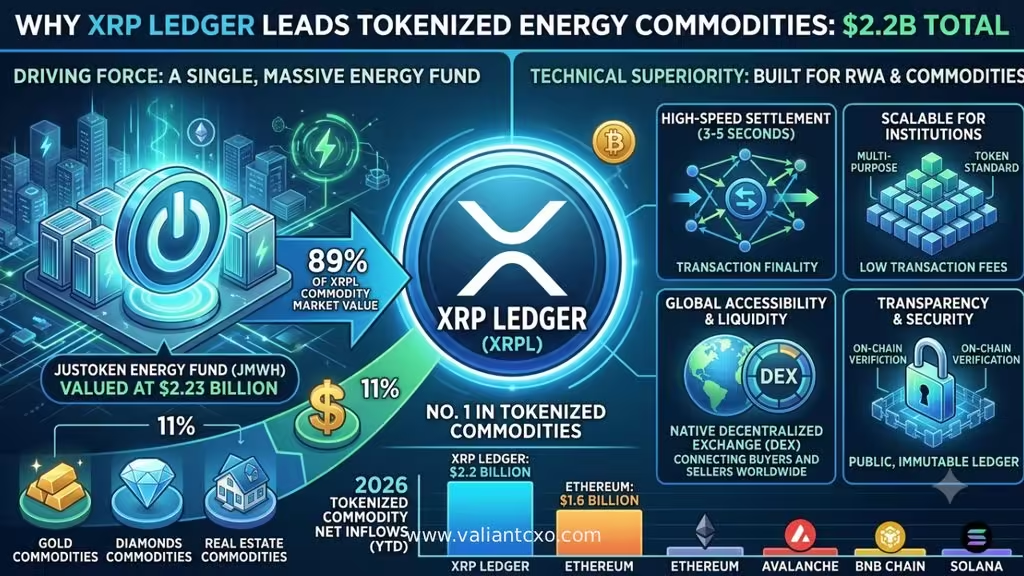
Why XRP Ledger leads tokenized energy commodities $2.2B comes down to speed, cost, and one outsized energy play that flipped the rankings in 2026. XRPL pulled in roughly $2.2 billion in net commodity inflows year-to-date, ahead of Ethereum’s $1.6 billion, according to data tracked by the RWA Foundation and Token Terminal. Most of that edge sits in a single Justoken product called JMWH—tokenized megawatt-hours of Argentine electricity that accounts for the bulk of the ledger’s commodity value.
Here’s the quick snapshot:
- XRPL recorded the largest 2026 net inflows into tokenized commodities at about $2.2B.
- One energy token (JMWH) drives the majority of that figure and roughly 89% of XRPL commodity value.
- Settlement in 3–5 seconds and sub-cent fees make the ledger practical for industrial energy contracts.
- The lead is real on the inflow metric, yet highly concentrated—liquidity and holder breadth remain limited.
That concentration is the story most people miss. Rankings look different once you separate reported inflows from actual trading depth.
Why XRP Ledger leads tokenized energy commodities $2.2B in practice
Why XRP Ledger leads tokenized energy commodities $2.2B XRPL was never built as a general smart-contract playground. It was built for payments and issued assets that need to move fast and cheap. Energy contracts fit that profile. Power producers and offtakers care about settlement finality measured in seconds, not minutes, and fees that stay predictable when volumes spike.
JMWH from Justoken illustrates the point. Each token represents one megawatt-hour of electricity from Argentine producers. The product sits on-chain as a represented asset—primarily a recordkeeping and settlement tool rather than a free-floating speculative coin. Issuers mint when contracts are signed and burn when power is delivered. The structure keeps the ledger focused on operational reality instead of pure secondary-market trading.
In my experience working with commodity desks, this is exactly the use case that survives contact with operations teams. Fancy DeFi wrappers often get discarded the moment a compliance officer or plant manager asks how the token maps to physical delivery. XRPL’s native issued-asset model and later multi-purpose token features give issuers freeze, clawback, and authorization controls without bolting on extra contract layers.
Compare the numbers side by side and the picture sharpens.
| Network | 2026 Net Commodity Inflows | Key Driver | Relative Concentration |
|---|---|---|---|
| XRP Ledger | ~$2.2B | JMWH energy token (~$2.23B) | Very high (one asset ~89%) |
| Ethereum | ~$1.6B | Gold and broader commodities | Lower |
| Avalanche | ~$335M | Diversified smaller issues | Moderate |
| Others (BNB, Solana, etc.) | Under $60M each | Scattered | Low |
Data drawn from RWA Foundation / Token Terminal reporting through late 2026. Ethereum still holds more total commodity value when gold products such as Tether Gold and Paxos Gold are counted across chains. XRPL’s lead is specific to the inflow and energy-heavy slice of the market.
Why XRP Ledger leads tokenized energy commodities $2.2B for institutions
Three practical advantages keep showing up in conversations with energy and commodity teams.
First, settlement speed. Three to five seconds is fast enough for daily balancing and invoice cycles. Second, cost. Fees measured in fractions of a cent remove the friction that kills high-volume, low-margin commodity flows. Third, native compliance primitives. Issuers can control who holds the tokens and reverse problem transfers without relying solely on external smart-contract logic.
The result is a ledger that behaves more like a specialized settlement rail than a general-purpose app platform. That suits energy commodities. Power is produced, metered, and delivered under tight time windows. A chain that can record the claim, settle the payment, and support audit trails in near real time has an edge.
Why XRP Ledger leads tokenized energy commodities $2.2B What would I do if I were evaluating this for a mid-sized energy trader or offtaker in the U.S.? Start with the operational fit, not the market-cap headline. Map the physical contract terms to the token’s redemption and burn mechanics. Confirm the legal wrapper (Argentine and UK frameworks in the JMWH case) actually binds the underlying power. Stress-test holder concentration and secondary liquidity—or the lack of it. Only then look at the ranking numbers.
Step-by-step action plan for beginners
- Read the current RWA.xyz and Token Terminal commodity dashboards so you see the live numbers instead of secondary headlines.
- Pull the official XRPL documentation on issued assets and multi-purpose tokens to understand the native controls.
- Review one concrete product page—JMWH or a comparable energy token—to see how physical delivery maps to on-chain mint and burn.
- Compare settlement times and fee ranges against the chains your counterparties already use.
- Talk to legal and ops teams about whether the representation model (versus fully distributed tradable tokens) matches your risk and audit requirements.
- Run a small internal pilot with a non-critical contract volume before committing larger flows.
Common mistakes and how to fix them
Why XRP Ledger leads tokenized energy commodities $2.2B Treating the $2.2B figure as broad market adoption. Fix: separate the single-asset concentration from the rest of the ledger’s commodity activity. The diamonds and smaller issues matter for diversification, but they are a fraction of the total.
Assuming secondary-market liquidity equals the reported value. Fix: check actual transfer counts and holder distribution. Many energy tokens function as settlement records, not liquid trading instruments.
Ignoring the difference between “represented” and “distributed” assets. Fix: understand that represented tokens often stay inside the issuing platform’s workflow while the ledger provides the immutable record.
Chasing rankings without testing operational reality. Fix: map one real power-purchase agreement to the token lifecycle before scaling.
Key Takeaways
- XRPL led 2026 tokenized commodity net inflows at approximately $2.2 billion, ahead of Ethereum.
- The lead is heavily concentrated in Justoken’s JMWH energy token representing Argentine megawatt-hours.
- Speed (3–5 second settlement) and low fees remain the practical advantages for energy contracts.
- Concentration creates ranking leadership but also liquidity and breadth risks.
- Represented assets serve settlement and audit use cases more than open trading.
- Institutional controls built into the ledger reduce the need for complex external contracts.
- Always verify current RWA.xyz and Token Terminal data—numbers move.
The real test for why XRP Ledger leads tokenized energy commodities $2.2B is not the headline ranking. It is whether the ledger’s design actually reduces friction for the people who produce, buy, and settle power. So far in 2026 the answer for a meaningful slice of the energy market has been yes. The next step is straightforward: pull the live dashboards, map one contract, and decide if the operational fit beats the alternatives for your specific flows.
FAQs
Why does XRP Ledger lead tokenized energy commodities $2.2B if one token dominates?
The $2.2B figure reflects net inflows tracked by RWA Foundation and Token Terminal. JMWH accounts for the large majority of XRPL’s commodity value, so the ranking is real on the inflow metric yet concentrated.
Is the energy token liquid on secondary markets?
In most reported cases, JMWH functions primarily as a represented settlement and audit instrument with limited secondary transfers. Liquidity should be verified directly rather than assumed from total value.
How does XRPL compare to Ethereum for energy commodities specifically?
XRPL wins on settlement speed and predictable low fees for high-volume operational flows. Ethereum retains broader total commodity value, especially in gold products, and deeper DeFi tooling.