25th amendment controversy explained begins with a simple yet profound question: What happens when the leader of the free world can’t lead? Imagine a scenario where the President of the United States faces a crisis—not from enemies abroad, but from within their own health or actions. That’s where the 25th Amendment steps in, a constitutional safeguard that’s sparked heated debates since its inception. As someone who’s delved into American politics, I can tell you it’s not just legalese; it’s a drama-filled mechanism that could reshape history in an instant. In this deep dive, we’ll unpack the 25th amendment controversy explained, from its origins to modern-day showdowns, all while keeping things straightforward and relatable. Think of it like a safety net for the presidency—strong in theory, but wobbly when politics gets involved.
What Exactly Is the 25th Amendment? A Quick Primer
Let’s start at the basics because, hey, not everyone’s a constitutional scholar. The 25th Amendment to the U.S. Constitution, ratified back in 1967, deals with presidential succession and disability. It’s like the backup plan when the top job hits a snag. Before this amendment, things were murky—picture a ship without a clear captain during a storm. The original Constitution hinted at what to do if a president died or couldn’t serve, but it left too many gaps. Enter the 25th Amendment, which fills those holes with four key sections.
Why does this matter in the 25th amendment controversy explained? Well, it’s designed to ensure smooth power transitions, but its vagueness has fueled endless arguments. For instance, what counts as “inability” to serve? Is it a coma, mental health issues, or something more subjective like poor judgment? These questions aren’t just academic; they’ve popped up in real-life political firestorms, making the amendment a lightning rod for controversy.
Historical Roots: Why the 25th Amendment Was Born
To truly grasp the 25th amendment controversy explained, we need to rewind the clock. The amendment didn’t appear out of thin air—it was a response to chaos. Think about President John F. Kennedy’s assassination in 1963. Suddenly, Vice President Lyndon B. Johnson stepped up, but what if both had been hit? The Constitution’s Article II was vague on vice presidential vacancies and presidential disabilities. Earlier, in 1841, President William Henry Harrison died, and Vice President John Tyler boldly claimed the full presidency, setting a precedent but stirring debates.
Fast-forward to the Cold War era, when nuclear threats loomed. Lawmakers worried: What if a president had a stroke or was captured? Congress pushed for clarity, leading to the 25th Amendment’s ratification. It’s like installing airbags in a car after a major crash—preventive, but hindsight-driven. Yet, this very clarity has bred controversy. Critics argue it hands too much power to unelected officials, turning potential health issues into political weapons. Have you ever thought about how one amendment could prevent a leadership vacuum but also invite power grabs?
Breaking Down the Sections: 25th Amendment Controversy Explained in Detail
Diving deeper into the 25th amendment controversy explained, let’s dissect its four sections. Each one addresses a specific “what if” scenario, but they’ve all sparked their share of drama.
Section 1: Clarifying Presidential Succession
Section 1 is straightforward: If the president dies, resigns, or gets removed (say, via impeachment), the vice president becomes president. Sounds simple, right? But before 1967, it wasn’t clear if the VP got the full title or just the duties. John Tyler’s bold move in 1841 set the tone, but it took this section to make it official. In the 25th amendment controversy explained, this part rarely stirs trouble—it’s been used seamlessly, like when Gerald Ford became president after Richard Nixon’s resignation in 1974.
Section 2: Filling Vice Presidential Vacancies
Here’s where things get interesting. Section 2 lets the president nominate a new VP if the office is vacant, with Congress confirming. This was a game-changer because, pre-amendment, a VP vacancy meant no backup. Ford’s ascension to VP after Spiro Agnew’s resignation in 1973 was the first test. But in the broader 25th amendment controversy explained, skeptics worry it could lead to cronyism—picking a loyalist over the best fit. Imagine a president stacking the deck; it’s like choosing your own successor mid-game.
Section 3: Voluntary Transfer of Power
Section 3 allows the president to temporarily hand over powers to the VP, usually for medical reasons. Presidents like Ronald Reagan (during surgery in 1985) and George W. Bush (for colonoscopies) have used it without fuss. It’s like saying, “Hey, hold the fort while I’m out.” The 25th amendment controversy explained here is minimal—it’s consensual and reversible. But what if a president refuses to admit they’re unfit? That’s where the real fireworks begin.
Section 4: The Involuntary Clause – Heart of the Controversy
Ah, Section 4—the nuclear option in the 25th amendment controversy explained. This lets the VP and a majority of the cabinet declare the president “unable to discharge the powers and duties” of the office. The VP then becomes acting president. The president can fight back by declaring themselves fit, triggering a congressional vote if challenged. It’s never been invoked, and that’s the rub. Why? It’s politically explosive. Cabinet members, appointed by the president, would essentially betray their boss. Picture a family intervention gone wrong, but with the fate of the nation at stake.
In the 25th amendment controversy explained, Section 4’s vagueness on “inability” is a hot topic. Does it cover physical coma, mental illness, or ethical lapses? Legal experts debate this endlessly, as it’s a high-stakes gray area.
Major Historical Controversies: When the 25th Amendment Hit the Headlines
The 25th amendment controversy explained wouldn’t be complete without real-world examples. Let’s explore times it almost—or did—come into play.
The Reagan Assassination Attempt in 1981
On March 30, 1981, John Hinckley Jr. shot President Ronald Reagan, nearly killing him. As Reagan underwent surgery, his aides debated invoking Section 3 or 4. Secretary of State Alexander Haig famously (and wrongly) declared himself “in charge.” In the end, they skipped the amendment, fearing panic. This episode highlights the 25th amendment controversy explained: Hesitation in crisis can lead to confusion, yet invoking it might signal weakness. It’s like hesitating to pull the emergency brake on a speeding train.
Nixon’s Watergate Scandal and Resignation
During Watergate, whispers of the 25th Amendment swirled as Nixon’s mental state deteriorated. But impeachment loomed larger, and he resigned before any invocation. Ford’s pardon of Nixon added layers to the 25th amendment controversy explained, showing how succession can intertwine with scandal. Could Section 4 have sped things up? We’ll never know, but it underscores the amendment’s role as a last resort.
The Trump Era: 25th Amendment Controversy Explained in Modern Times
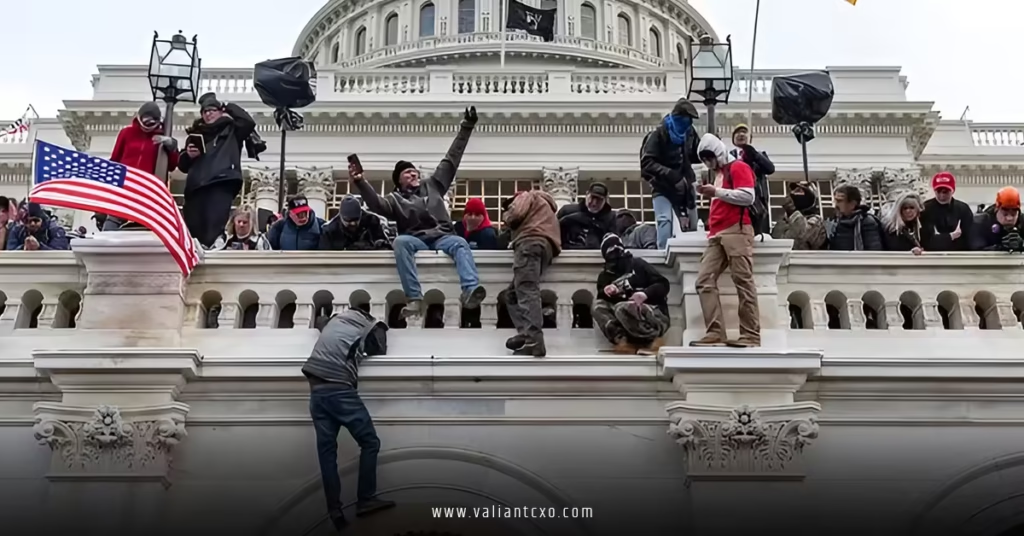
Fast-forward to Donald Trump’s presidency, where the 25th amendment controversy explained reached fever pitch. After the January 6, 2021, Capitol riot, calls to invoke Section 4 surged. Critics argued Trump was unfit, inciting violence. Vice President Mike Pence resisted, citing stability. Earlier, anonymous op-eds hinted at cabinet discussions on Trump’s fitness. This era amplified the 25th amendment controversy explained, revealing partisan divides. Is it a tool for accountability or a coup mechanism? Rhetorically, if the amendment exists for such moments, why the reluctance?
Health rumors during Trump’s COVID-19 bout in 2020 also stirred debates. What if a president downplays their illness? The 25th amendment controversy explained here is about transparency—voters deserve to know if their leader’s compromised.
Pros and Cons: Debating the 25th Amendment’s Effectiveness
Weighing the scales in the 25th amendment controversy explained, let’s look at both sides.
On the pro side, it’s a vital safeguard. It prevents power vacuums, ensures continuity, and adapts to unforeseen crises. Like a fire extinguisher, you hope not to use it, but it’s there.
Cons? It’s too vague and political. “Inability” lacks definition, inviting abuse. Cabinet loyalty makes invocation unlikely, as seen in Trump debates. Some argue for reforms, like an independent medical panel. In the 25th amendment controversy explained, this tension keeps scholars buzzing—balance stability with accountability?
The 25th Amendment in Pop Culture and Public Perception
You can’t ignore how the 25th amendment controversy explained seeps into movies and TV. From “Air Force One” to “The West Wing,” it’s dramatized as a high-stakes plot twist. This shapes public view: Is it heroic or villainous? In reality, it’s neither—just a tool. But media amplifies fears, making everyday folks question presidential fitness. Ever binge-watched a political thriller and wondered if it could happen? That’s the amendment’s cultural footprint.
Potential Reforms: Fixing the Flaws in the 25th Amendment Controversy Explained
As debates rage, ideas for tweaks emerge. Clarify “inability” with medical criteria? Empower Congress more? Or create a bipartisan commission? In the 25th amendment controversy explained, reforms could depoliticize it, but amending the Constitution is tough—like herding cats in Washington. Still, discussions keep the topic alive, ensuring it’s ready for future crises.
Global Comparisons: How Other Countries Handle Leadership Incapacity
To put the 25th amendment controversy explained in perspective, glance abroad. In the UK, the monarch’s regency laws handle similar issues, but it’s ceremonial. France’s constitution allows parliamentary removal for health reasons. America’s system is unique—vice presidential involvement adds intrigue. It’s like comparing apples to oranges, but it highlights why our debates feel so intense.
In wrapping up this exploration of the 25th amendment controversy explained, we’ve journeyed from its historical birth to modern flashpoints. It’s a cornerstone of stability, yet its ambiguities spark endless debate. Whether it’s safeguarding against disaster or risking overreach, the amendment reminds us: Power is fragile. So, stay informed, question leaders, and remember—democracy thrives on vigilance. What will the next chapter bring? Only time will tell, but understanding this tool empowers you to engage.
FAQs
What is the core of the 25th amendment controversy explained?
The 25th amendment controversy explained revolves around its provisions for presidential succession and disability, particularly Section 4’s potential for involuntary removal, which has never been used due to political risks.
How has the 25th amendment controversy explained played out in recent U.S. history?
In the 25th amendment controversy explained, recent examples include debates during Trump’s presidency, especially post-January 6, where calls to invoke it highlighted partisan tensions over presidential fitness.
Why is Section 4 key to the 25th amendment controversy explained?
Section 4 allows the VP and cabinet to declare a president unfit, fueling the 25th amendment controversy explained because of its vagueness and the high-stakes loyalty test it imposes on officials.
Can the 25th amendment controversy explained lead to permanent removal?
No, the 25th amendment controversy explained clarifies that it only transfers powers temporarily; permanent removal requires impeachment, making it a stopgap rather than a full ouster.
How does the 25th amendment controversy explained compare to impeachment?
While impeachment addresses crimes, the 25th amendment controversy explained focuses on incapacity, offering a quicker but more controversial path to sideline a president without trials.