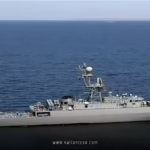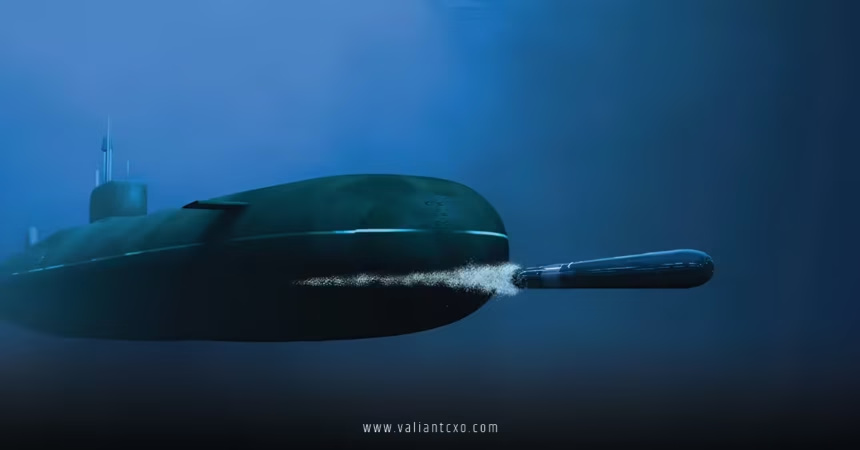
Mark 48 torpedo capabilities have once again captured global attention following the US submarine sinks IRIS Dena Indian Ocean incident on March 4, 2026. In that dramatic event, a single Mark 48 heavyweight torpedo fired from a U.S. Navy fast-attack submarine sent the Iranian frigate IRIS Dena to the ocean floor off Sri Lanka’s coast. Have you ever stopped to think about what makes this underwater weapon so devastatingly effective? It’s not just brute force—it’s a blend of stealth, intelligence, and raw power that has kept it as the U.S. Navy’s go-to heavyweight torpedo for decades.
Whether you’re a naval enthusiast, a defense buff, or just curious about how one torpedo can change the course of a conflict, let’s break down the Mark 48 torpedo capabilities in detail. We’ll explore its design, specs, guidance systems, and why it remains unmatched in anti-submarine and anti-surface warfare.
A Brief History of the Mark 48 Torpedo
The Mark 48 story starts in the late 1960s. Back then, the U.S. Navy needed a weapon to counter fast, deep-diving Soviet submarines like the Alfa class. Enter the Mark 48—introduced in 1972 as a replacement for older models like the Mk 37 and Mk 14. Over the years, it evolved into the Advanced Capability (ADCAP) variant, with upgrades focusing on digital tech, better sonar, and enhanced propulsion.
Today, the Mark 48 torpedo capabilities shine through continuous software and hardware refreshes. The latest iterations, like Mod 7 CBASS (Common Broadband Advanced Sonar System) and emerging Mod 8 upgrades, keep it ahead of evolving threats. Fun fact: this torpedo has been in service longer than many sailors have been alive, yet it still dominates.
Key Specifications of the Mark 48 Torpedo
Let’s get into the numbers that make the Mark 48 torpedo capabilities so impressive.
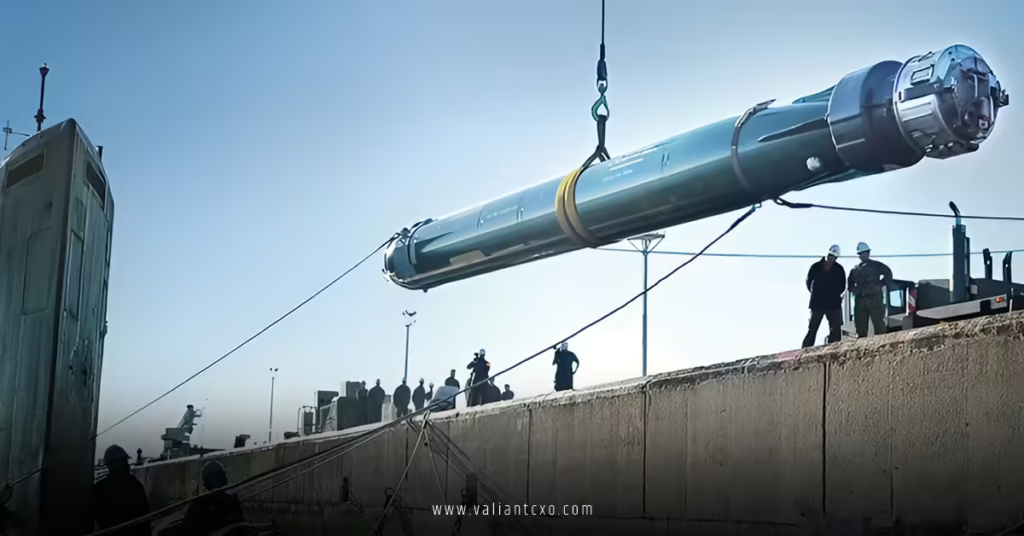
- Length: About 19 feet (5.8 meters)
- Diameter: 21 inches (533 mm) – standard heavyweight size
- Weight: Around 3,434–3,744 pounds (1,558–1,700 kg), depending on the variant (ADCAP is heavier)
- Warhead: 650 pounds (295 kg) of high-explosive PBXN-103 or PBXN-105 – one of the most powerful non-nuclear underwater explosives
That warhead isn’t just big; it’s designed to detonate under a ship’s keel. The explosion creates a massive bubble that lifts the vessel, then collapses, snapping the hull like a twig. In the US submarine sinks IRIS Dena Indian Ocean case, footage showed exactly this: the frigate’s stern lifted before the ship broke apart and sank rapidly.
Propulsion and Speed: How Fast and Far Can It Go?
Speed kills in underwater combat, and the Mark 48 delivers.
Official figures are conservative—greater than 28 knots—but reliable estimates put maximum speed at 55–65 knots (over 100 km/h). That’s faster than most surface ships can sprint!
Range varies by speed mode:
- At high speed (around 55 knots): 20–30+ nautical miles
- At lower cruise speeds: Up to 31–38 nautical miles or more in some configurations
Propulsion comes from a liquid propellant (Otto Fuel II) piston engine driving a pump-jet propulsor. This setup is quiet, efficient, and allows variable speeds—high for closing in, slower for stealthy search. Imagine a shark: explosive burst to chase, then silent glide to stalk. That’s the Mark 48 torpedo capabilities in action.
Recent upgrades (as of 2025–2026 discussions) hint at even better endurance with potential new energy sources, ensuring it stays relevant against longer-range threats.
Guidance and Homing Systems: The Brains of the Beast
What sets the Mark 48 apart isn’t raw power—it’s smarts.
The torpedo uses:
- Wire guidance – A thin wire from the launching sub provides real-time updates and target motion analysis (TMA). The operator can steer it mid-course.
- Acoustic homing – Passive (listening silently) and active (pinging like sonar) modes.
- Common Broadband Advanced Sonar System (CBASS) – In Mod 7 and later, this wideband sonar excels in shallow water, littoral zones, and against countermeasures.
Advanced digital processing lets it classify targets, ignore decoys, and even re-attack if it misses the first time. If the wire breaks? No problem—it switches to autonomous mode and keeps hunting.
This combination made it perfect for the US submarine sinks IRIS Dena Indian Ocean strike: stealthy approach, precise lock-on, and devastating effect with minimal warning.
Warhead and Detonation: Why One Hit Is Often Enough
The 650-pound warhead packs a punch equivalent to over 1,200 pounds of TNT underwater. Multiple fuzing options include:
- Contact
- Proximity (magnetic or acoustic)
- Short- or long-range detonation
Tested extensively in sinkex (sinking exercises), it has proven lethal against submarines and surface ships alike. The under-keel explosion maximizes structural damage—exactly what happened to IRIS Dena, where the single torpedo caused catastrophic failure.
Operational Advantages and Real-World Use
The Mark 48 torpedo capabilities excel in versatility:
- Anti-submarine warfare (ASW) against deep-diving nukes
- Anti-surface warfare (ASuW) against frigates, destroyers, and carriers
- Launch from all U.S. submarine classes via swim-out or impulse
It’s reliable in Sea State 6+, works in shallow littorals, and boasts incredible in-water reliability from thousands of test firings.
The March 2026 incident in the Indian Ocean marked a historic first: the first U.S. submarine torpedo sinking of an enemy vessel since World War II. That single Mark 48 demonstrated why this weapon remains the silent service’s deadliest tool.
Future of Mark 48 Torpedo Capabilities
The Navy isn’t resting. Mod 8 (APB 6/Tech Insertion-1) brings denser sonar arrays, better transmitters, and fiber-optic guidance links. Future mods promise enhanced propulsion for even greater range and speed.
As threats evolve—think quieter subs or advanced countermeasures—the Mark 48 evolves too, via software updates that breathe new life into existing stockpiles.
In conclusion, the Mark 48 torpedo capabilities combine stealth, speed, intelligence, and overwhelming destructive power into one package. From its role in the US submarine sinks IRIS Dena Indian Ocean event to its ongoing dominance, this torpedo proves that in undersea warfare, the quiet killer often wins. Whether deterring aggression or delivering precision strikes, the Mark 48 remains a cornerstone of naval superiority. Curious about submarine tactics or other naval weapons? Keep exploring—the ocean depths hold endless stories.
For deeper reading:
- U.S. Navy Fact File on MK 48 Heavyweight Torpedo
- Wikipedia: Mark 48 Torpedo
- Lockheed Martin: 5 Fast Facts About the MK 48
FAQs
1. What are the primary Mark 48 torpedo capabilities in modern naval combat?
The Mark 48 excels in anti-submarine and anti-surface roles with wire-guided acoustic homing, speeds up to 55–65 knots, ranges exceeding 20–30 nautical miles, and a 650-pound warhead for devastating under-keel detonations.
2. How was the Mark 48 torpedo used in the US submarine sinks IRIS Dena Indian Ocean incident?
In March 2026, a U.S. submarine fired a single Mark 48 torpedo that struck the Iranian frigate IRIS Dena, causing it to sink rapidly in international waters off Sri Lanka—the first such U.S. torpedo sinking since WWII.
3. What makes the guidance system one of the standout Mark 48 torpedo capabilities?
It combines wire guidance for real-time control with active/passive acoustic homing and advanced broadband sonar, allowing target discrimination, decoy evasion, and autonomous re-attack if needed.
4. What is the warhead size and explosive power in Mark 48 torpedo capabilities?
The warhead weighs 650 pounds (295 kg) of high-explosive PBXN compounds, designed for under-keel detonation to maximize hull-breaking shockwaves against surface ships and submarines.
5. Are there ongoing upgrades to Mark 48 torpedo capabilities as of 2026?
Yes, Mod 8 introduces new sonar arrays, receivers, and potential fiber-optic links, with future mods focusing on propulsion and sensing to counter emerging threats.