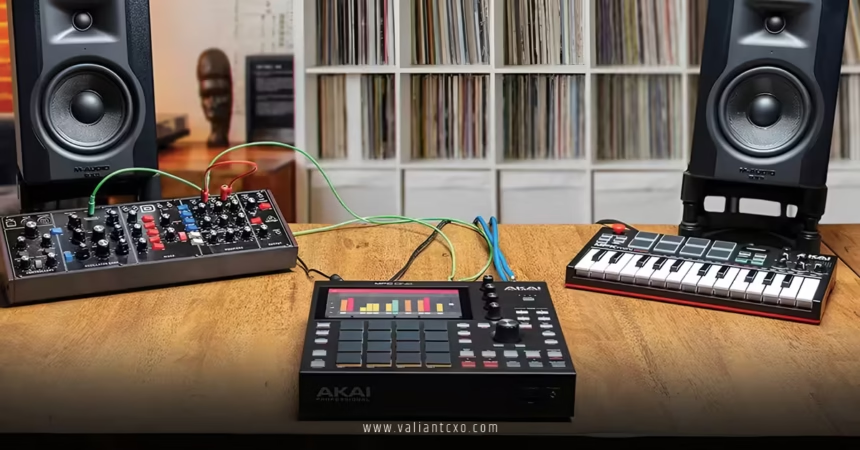
Akai MPC Sample 2026 review and unboxing time—let’s crack open this hot new portable sampler that’s got every producer talking. If you’re tired of lugging around a laptop just to chop a break or lay down some fire drums, this little gray box might be exactly what you’ve been waiting for. I finally got my hands on one the day it dropped on March 24, 2026, and honestly? It feels like Akai took the soul of the classic MPC60 and MPC3000, shrunk it down, added a battery, and made it affordable.
In this full Akai MPC Sample 2026 review and unboxing, I’ll walk you through everything from the moment you open the box to real-world beatmaking sessions. We’ll cover build quality, sound, workflow, pros, cons, and how it stacks up against the Roland SP-404MKII and Teenage Engineering KO-II. Plus, I’ll link back to everything you need to know about the Akai MPC Sample 2026 portable sampler drum kits and one shots that make this thing sing.
Unboxing the Akai MPC Sample 2026: First Impressions Straight Out of the Box
The box arrived in that classic Akai no-nonsense packaging—clean, professional, with a big “MPC Sample” label and the iconic “WHERE BEATS ARE BORN” tagline. Inside, everything felt premium for a $399 device.
You get:
- The MPC Sample unit itself (compact at 23.6 × 19.4 × 5.0 cm and surprisingly light at around 900g)
- A USB-C charging cable
- A quick-start guide
- Some stickers and warranty info
No fancy extras like a case or power adapter (you’ll use your own USB-C charger or power bank), but that’s fine—this thing is built for portability.
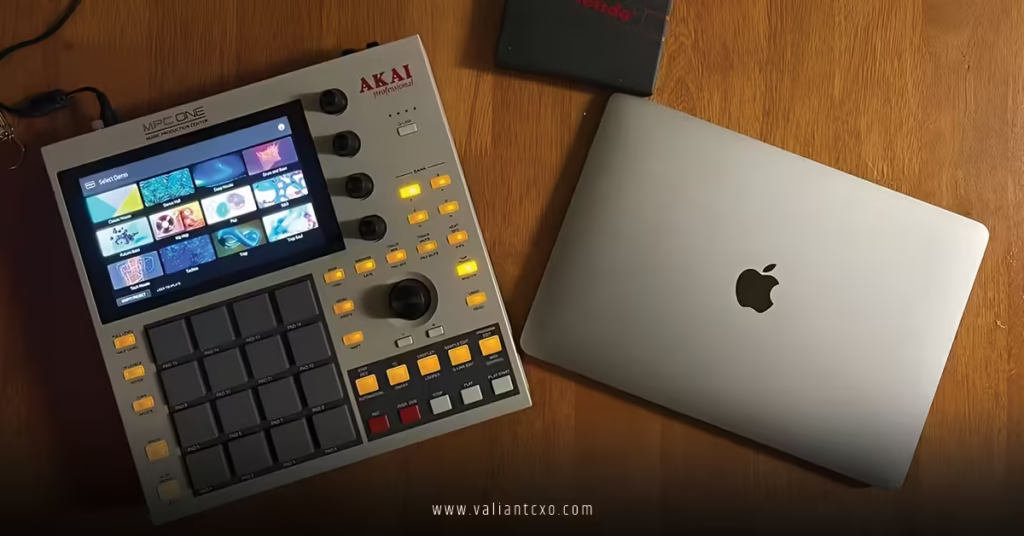
Pulling it out, the vintage gray finish immediately screams “MPC heritage.” The 16 velocity-sensitive RGB pads have that satisfying bouncy feel I remember from older MPCs. The small color screen looks sharp even in daylight, and the built-in speaker and mic are tucked neatly on the top edge. Flip it over and you’ll find microSD slot, USB-C port (for data, audio, and charging), 1/4″ outputs, and a headphone jack. Everything feels solid—no creaky plastic here.
First power-on was instant. Battery came partially charged, and within seconds I was scrolling through the 100+ factory kits. That alone made me grin—this isn’t some toy; it’s a real sampler ready to go.
Design and Build Quality in the Akai MPC Sample 2026 Review
Akai nailed the “portable but pro” balance. It’s smaller than a laptop but bigger than the KO-II, giving you room for comfortable pad playing without feeling cramped.
The pads respond beautifully with excellent velocity sensitivity—soft taps for ghost notes, hard hits for punchy kicks. The screen, while not huge, is bright and clear, making sample trimming and effect tweaking painless even on the move.
Battery life? Akai rates it up to 5 hours, and in my testing (moderate volume, effects on, screen at 70%), I got a solid 4+ hours before needing a top-up. Perfect for park sessions, train rides, or hotel room late-night ideas.
The built-in mic is surprisingly usable for quick field recordings, and the tiny speaker lets you preview ideas without headphones. For serious work, you’ll plug into monitors or headphones, but the convenience factor is huge.
Key Features That Shine in This Akai MPC Sample 2026 Review
This isn’t a stripped-down toy—it’s a full MPC workflow in portable form.
- Classic Sampling Engine — Record via mic, resample internally, or import via USB-C/microSD. Supports WAV, AIFF, MP3, and more.
- 32-Voice Polyphony & 2GB RAM — Plenty of headroom for layering drums and one shots without choking.
- Onboard Sequencer — 4-bar patterns expandable to full songs, with swing, quantize, and that legendary MPC timing feel.
- Effects Powerhouse — Four independent effects processors with 60+ types including granulator, Lo-Fi, beat repeat, half-speed, plus a master compressor. These effects turn basic one shots into ear candy instantly.
- Storage & Expansion — 8GB internal + microSD streaming means you can carry massive libraries of [Akai MPC Sample 2026 portable sampler drum kits and one shots] without worry.
- Connectivity — USB-C audio class compliant (works great with phones and computers), MIDI over USB, and standard audio I/O.
The workflow stays true to vintage MPC: load a program, assign samples to pads, chop breaks, sequence, add effects, bounce if needed. No menu diving hell—just intuitive pad-based music making.
Sound Quality and Factory Content – The Heart of the Akai MPC Sample
The stock sounds are surprisingly good for the price. Over 100 factory kits cover boom-bap, trap, house, lo-fi, and more. The drum one shots hit hard—crisp snares, deep 808s, and characterful percussion with natural velocity layers.
What really stands out? The MPC “swing” and feel. Those pads encourage groove in a way mouse-clicking never does. Chopping a break into one shots is buttery smooth thanks to the responsive trim tools and slice functions.
In my testing, layering multiple one shots with the effects chain produced pro-level results quickly. Throw a bit of Lo-Fi and saturation on a kick and it instantly gets that warm analog vibe. The granulator and beat repeat are fantastic for turning simple hits into evolving textures.
If you’re coming from the full Akai MPC Sample 2026 portable sampler drum kits and one shots discussion, you’ll be happy to know all your custom kits and expansions load perfectly here.
Workflow and Real-World Performance: Who Is This For?
I spent a full week making beats exclusively on the MPC Sample—morning coffee jams, afternoon park sessions, and evening studio tweaks. Here’s what I loved:
- Creativity on the Go — No boot time, no DAW lag. Grab it, power on, and you’re making music in under 10 seconds.
- Beginner-Friendly Yet Deep — New producers can start making beats immediately, while veterans will appreciate the deep sampling and effect options.
- Fun Factor — It’s just enjoyable to play. The pads feel alive, and the instant gratification keeps ideas flowing.
Minor gripes? The screen could be a tad larger for detailed waveform editing, and there’s no touchscreen (you use the encoder and buttons). Also, no built-in WiFi or cloud sync—old-school file transfer only. But these are small trade-offs for the price and portability.
Compared to the Roland SP-404MKII, the MPC Sample wins on classic workflow and pad feel. Against the KO-II, it offers more polyphony, better effects variety, and that unmistakable MPC swing. At $399, it undercuts both in value for many users.
Pros and Cons – Honest Akai MPC Sample 2026 Review
Pros:
- Excellent build quality and portability
- Authentic MPC workflow and feel
- Powerful effects and solid sound
- Great battery life
- Very affordable at $399
- Easy integration with existing MPC drum kits and one shots
Cons:
- Small screen for detailed editing
- No touchscreen
- Limited internal storage without microSD
- Speaker is basic (expected at this size)
Overall rating: 8.7/10. It’s not trying to replace your full MPC Live or studio DAW, but as a sketchpad, travel companion, or dedicated drum machine, it’s fantastic.
Who Should Buy the Akai MPC Sample 2026?
- Bedroom producers who want hardware inspiration without complexity
- Live performers needing a compact sampler for on-stage loops and effects
- Beginners entering the world of hardware beatmaking
- Experienced MPC users wanting a secondary portable unit for idea generation
- Anyone who loves chopping breaks and building Akai MPC Sample 2026 portable sampler drum kits and one shots anywhere
If you already own a full MPC, this makes an amazing companion for mobile work.
Final Verdict in the Akai MPC Sample 2026 Review and Unboxing
After days of hands-on time, I’m genuinely impressed. The Akai MPC Sample 2026 delivers on its promise: classic MPC magic in a truly portable, battery-powered package at an accessible price. It won’t replace high-end workstations, but it might just become your most-used piece of gear because it’s always ready when inspiration strikes.
The unboxing excitement carries through to daily use—this thing is fun, inspiring, and surprisingly powerful. If you’re in the market for a portable sampler that respects the past while embracing modern convenience, put the MPC Sample at the top of your list.
Ready to dive deeper into the sounds? Check out my earlier guide on Akai MPC Sample 2026 portable sampler drum kits and one shots for everything you need to load, chop, and customize your drums on this machine.
Conclusion
The Akai MPC Sample 2026 is a winner. From the satisfying unboxing to the addictive workflow and punchy results, it proves you don’t need to spend a fortune or carry heavy gear to make great beats. Whether you’re just starting or a seasoned producer, this portable sampler brings joy back to music making. Grab one, fire it up, and let the pads do the talking—your next favorite track is waiting.
External Links:
- Akai Professional Official MPC Sample Page
- MusicTech Akai MPC Sample Coverage
- Synth Anatomy MPC Sample Details
FAQs – Akai MPC Sample 2026 Review and Unboxing
1. What’s included in the Akai MPC Sample 2026 box?
You get the unit, USB-C cable, quick-start guide, and basic accessories. No power adapter or case, but everything you need to start sampling right away.
2. How does the battery life perform in real use?
Expect 4–5 hours depending on usage. It’s more than enough for extended sessions on the go, and USB-C charging is fast.
3. Can I use my existing MPC drum kits and one shots on the Akai MPC Sample?
Yes! It fully supports the Akai MPC Sample 2026 portable sampler drum kits and one shots ecosystem, including third-party expansions via microSD.
4. Is the Akai MPC Sample good for beginners?
Absolutely. The intuitive interface and factory content let new users make beats quickly, while the depth keeps them growing for years.
5. How does it compare to the SP-404MKII or KO-II?
It offers a more classic MPC workflow, better polyphony, and strong effects at a competitive price. Many prefer its pad feel and swing over the competition.