Sustainable farming methods for Mars colonies aren’t science fiction anymore—they’re becoming an engineering and agricultural reality. As NASA, SpaceX, and international space agencies edge closer to permanent human settlement on Mars, the question of food production has shifted from “if” to “how.” We’re talking about closed-loop systems, controlled environments, and techniques that’ll make even the most advanced Earth-based farms look primitive.
Here’s the thing: you can’t just ship freeze-dried meals to Mars for 50 years. Resupply missions are expensive, unpredictable, and logistically nightmarish. A self-sustaining colony needs to grow its own food. And that means reimagining agriculture from the ground up—literally, since Martian regolith (soil) is nothing like what we farm in Iowa.
Why Mars Farming Matters Right Now
Let me cut straight to it: a thriving Mars colony without local food production is a colony that fails.
Quick overview of what you need to know:
- Closed-loop hydroponics and aeroponics eliminate the need for water-rich soil and recycle nutrients efficiently
- LED grow lights replace sunlight and use less energy than transporting food from Earth
- Controlled atmosphere chambers allow year-round, weather-independent crop cycles
- Regolith treatment and bioreactors turn Martian soil into growing medium
- Waste recycling systems transform human and plant byproducts back into fertilizer
The math is brutal: launching 1 pound of food from Earth to Mars costs roughly $1 million (depending on mission profile). A single colonist needs about 1 pound of food per day. Do the arithmetic. A 100-person colony needs 36,500 pounds annually. That’s not sustainable—it’s a financial black hole.
So we farm on Mars.
The Core Challenge: Mars Isn’t Earth
Before we talk solutions, let’s be clear about the problem.
Mars has massive environmental constraints. The average temperature hovers around -80°F (-60°C). Atmospheric pressure is less than 1% of Earth’s. Solar radiation pummels the surface because there’s almost no atmospheric protection. The soil lacks organic matter and harbors perchlorates—chemicals that can damage plant tissues.
And here’s the kicker: you can’t just open a window and let the sun in.
That’s where the tech comes in.
Hydroponic and Aeroponic Systems: The Foundation
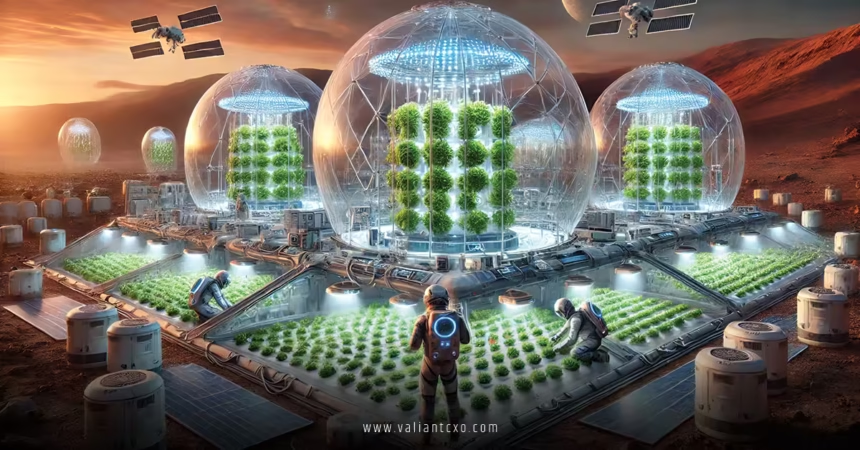
When you’re farming on Mars, soil becomes optional. Hydroponic systems—where plants grow in nutrient-rich water without soil—are the heavy lifter here.
Why hydroponics works for Mars:
- Uses 90% less water than traditional agriculture (critical when every drop matters)
- No dependence on Martian regolith quality (though supplementing with treated regolith is possible)
- Allows precise nutrient control and faster growth cycles
- Takes up minimal space—critical in a pressurized dome
- Recycling systems capture and reuse water, closing the loop
Aeroponics takes it further. Plants are suspended in air and misted with nutrient solution. Roots don’t sit in standing water, so you get faster oxygen exchange, reduced disease risk, and even more efficient water use (95% less than soil farming).
Think of it this way: if hydroponics is a step ahead of soil farming, aeroponics is running. It’s more complex to manage, but for Mars? The efficiency wins are worth it.
What NASA and private contractors are actually testing (as of 2026):
- Modular stackable growing units that maximize vertical space
- Deep Water Culture (DWC) systems for high-yield crops like lettuce and herbs
- NFT (Nutrient Film Technique) channels for root vegetables
- Fogger-based aeroponics for delicate crops
LED Grow Lights: Replacing Martian Sunlight
Mars gets about 43% of the solar radiation Earth receives at noon. Plus, those intense radiation bands? They’re not ideal for photosynthesis in the spectrum plants need.
Enter LED grow lights.
Modern full-spectrum LEDs (around 200–400 watts per square meter) can match or exceed natural sunlight’s effectiveness for plant growth. The energy density is tuned exactly to what plants photosynthesize best—eliminating wasted wavelengths. On Mars, where every watt of power comes from solar panels, nuclear reactors, or radioactive heaters, efficiency is life.
The cost of LED technology has plummeted since 2020. Today, running lights for a 100-square-meter growing area consumes roughly 30–50 kilowatts. That’s manageable if you’ve got a robust power infrastructure (solar arrays + battery storage, or a small reactor).
Here’s a practical rule of thumb: allocate 5–10% of your colony’s total power budget to grow-light operation, and you can feed everyone.
Controlled Atmosphere Chambers: Your Bubble of Life
Let’s be honest: growing food in a Martian greenhouse means building a pressurized chamber. The atmosphere outside is toxic (CO₂ at 95% concentration, trace methane, no oxygen). Your plants need nitrogen, oxygen, and controlled CO₂—Earth’s composition, essentially.
A greenhouse dome pressurized to Earth-normal levels (14.7 psi) needs serious engineering:
- Transparent materials (polycarbonate or regolith-composite covers) that withstand internal pressure and UV
- Airlock systems to prevent decompression when moving supplies in/out
- Humidity and temperature regulation (plants like 65–75°F and 50–70% relative humidity)
- CO₂ recycling from colonist habitats and bioreactors—turning waste into crop fuel
The upside? Inside that pressurized dome, you’re not fighting Martian weather. No dust storms, no radiation peaks. You control every variable. Growth cycles become predictable and rapid.
| Factor | Martian Surface | Pressurized Dome |
|---|---|---|
| Temperature range | -125°F to 70°F (-87°C to 20°C) | 65–75°F (18–24°C) |
| Atmospheric pressure | 0.6 kPa | 101.3 kPa |
| Radiation level | High (300+ mSv/year) | Shielded (regolith or water) |
| Water availability | Frozen subsurface | Recycled system |
| Dust/Contaminants | Perchlorates, abrasive dust | Controlled |
Treating Martian Regolith: Using Local Resources
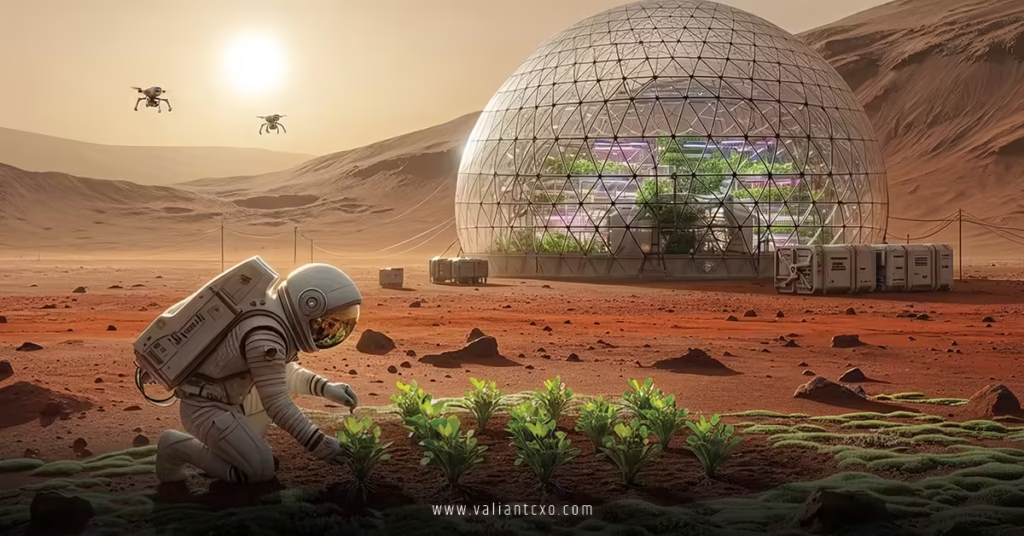
Here’s where sustainable farming gets clever. You want to use Martian resources when possible—reduce launch mass from Earth.
Martian regolith can be amended for growing. The process involves:
- Removing perchlorates (via leaching or chemical extraction)
- Adding organic matter (biosolids from waste recycling)
- Inoculating with microbial communities (bacteria and fungi to establish soil biology)
- pH adjustment (Martian soil is slightly alkaline; many crops prefer neutral)
Researchers at universities and space agencies have run successful trials growing plants in Mars-analog regolith—soil simulants that match Martian composition. Crops like potatoes, radishes, and beans have germinated and grown in these simulated conditions when supported with added nutrients.
The kicker: you’re not trying to replace Earth soil 1:1. You’re creating a hybrid growing medium—50% treated regolith, 50% organic compost from colony waste. It works.
Bioreactors and Waste Recycling: Closing the Loop
A closed-loop system recycles everything. Human waste, plant trimmings, uneaten food scraps—all become feedstock.
Anaerobic digesters break down organic waste, producing methane (usable for energy) and nutrient-rich digestate (fertilizer). Algae bioreactors consume CO₂ and produce oxygen, while also generating protein-rich biomass for animal feed or human consumption (spirulina, anyone?).
Here’s the chain:
- Colonists eat crops → produce waste
- Waste enters digesters → methane harvested for heat/power, digestate recovered
- Digestate becomes fertilizer for next crop cycle
- Plant trimmings feed algae bioreactors → algae produces oxygen and food
- Uneaten plant material returns to compost system
Nothing leaves the system. It’s agriculture as a closed ecosystem—the opposite of how we farm on Earth, where we’re constantly mining soil and exporting waste.
Step-by-Step: How a Colony Sets Up Sustainable Farming
Phase 1: Infrastructure (Months 1–6)
- Construct pressurized dome(s) with airlock access
- Install power systems (solar + battery or reactor)
- Set up water recycling plant with purification and storage tanks
Phase 2: Growing Systems (Months 6–12)
- Assemble hydroponic/aeroponic units and LED fixtures
- Install HVAC and climate control
- Commission bioreactor and waste processing systems
Phase 3: Cultivation (Months 12–18)
- Start with fast-growing, nutrient-dense crops (leafy greens, herbs)
- Transition to staple crops (potatoes, grains, beans) once system stabilizes
- Establish seed bank and propagation protocols
Phase 4: Optimization (Ongoing)
- Monitor crop yields, adjust nutrient formulas, refine regolith amendments
- Scale up production based on colony population growth
- Introduce pollinators (bees or mechanical systems) if fruit/seed crops are priority
Common Mistakes and How to Avoid Them
Mistake 1: Underestimating water loss Fix: Even recycled systems lose water to plant transpiration and evaporation. Plan for 10–15% annual loss. Tap subsurface ice deposits early.
Mistake 2: Ignoring salinity buildup Fix: In closed hydroponic systems, minerals accumulate. Flush the system quarterly and use high-quality water recycling with ion-exchange filters.
Mistake 3: Single-crop focus Fix: Monocultures fail. Pests, diseases, or nutrient depletion tank everything. Grow 5–8 crop types in rotation.
Mistake 4: Underestimating power needs Fix: LEDs, climate control, and water pumps are power-hungry. Plan for 20–30 kW continuous. Factor in redundancy.
Mistake 5: Treating colonists as passive consumers Fix: Get them involved in farming maintenance. Distributed responsibility reduces failure points and builds colony resilience.
What Crops Make Sense for Mars Farming
You won’t be growing watermelons in year one. Start strategic.
High-priority crops:
- Lettuce, spinach, kale (fast, high-yield, minimal resource input)
- Herbs (basil, oregano, cilantro—high value, small footprint)
- Tomatoes (calorie density, morale factor)
- Potatoes (carbs, storage life, high yield)
- Beans and lentils (protein, nitrogen fixation helps soil)
- Microgreens (nutrient-dense, grow in 1–2 weeks)
Secondary crops (as colony grows):
- Wheat and barley (grain production, carbs)
- Peppers (calories, vitamins, psychological variety)
- Fruit-bearing crops (apples, strawberries—require more labor but huge morale boost)
Data from the International Space Station Veggie experiments shows that leafy greens and peppers thrive in microgravity with LED support. Mars’s 38% Earth gravity (and closed-environment control) actually makes farming easier than ISS conditions.
Energy Budget: The Real Constraint
Let’s talk reality. Your entire farming operation runs on power.
Typical energy allocation for 100-person Mars colony:
- LED grow lights: 35–50 kW (if growing ~200 m² of crops)
- Climate control (HVAC): 15–25 kW
- Water recycling/pumping: 5–10 kW
- Bioreactor operation: 3–5 kW
- Total: ~60–90 kW continuous
A solar array on Mars (accounting for dust, seasonal variation) generates roughly 150 watts per square meter on a good day. You’d need 400–600 m² of panels. Add a battery bank for night cycles (Martian day is 24.6 hours) and backup systems, and you’re looking at a serious power infrastructure.
Here’s why nuclear options are attractive: a small 10-kW nuclear reactor could run your entire farm with minimal maintenance. Some agencies are seriously considering it.
Key Takeaways
- Sustainable farming on Mars is hydroponic or aeroponic—soil is optional, water-efficiency is mandatory
- Closed-loop recycling turns waste into fertilizer; nothing leaves the system
- LED grow lights and controlled atmosphere chambers replace Martian sunlight and air
- Treated Martian regolith reduces launch mass and ties the colony to its environment
- Start with leafy greens and herbs, scale to staples (potatoes, beans) as capacity grows
- Power budget is critical—allocate 5–10% of colony power to farming
- Diversity in crops beats monoculture every time
- Colonist involvement in farming reduces system fragility and boosts psychological health
- Early investment in bioreactors and waste systems pays dividends as colony grows
- Backup systems and redundancy aren’t optional—they’re the difference between thriving and starving
Conclusion
Sustainable farming methods for Mars colonies are the foundation of permanent human presence on the Red Planet. We’re not talking about theoretical science—hydroponic systems, LED agriculture, and waste recycling are proven technologies today. The engineering challenge is packaging them into a reliable, scalable system that can feed colonists for decades.
The path forward is clear: start small with high-yield crops in controlled hydroponics, recycle everything through bioreactors, and scale progressively as infrastructure matures. Power management and redundancy are non-negotiable. Early investments in waste systems pay dividends. And most importantly, involve colonists directly—a farm run by the people who eat from it is a farm that survives.
Mars isn’t Earth. Farming there will never look like Iowa. But with the right methods, the Red Planet’s next inhabitants will eat well.
External Sources Referenced:
- NASA Veggie Project on the International Space Station — Documents real-world LED growing systems and crop success in controlled environments
- NASA’s Mars Architecture and Human Exploration Program — Outlines agency strategies for sustainable Mars colonization
- ESA’s Bioregenerative Life Support Systems Research — Details closed-loop recycling and waste management for long-duration space missions
FAQ
1. Can you grow food on Mars without a pressurized dome?
No. Mars’s atmosphere is 95% CO₂, with almost no oxygen and extreme cold. Plants need controlled conditions—pressure, temperature, and light. A pressurized greenhouse is non-negotiable.
2. How much food can one growing chamber produce per person?
A well-optimized 200-m² hydroponic system can supply roughly 50% of daily caloric needs for 100 colonists (roughly 1 kg per person daily). The remaining 50% comes from stored supplies, supplemented as production scales. Full self-sufficiency takes multiple chambers and 2–3 years of optimization.
3. Will Martian soil eventually become fertile like Earth soil?
Not quickly. Earth soil took millions of years to develop biological community. On Mars, you’re creating synthetic soil using regolith + treated waste. It works for farming, but it’s not “natural fertility.” Continuous amendment is required.
4. What happens if the grow-light system fails?
That’s why you need redundancy. Backup LED units, inverters, and a prioritization system (food crops get power first; non-essentials second). A single-point failure in lighting means crop loss in 3–5 days. Design around it.
5. Can you grow food in natural Martian sunlight as production scales?
Possibly, but inefficiently. Mars receives 43% of Earth’s solar radiation. For staple crops needing high energy input, supplemental LED lights are still necessary. Full outdoor farming on Mars isn’t viable without massive genetic modification or multi-year adaptation programs.