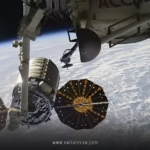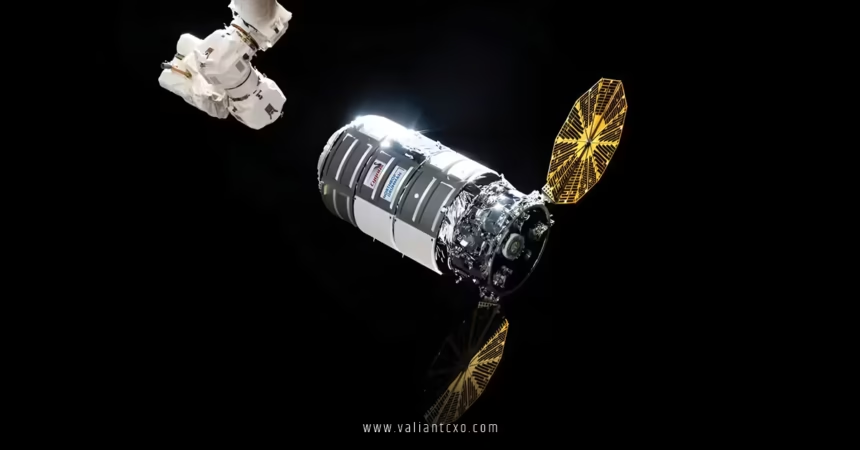
Northrop Grumman CRS-24 Cygnus cargo arrival at ISS April 2026 marked a smooth handover of fresh supplies and cutting-edge science to the orbiting lab.
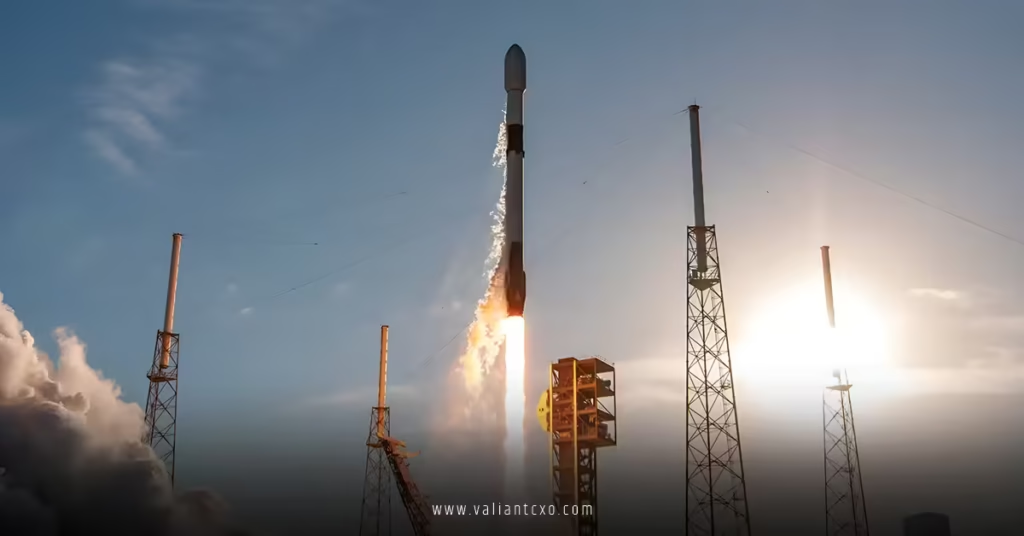
Northrop Grumman CRS-24 Cygnus cargo arrival at ISS April 2026 delivered roughly 11,000 pounds of cargo just two days after launch. The uncrewed Cygnus XL spacecraft, named S.S. Steven R. Nagel, lifted off April 11 on a SpaceX Falcon 9 from Cape Canaveral. Astronauts captured it with the Canadarm2 on April 13 and berthed it to the Unity module’s Earth-facing port.
This resupply keeps the International Space Station running. Crews get food, equipment, and experiments that push quantum tech, stem cell production, and space weather monitoring forward. No drama. Just another reliable link in NASA’s commercial cargo chain.
- What happened: Launch on April 11, 2026, at 7:41 a.m. EDT. Rendezvous and robotic capture on April 13 at about 1:20 p.m. EDT.
- Cargo total: Approximately 11,000 pounds (5,000 kg), including science investigations, crew supplies, and hardware.
- Why it matters: Sustains Expedition 74/75 operations while testing hardware that could improve Earth-based tech like computing and medical therapies.
- Vehicle details: Second flight of the larger Cygnus XL variant, capable of hauling more mass than earlier models.
- Next steps: Crew unloads cargo; Cygnus stays berthed for weeks before eventual disposal.
What Is the Northrop Grumman CRS-24 Cygnus Cargo Arrival at ISS April 2026?
Picture the ISS as a remote research outpost hundreds of miles up. It can’t run on hopes and dreams. It needs regular truckloads of everything from freeze-dried food to lab gear that won’t fit on a crewed flight.
Northrop Grumman CRS-24 Cygnus cargo arrival at ISS April 2026 is exactly that delivery run. Northrop Grumman built the Cygnus spacecraft. SpaceX provided the ride to orbit. NASA coordinated the whole thing under the Commercial Resupply Services contract.
The spacecraft launched Saturday morning. It chased the station for about 48 hours, then parked itself precisely for capture. Astronauts Jack Hathaway and Chris Williams operated the Canadarm2 to grab it. Ground teams later installed it on Unity. Simple in concept. Precision engineering in practice.
Here’s the kicker: This wasn’t just groceries. The payload included a new Science Module-3X for the Cold Atom Lab to advance quantum science, hardware for producing more therapeutic stem cells, model organisms for gut microbiome studies, and a receiver to sharpen space weather predictions. Each item targets real gaps—better computers, improved treatments for blood diseases and cancer, or protecting satellites from solar storms.
Timeline of the Mission
- April 11, 2026: Falcon 9 liftoff from SLC-40, Cape Canaveral Space Force Station. Cygnus XL separates, deploys solar arrays, and begins its trek.
- April 13, 2026: Rendezvous. Capture at roughly 1:20 p.m. EDT. Berthing to Unity module shortly after.
- Following days: Unloading begins. Experiments transfer to station facilities. Crew starts running new investigations.
The whole process from wheels-up to grapple took under 50 hours. That’s fast for orbital ballet.
Why Cygnus XL Stands Out
Northrop Grumman upgraded to the XL version for good reason. It offers about 33% more cargo mass capacity than previous Cygnus models. Volume jumped too—plenty of room for bulky items that smaller vehicles struggle with.
The service module handles propulsion, power, and guidance. The pressurized cargo module, built with European partners, keeps everything safe and accessible. After unloading, Cygnus can even perform a reboost to adjust the station’s orbit if needed. Not every cargo ship pulls double duty like that.
In my experience watching these missions, reliability beats flash every time. Cygnus has quietly delivered over 159,000 pounds across its flights. No headlines when it works. That’s the point.
Cargo Breakdown: Science That Actually Moves the Needle
You don’t send 11,000 pounds just to restock snacks. The real value sits in the experiments.
Key payloads included:
- Cold Atom Lab expansion — New module pushes quantum research. Think ultra-cold atoms that behave in ways impossible on Earth. Potential payoffs? Better sensors, navigation, even dark matter hunts.
- Stem cell production hardware — Aims to grow larger quantities of therapeutic stem cells. Could accelerate treatments for blood disorders and cancers back home.
- Gut microbiome model organisms — Studies how space affects digestion and immunity. Long-duration missions need this data.
- Space weather receiver — Improves models that protect GPS, power grids, and satellites from solar activity.
Crew supplies rounded it out—food, clothes, spare parts, personal items. The station runs like any isolated base. Skip a resupply and things get tight fast.
Comparison of Cygnus Variants
| Feature | Standard/Enhanced Cygnus | Cygnus XL (CRS-24) |
|---|---|---|
| Cargo Mass Capacity | ~3,500–4,000 kg typical | Up to ~5,000+ kg |
| Pressurized Volume | ~18–27 m³ | ~36 m³ |
| Launch Vehicle | Antares or Falcon 9 | Falcon 9 (this mission) |
| Reboost Capability | Limited | Enhanced |
| Flight Heritage | Proven | Second XL flight |
Data drawn from mission overviews and Northrop Grumman descriptions. Exact numbers vary slightly by configuration.
How the Arrival Process Works – Step by Step for Beginners
Watching your first cargo arrival? It feels like slow-motion choreography.
- Launch and Orbit Insertion — Falcon 9 does the heavy lift. Cygnus separates, powers up, and raises its orbit.
- Phasing and Rendezvous — The spacecraft gradually catches up using thrusters. Navigation systems keep it safe—miles become meters.
- Hold Point — Cygnus stops about 12 meters away. Crew and ground teams check systems.
- Capture — Canadarm2 reaches out and grapples a fixture on Cygnus. Takes steady hands and perfect timing.
- Berthing — Arm moves the spacecraft to the port. Bolts secure it. Hatches open later for transfer.
- Unloading — Astronauts move cargo inside. Trash and waste later load back for disposal.
If you’re new to this, treat it like docking a boat in wind. Small corrections matter. One wrong move and you back off for another try.
Action Plan if You Want to Follow Future Missions:
- Check NASA’s live streams on NASA+ or YouTube.
- Track orbital data via public tools like those from NASA or Spot the Station.
- Read mission overviews a week before launch for cargo highlights.
- Set alerts for capture windows—usually daytime passes over ground stations.
Start small. Watch one full rendezvous. You’ll spot the patterns quick.
What Could Go Wrong – Common Mistakes and Fixes
Even smooth missions have taught hard lessons.
- Mistake: Assuming every launch window is guaranteed. Weather or range issues can slip dates. Fix: Build buffer time into your viewing plans. April 11 slipped from earlier targets due to forecasts.
- Mistake: Ignoring safety holds during rendezvous. Close approach is no time for shortcuts. Fix: Teams use multiple hold points and abort options. Redundancy saves the day.
- Mistake: Underestimating berthing time. Capture is dramatic, but full installation takes hours. Fix: Patience. Live coverage often shows the full sequence.
- Mistake: Focusing only on launch. The real science payoff happens weeks later in the lab. Fix: Follow experiment results via NASA’s research pages.
Rule of thumb: Commercial space looks easy when it works. Behind the scenes sit layers of checks most people never see.
Northrop Grumman CRS-24 Cygnus Cargo Arrival at ISS April 2026 in Context
This mission continues a shift that started years ago. NASA moved from owning every rocket to partnering with industry. Northrop Grumman handles Cygnus. SpaceX flies it on Falcon 9. Both deliver where government-only systems once dominated.
The kicker? Costs dropped. Cadence increased. Crew focuses on science instead of logistics. CRS-24 is the latest data point proving the model works.
For the United States, it keeps American leadership in low-Earth orbit strong while international partners contribute experiments and modules.
Learn more about NASA’s Commercial Resupply Services program: NASA Commercial Resupply Services.
Details on the Cygnus spacecraft from the builder: Northrop Grumman Cygnus.
ISS research overview: NASA Space Station Research.
Key Takeaways
- Northrop Grumman CRS-24 Cygnus cargo arrival at ISS April 2026 succeeded on schedule with ~11,000 pounds delivered.
- Cygnus XL brings bigger capacity and reliable performance using Falcon 9.
- Science focus included quantum advancements, stem cells, microbiome, and space weather tools.
- Robotic capture by Canadarm2 remains a highlight of station operations.
- Commercial partnerships keep the ISS supplied efficiently.
- Future missions will build on this steady rhythm.
- Unloading and experiment activation happen over the following weeks.
- The mission honors astronaut Steven R. Nagel through its naming.
Conclusion
Northrop Grumman CRS-24 Cygnus cargo arrival at ISS April 2026 kept the station’s lights on and its labs humming. No fireworks. Just dependable execution that lets astronauts and researchers do what they do best.
If you’re curious about space logistics, start by watching the next live capture. You’ll see engineering at its quiet best. Then dig into one experiment payload. That’s where the future hides—in small packages delivered reliably from Earth.
Punchy truth: Space only feels empty until you watch the trucks keep showing up on time.
External Links
- NASA Press Release on CRS-24 Launch
Anchor text suggestion: NASA’s official release on the Northrop Grumman CRS-24 launch
(Direct source for launch details, cargo overview, and timeline.) - Northrop Grumman NG-24 Mission Page
Anchor text suggestion: Northrop Grumman’s NG-24 mission overview and spacecraft details
(Builder’s perspective, including naming after astronaut Steven R. Nagel and XL capabilities.) - NASA Space Station Blog – Cygnus XL Launch Coverage
Anchor text suggestion: NASA blog post on the Cygnus XL cargo craft launch to resupply the ISS
(Real-time updates, arrival information, and context for Expedition 74 operations.)
FAQ :
1. What exactly was delivered during the Northrop Grumman CRS-24 Cygnus cargo arrival at ISS April 2026?
The mission delivered approximately 11,000 pounds (about 5,000 kg) of cargo, including crew supplies, vehicle hardware, and science investigations. Key payloads featured a new module for the Cold Atom Lab to advance quantum science, hardware for producing therapeutic stem cells, model organisms for gut microbiome research, and tools to improve space weather predictions. This mix keeps the ISS running smoothly while pushing forward technologies that benefit life on Earth.
2. When did the Northrop Grumman CRS-24 Cygnus cargo arrival at ISS April 2026 actually happen?
The Cygnus XL spacecraft launched on April 11, 2026, at 7:41 a.m. EDT atop a SpaceX Falcon 9 from Cape Canaveral. It arrived at the station two days later, with Canadarm2 capture occurring around 1:20 p.m. EDT on April 13. The spacecraft was then berthed to the Unity module’s Earth-facing port for unloading.
3. Why was the Cygnus XL used for the Northrop Grumman CRS-24 mission?
Northrop Grumman’s larger Cygnus XL variant offers significantly more cargo capacity—up to about 33% more mass and roughly 36 cubic meters of pressurized volume compared to earlier models. This was only its second flight, allowing the mission to haul bulkier science hardware and supplies that smaller vehicles struggle to carry, making resupply more efficient.
4. What happens to the Cygnus spacecraft after the Northrop Grumman CRS-24 Cygnus cargo arrival at ISS April 2026?
After astronauts finish unloading the cargo over several weeks, the crew will load the spacecraft with trash and waste from the station. Cygnus will then undock, perform a deorbit burn, and burn up harmlessly during re-entry over the Pacific Ocean. It is designed as an expendable vehicle, so it does not return to Earth.
5. How can I watch future missions similar to the Northrop Grumman CRS-24 Cygnus cargo arrival at ISS April 2026?
NASA provides live coverage of launches and rendezvous/capture events on NASA+, YouTube, and their website. For the April 2026 mission, streams showed the full sequence from launch to Canadarm2 grapple. Check NASA’s mission schedule or the Space Station blog in advance to catch upcoming Commercial Resupply Services flights.