Perseverance Rover Cheyava Falls Potential Biosignature 2026 stands as one of the most tantalizing clues yet in the hunt for ancient life on Mars.
The rover drilled into this intriguing rock back in 2024. By 2025, detailed analysis pointed to possible signs of microbial activity from billions of years ago. Scientists remain cautious—it’s not proof. But the combination of features has the community buzzing.
Here’s the quick rundown:
- What it is: A rock sample called “Sapphire Canyon” from the Cheyava Falls outcrop in Jezero Crater’s ancient river valley.
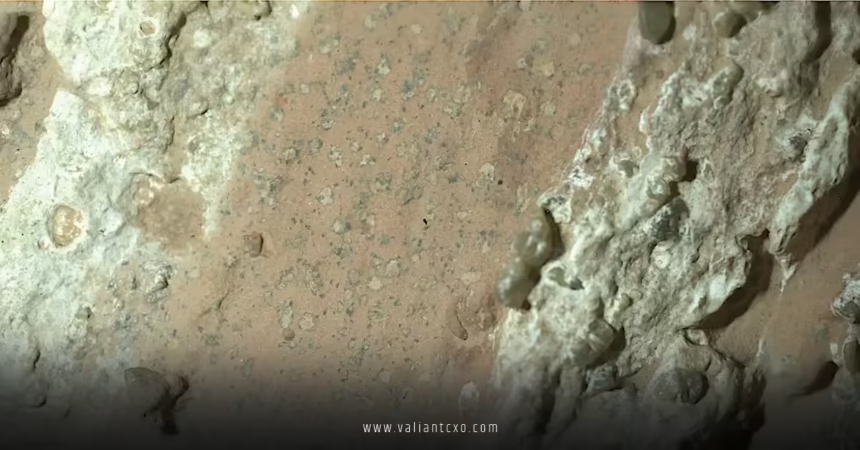
- Key features: Organic molecules plus distinctive “leopard spots” and “poppy seeds” rich in iron minerals that could hint at chemical reactions once fueled by microbes.
- Why it matters: This spot may have held water, energy sources, and carbon—life’s basic recipe—making it a prime target for NASA’s sample return efforts.
- Current status (2026): Strong potential biosignature on the lowest rung of NASA’s CoLD scale. Lab work on Earth is needed for confirmation.
- The kicker: No slam-dunk abiotic explanation fits perfectly so far.
Perseverance rover Cheyava Falls potential biosignature 2026 updates keep rolling in as teams refine the data. This discovery didn’t just add another rock to the collection. It sharpened the focus on whether Mars ever hosted microbial life.
Discovery Background
Perseverance touched down in Jezero Crater in 2021. The site was chosen for its ancient lake and river delta—prime real estate for preserving signs of past habitability.
In July 2024, the rover rolled into Neretva Vallis, an ancient river channel. There it spotted an arrowhead-shaped rock partially buried in sediment. Team members named it Cheyava Falls after a Grand Canyon waterfall.
The rock sat in the Bright Angel formation. Instruments like PIXL and SHERLOC went to work immediately. They revealed white calcium sulfate veins suggesting water once flowed through. Then came the spots.
Perseverance rover Cheyava Falls potential biosignature 2026 chatter exploded when those leopard spots showed up in images—lighter centers with dark rims, alongside tiny dark poppy seeds. On Earth, similar patterns often tie back to microbes mediating chemical reactions.
What Makes This a Potential Biosignature?
The rock contains organic carbon. That’s carbon-based molecules, the building blocks of life. Mix in sulfur, phosphorus, and oxidized iron. Add the specific mineral textures. You get something that looks a lot like what microbes might leave behind.
Leopard spots contain ferrous iron phosphate (like vivianite) and iron sulfide (greigite). These suggest low-temperature redox reactions—basically, chemistry where electrons get swapped. Microbes on Earth love doing exactly that for energy.
Here’s the thing: abiotic processes could mimic this too. Volcanic heat or other non-living chemistry remain on the table. That’s why scientists call it potential.
Perseverance rover Cheyava Falls potential biosignature 2026 analysis published in Nature in September 2025 laid out the evidence clearly. The team stressed the need for returned samples.
| Feature | Description | Possible Life Link | Alternative Explanation |
|---|---|---|---|
| Organic Carbon | Detected by SHERLOC | Building blocks for microbes | Meteorites or abiotic synthesis |
| Leopard Spots | Reaction fronts with Fe-phosphate/sulfide | Microbial redox activity | Chemical diffusion without life |
| Poppy Seeds | Sub-mm nodules | Microbe-mediated mineralization | Mineral precipitation |
| Clay/Silt Matrix | Excellent preservation | Traps biosignatures | Standard sedimentary deposit |
| Water Evidence | Calcium sulfate veins | Habitability requirement | Post-depositional alteration |
This table sums up why experts get excited—and why they pump the brakes.
How Perseverance Collected and Analyzed the Sample
The process was textbook rover ops, but with high stakes.
First, imaging and remote sensing identified the target. Then came the close-up work with the arm-mounted instruments. PIXL mapped chemistry at fine scales. SHERLOC hunted for organics with Raman spectroscopy.
Drilling produced the Sapphire Canyon core—Perseverance’s 25th sample. It now sits sealed in a tube, waiting for a future return mission.
In my experience, this multi-instrument approach catches details a single tool would miss. What usually happens is one dataset raises questions that another answers. Here, the spots aligned perfectly with the organic signals.
Step-by-Step Guide for Beginners: Following Mars Discoveries
Want to track stories like Perseverance rover Cheyava Falls potential biosignature 2026 without getting lost? Try this:
- Start with NASA.gov: Check the latest press releases. They break down complex science into plain terms.
- Look at raw images: The Mars rover raw image site lets you see what the team sees.
- Read the papers: Don’t fear Nature or Science. Skim abstracts first.
- Follow key accounts: NASA Perseverance on social media drops visuals fast.
- Cross-check with experts: Sites like The Planetary Society explain context without hype.
- Ask the big question: Does this fit with other Jezero findings?
Do this consistently and you’ll spot patterns across missions.
Common Mistakes & How to Fix Them
Newcomers often treat every “possible sign” as confirmed life. Fix: Remember the CoLD scale. Cheyava Falls sits at Step 1—possible signal only.
Another trap? Ignoring abiotic alternatives. Fix: Always ask what non-biological process could produce the same result. Scientists do this rigorously.
Over-relying on one instrument’s data trips people up too. Fix: Wait for the full dataset and peer review. The 2025 Nature paper took months of scrutiny.
Finally, expecting quick answers. Mars science moves deliberately. Fix: Enjoy the journey. Each sample adds pieces to a massive puzzle.
Deeper Implications for Mars Exploration
Perseverance rover Cheyava Falls potential biosignature 2026 raises the stakes for sample return. Bringing rocks home lets Earth labs use techniques too heavy for a rover. Think advanced mass spectrometry and isotope analysis.
It also spotlights Jezero Crater’s history. This area had sustained water, energy gradients, and organics. That’s more than many sites offer.
Picture a Martian shoreline billions of years ago, with chemistry fizzing like a battery. Microbes—if they existed—might have tapped that power. Like finding an old campfire ring in the desert: it doesn’t prove people roasted marshmallows last week, but it sure suggests they might have.
What if this pans out? It would rewrite our understanding of life in the solar system. Even a negative result teaches us volumes about Mars’ evolution.
Key Takeaways
- Perseverance rover Cheyava Falls potential biosignature 2026 centers on the Sapphire Canyon sample with compelling mineral and organic features.
- Leopard spots and poppy seeds suggest possible microbial chemistry but aren’t definitive.
- The find combines water evidence, organics, and energy sources in one location.
- Sample return to Earth remains essential for confirmation.
- This represents the strongest hint yet, yet science demands caution.
- Jezero Crater continues delivering high-value targets for astrobiology.
- Public interest drives funding—stay engaged with real sources.
- Discoveries like this build step by step toward answering humanity’s biggest questions.
Perseverance rover Cheyava Falls potential biosignature 2026 reminds us why we explore. It pushes boundaries and sparks imagination while grounding us in hard data.
Next step? Follow NASA’s Mars Sample Return updates. The rocks Perseverance collected could hold answers for generations. Dive into the imagery yourself and form your own questions. The Red Planet still has stories to tell.
FAQs
What exactly is the Perseverance rover Cheyava Falls potential biosignature 2026?
It refers to mineral textures and organic compounds in the Sapphire Canyon sample that could indicate ancient microbial processes, announced after detailed 2025 analysis.
Has the Perseverance rover Cheyava Falls potential biosignature been confirmed as life?
No. It remains a potential biosignature requiring Earth-based laboratory study. Abiotic explanations are still possible.
When might we know more about the Perseverance rover Cheyava Falls potential biosignature 2026?
Sample return missions could deliver material for analysis in the 2030s, depending on funding and technical progress.