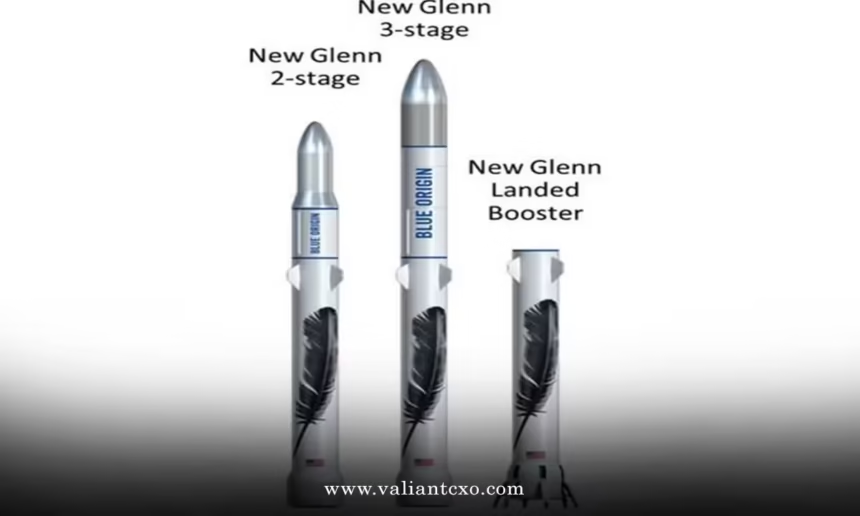
New Glenn rocket specifications have become a hot topic as Blue Origin pushes deeper into the high-stakes orbital launch market. If you want to understand how serious this vehicle really is, you need more than marketing slides—you need numbers, architecture, and context.
You’ll also see why more people discovered New Glenn while reading about the Blue Origin New Glenn rocket explosion Cape Canaveral May 2026, and then stuck around to study the hardware behind the headlines.
Quick Overview: New Glenn at a Glance
For fast scanning, here’s the TL;DR on New Glenn rocket specifications:
- Two-stage (with optional third stage), reusable heavy-lift rocket designed for orbital missions.
- First stage powered by seven methane-fueled BE-4 engines; second stage uses vacuum-optimized engines.
- Large payload fairing targeting big GEO satellites, deep-space missions, and constellations.
- Booster designed to land downrange on a ship for reuse, similar in concept to other reusable launchers.
- Competes directly in the commercial and government launch market as a high-capacity U.S. launcher.
What Is New Glenn?
New Glenn is Blue Origin’s first orbital-class rocket, named after astronaut John Glenn. It’s designed to:
- Carry heavy payloads to low Earth orbit (LEO), geostationary transfer orbit (GTO), and beyond.
- Reuse its first stage to cut per-launch costs over time.
- Serve commercial satellite operators, government missions, and potentially future human missions.
Think of New Glenn as Blue Origin’s flagship: the vehicle that moves it from suborbital tourist hops to serious orbital logistics.
Core New Glenn Rocket Specifications
Let’s break the rocket down into its major components and capabilities.
Overall Vehicle Design
New Glenn is a two-stage rocket, with a potential optional third stage for specific mission profiles.
Key design themes:
- Methane/LOX propulsion via BE-4 engines.
- Reusable first stage, expendable second stage.
- High-capacity fairing to support large satellites and multiple-payload missions.
First Stage Specifications
The first stage is the workhorse and the reusable part of the system.
- Engines: 7 × BE-4 engines
- Propellant: Liquefied natural gas (methane) and liquid oxygen
- Role: Provide initial thrust to escape Earth’s gravity well and then return for recovery
- Recovery method: Downrange landing on an ocean-going ship (drone ship–style concept)
In practical terms, this stage is where most of the performance—and most of the risk—lives. Failures like the Blue Origin New Glenn rocket explosion Cape Canaveral May 2026 tend to involve first-stage propulsion or structural systems, which is why they get scrutinized so heavily in post-flight investigations.
Second Stage Specifications
The second stage handles orbital insertion and mission-specific maneuvers.
- Engine type: Vacuum-optimized upper-stage engine(s), derived from Blue Origin’s methane engine family
- Propellant: Methane/LOX, consistent with the first stage
- Role: Circularize orbit, perform GTO burns, and set up complex mission profiles
A strong, efficient upper stage is what turns a big booster into a truly flexible orbital transport system.
Fairing and Payload Volume
One of New Glenn’s stand-out features is its large payload fairing.
Why this matters:
- Bigger fairings allow larger satellites and multiple rideshare payloads.
- Certain commercial and government missions prefer spacious fairings for complex, delicate hardware.
- Future in-space infrastructure (think station modules or large platforms) benefits from this extra volume.
New Glenn Rocket Specifications: Quick Reference Table
Here’s a scannable summary of the major New Glenn rocket specifications. Values are generalized and conceptual, based on public technical positioning and design intent.
| Component / Aspect | New Glenn Rocket Specifications (High-Level) |
|---|---|
| Rocket Type | Two-stage, orbital-class, heavy-lift rocket with reusable first stage |
| Primary Propellant | Methane (LNG) and liquid oxygen (LOX) |
| First Stage Engines | 7 × BE-4 engines (methane/LOX) |
| Second Stage Engine | Vacuum-optimized methane/LOX engine(s) for orbital insertion |
| Reusability | First stage booster designed to land and be reused; upper stage is expendable |
| Payload Fairing | Large-diameter fairing to support heavy satellites and multiple payloads |
| Launch Site | Cape Canaveral, Florida (with operations tied to U.S. spaceport infrastructure) |
| Mission Types | LEO, GTO, deep-space missions, potential future human-rated missions |
Engine Technology: BE-4 at the Heart of New Glenn
The BE-4 engine family is central to New Glenn rocket specifications and performance.
BE-4 Engine Highlights
- Propellant: Methane and liquid oxygen
- Cycle: Oxidizer-rich staged combustion architecture
- Design goals: High thrust, efficiency, and reusability
Methane engines are appealing because they:
- Can be cleaner-burning than traditional kerosene engines.
- Help with reusability by reducing coking and residue.
- Are being explored by multiple providers as a next-generation standard.
From a risk standpoint, early BE-4 operations are where many engineers keep their eyes. Any anomaly here can cascade into events like the Blue Origin New Glenn rocket explosion Cape Canaveral May 2026, which is why engine test campaigns are so thorough and why post-flight analyses obsess over performance data.
Reusability: How New Glenn Plans to Fly Again and Again
Reusability isn’t just a buzzword; it’s a design philosophy baked into New Glenn rocket specifications.
Booster Recovery Concept
The first stage is engineered to:
- Complete its primary ascent burn.
- Separate from the second stage.
- Execute a series of controlled maneuvers and burns.
- Land vertically on a drone-ship-style platform in the ocean.
That recovery loop is intended to:
- Spread development and manufacturing costs across many flights.
- Lower per-mission launch prices over time.
- Allow faster launch cadence once refurbishment is streamlined.
In practice, every recovery attempt delivers data—on thermal loads, structural fatigue, and guidance software—that feeds right back into how New Glenn evolves.

How New Glenn Compares Conceptually to Other Heavy-Lift Rockets
Without turning this into a scorecard, New Glenn sits in the same competitive zone as other high-capacity launchers that emphasize:
- Large payload mass to LEO and GTO.
- Reusable first stages.
- Support for commercial, civil, and national security missions.
The key differentiators often come from:
- Engine type (methane vs. kerosene vs. hydrogen).
- Number of engines and failure-tolerance design.
- Reuse logistics—how fast the booster can get back in the rotation.
New Glenn’s methane-based architecture and big fairing give it a distinct profile in that crowd.
Why New Glenn Rocket Specifications Matter After a Failure
When a major incident like the Blue Origin New Glenn rocket explosion Cape Canaveral May 2026 hits the news, everyone starts asking the same question:
“Is this rocket actually safe and capable, or was it overhyped?”
The specs help answer that—if you know what to look for.
Design vs. Operational Reality
On paper, New Glenn rocket specifications show a modern, competitive heavy-lift system. But:
- Real-world performance is about execution: engines, structures, software, and operations working together.
- A failure event tests whether design margins and quality controls match the ambition.
In my experience, the most useful way to think about it is this: specifications are the blueprint; actual flights, including the rough ones, are the stress test of that blueprint.
How to Use New Glenn Rocket Specifications as a Beginner or Intermediate Enthusiast
If you’re just getting into orbital launch hardware, specs can feel like alphabet soup. Here’s a practical way to make them actually useful.
Step 1: Understand the Big Three
Focus on:
- Propulsion – What fuel and engine type are used?
- Stages – How many, and what does each stage do?
- Reusability – Which parts come back and how?
Once you have those three, you can roughly place any rocket—including New Glenn—in the ecosystem.
Step 2: Connect Specs to Mission Types
Ask yourself:
- Are these specs optimized for heavy telecom satellites?
- Do they seem tuned for rapid-launch constellations?
- Is there a path to human-rating in the long term?
New Glenn rocket specifications clearly aim at heavy commercial loads and strategic missions, with a likely path toward more complex roles over time.
Step 3: Watch How Specs Evolve Post-Failure
Failures, like the Blue Origin New Glenn rocket explosion Cape Canaveral May 2026, often drive updates to:
- Engine operating envelopes and margins.
- Structural reinforcements.
- Software and guidance logic.
- Safety and range integration.
If you see New Glenn’s specs subtly shift over time, you’re watching the design mature in direct response to real flight data.
Common Misconceptions About New Glenn Rocket Specifications
Let’s clear up a few recurring myths.
“Big fairing = always better”
A large fairing is powerful, but not always necessary.
Reality:
- Smaller satellites don’t need massive fairings; they care more about schedule and cost.
- Huge fairings shine for big birds, multi-payload stacks, and complex hardware.
- New Glenn’s fairing is a strategic asset, not an automatic win.
“Methane is just a trendy fuel”
Methane isn’t a gimmick.
It offers:
- Cleaner combustion compared to kerosene, aiding reusability.
- Attractive performance characteristics for staged combustion engines.
- Synergy with broader industry trends moving toward methane-based boosters.
New Glenn rocket specifications reflect that long-term bet.
“One explosion means the specs are flawed”
Not automatically.
Most launch systems in history suffered significant failures early on. The key questions are:
- Were the specifications fundamentally unrealistic, or was there a specific implementation flaw?
- Did the investigation lead to clear, credible design changes?
- Does performance improve on subsequent flights?
Specs are living documents in rocketry, constantly tuned by the harsh feedback of physics.
Key Takeaways on New Glenn Rocket Specifications
- New Glenn rocket specifications describe a two-stage, methane-fueled, heavy-lift system with a reusable first stage and a large payload fairing aimed at big commercial and government missions.
- The rocket’s first stage uses seven BE-4 engines and is designed to land on a drone-ship-style platform for reuse, putting it squarely in the modern reusable-launch family.
- A powerful, vacuum-optimized second stage and spacious fairing allow New Glenn to handle complex, high-mass payloads across LEO, GTO, and deeper space trajectories.
- Events like the Blue Origin New Glenn rocket explosion Cape Canaveral May 2026 don’t erase New Glenn’s technical strengths but do pressure-test how solid those specifications are in real operations.
- For beginners and intermediate enthusiasts, focusing on propulsion, staging, and reusability is the fastest way to understand where New Glenn fits in the global launch market.
- Over time, watching how New Glenn’s specs evolve in response to test flights and investigations will reveal whether the rocket becomes a reliable mainstay or stays stuck in development turbulence.
New Glenn isn’t just a brochure of numbers—it’s a live, high-energy experiment in turning cutting-edge specifications into routine access to orbit. The specs are the promise; the flights will decide how much of that promise gets delivered.
FAQ :
1. What makes New Glenn’s rocket specifications different from other heavy-lift rockets?
New Glenn stands out with its methane-fueled BE-4 engines, reusable first stage, and an unusually large payload fairing designed for big commercial and government payloads. Together, these specs position it as a flexible, high-capacity launcher in the modern reusable rocket segment.
2. How did the Blue Origin New Glenn rocket explosion Cape Canaveral May 2026 impact New Glenn’s specifications?
The Blue Origin New Glenn rocket explosion Cape Canaveral May 2026 did not change the core architecture on paper but pushed engineers and regulators to scrutinize engine performance, structural margins, and safety systems. Any lessons from that failure are likely to refine operating limits, materials choices, and process controls tied to the existing specifications.
3. Are New Glenn’s specifications designed with future human missions in mind?
New Glenn rocket specifications emphasize high lift capacity, reusability, and robust upper-stage performance, all of which are compatible with future human-rated applications. While not all human-rating features are public or implemented yet, the design envelope and infrastructure clearly keep potential crewed missions on the table.