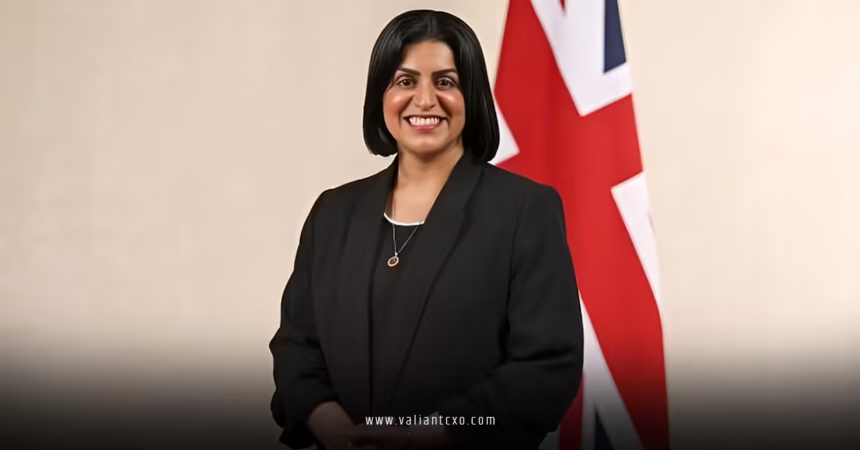
Shabana Mahmood first Muslim Home Secretary UK made headlines worldwide in September 2025. She stepped into one of the toughest jobs in British government: leading the Home Office on immigration, policing, national security, and more.
This wasn’t just another cabinet shuffle. It marked a genuine first for a Muslim woman in a top “great office of state.” For many in the US watching UK politics, it raises questions about diversity, tough policy choices, and how a daughter of immigrants handles one of the most pressurized roles in Westminster.
- Who she is: Labour MP for Birmingham Ladywood since 2010, barrister, and now the first Muslim woman Home Secretary.
- Why it matters: Her rise highlights shifting representation while she pushes hardline reforms on asylum and borders.
- Key challenges ahead: Small boat crossings, prison overcrowding fallout, and balancing security with fairness.
- Impact on policy: Focus on control, faster removals, and temporary protections for refugees.
- Broader significance: A test case for integration and pragmatic governance in diverse societies.
Her Path to Power
Born in Birmingham in 1980 to Pakistani-origin parents from Mirpur, Azad Kashmir, Mahmood’s story starts in working-class roots. She spent early years in Saudi Arabia where her father worked as a civil engineer, then returned to Birmingham. Her mother ran a corner shop. That shopkeeper grit? It shows in her no-nonsense style.
She attended local schools, aced her way to Oxford for law at Lincoln College, and built a career as a barrister. Elected in 2010, she became one of the first female Muslim MPs alongside Rushanara Ali and Yasmin Qureshi. Shadow roles followed. She steered clear of Jeremy Corbyn’s leadership, focusing instead on party infrastructure and campaigns.
By 2024, Keir Starmer made her Lord Chancellor and Justice Secretary—the first Muslim in that historic role too. Then came the September 2025 reshuffle. Yvette Cooper moved on, and Mahmood took the Home Office reins.
What Does the Home Secretary Actually Do?
The Home Office handles the sharp end of governance. Think borders, counter-terrorism, policing strategy, and citizenship. It’s a beast of a department, often called the “department of disasters” for good reason. Failures here make front pages fast.
Mahmood inherited a full inbox: record asylum backlogs, small boat arrivals in the Channel, and public frustration over integration. In my experience covering these shifts, the person in this seat gets judged on results, not rhetoric. What usually happens is early wins on visible enforcement, followed by deeper structural fights.
Here’s a quick comparison table of her role versus predecessors:
| Aspect | Traditional Focus | Mahmood’s Early Emphasis | Potential Outcomes |
|---|---|---|---|
| Immigration | Processing claims | Temporary refugee status, faster removals | Reduced backlogs, stricter returns |
| Policing | Resource allocation | Community trust + enforcement | Lower crime stats or protests |
| National Security | Threat monitoring | Counter-extremism balance | Public confidence metrics |
| Asylum Reform | Humanitarian routes | “One in, one out” deals, earned settlement | Manageable net migration |
Shabana Mahmood First Muslim Home Secretary UK: Breaking Barriers and Facing Scrutiny
Her appointment hit like a thunderclap. Supporters saw it as proof Britain rewards talent regardless of background. Critics—some vocal on social media—questioned everything from her faith to policy consistency. The kicker is, Mahmood doesn’t dodge her identity. She speaks openly as a child of legal immigrants who “played by the rules.”
Has representation changed outcomes? Too soon to say definitively. But her track record shows steel. As Justice Secretary, she pushed prisoner early releases to avert overcrowding “time bomb.” Now at the Home Office, she’s doubling down on asylum overhaul—moving from permanent to temporary protections, extending settlement timelines, and tightening support rules.

Step-by-Step: How Beginners Can Follow UK Political Shifts Like This
Want to track developments without getting lost in the noise? Here’s what I’d do if explaining it to a US colleague new to Westminster:
- Start with official sources: Check gov.uk for speeches and appointments. Straight facts, no spin.
- Read Hansard transcripts: Parliament’s record of debates shows exactly what she says under pressure.
- Cross-reference news: BBC, Guardian, and Times for balance. Look for primary quotes.
- Follow metrics: Home Office quarterly stats on arrivals, removals, and grants. Numbers don’t lie.
- Engage communities: Birmingham Ladywood’s diverse makeup offers real-world feedback loops.
- Watch for legislation: Bills on borders or human rights tweaks will define her tenure.
Stick to verifiable data. Speculation fills voids fast, especially on hot-button issues like migration.
Common Mistakes & How to Fix Them
New observers often trip up here.
- Mistake 1: Assuming faith dictates policy. Fix: Look at her actions—tough on illegal crossings and extremism—over assumptions.
- Mistake 2: Treating the role as symbolic only. Fix: The Home Office demands delivery. Early prisoner schemes and asylum pilots prove she’s hands-on.
- Mistake 3: Echoing unverified social media outrage. Fix: Verify with UK Parliament records or official releases.
- Mistake 4: Ignoring context of Labour’s overall agenda. Fix: Connect her moves to Starmer’s “control and compassion” framing.
Shabana Mahmood First Muslim Home Secretary UK in the Spotlight
She’s faced questions on past votes related to Gaza and community ties. Yet she calls out Islamist extremism directly. That balance? It’s the tightrope every senior figure walks in multicultural Britain. Like a skilled tightrope artist over choppy waters, she aims for steady progress without dramatic falls.
Rhetorical question: Can one person’s background both open doors and invite extra scrutiny? Absolutely. Does it define competence? History says results do.
Her push for “earned settlement” and high-skilled focus aligns with broader Western trends. Net migration pressures affect housing, services, and politics on both sides of the Atlantic. US readers see parallels with debates over border security and legal pathways.
Key Takeaways
- Shabana Mahmood’s September 2025 appointment broke new ground as the first Muslim woman Home Secretary.
- Her background combines legal expertise, local roots, and pragmatic politics.
- Early priorities center on asylum reform, temporary protections, and border control.
- Challenges include delivery under intense public and media gaze.
- Representation advances don’t automatically solve systemic issues—execution matters.
- Her immigrant-family story adds authenticity to “legal migration good, illegal bad” messaging.
- Watch for measurable drops in small boat arrivals and processing times.
- This role tests whether diverse leadership delivers tangible security and fairness.
Shabana Mahmood first Muslim Home Secretary UK isn’t just a milestone. It’s a pressure test for modern governance. For Americans eyeing transatlantic trends, her tenure offers lessons on managing diversity alongside strict rule of law.
Next step? Dive into the latest Home Office statistics yourself. Stay informed—policies here ripple outward.
FAQs
What makes Shabana Mahmood first Muslim Home Secretary UK historic?
She is the first Muslim woman to hold this position, overseeing critical areas like immigration and security after serving as Lord Chancellor. Her 2025 appointment underscores evolving representation in UK politics.
How has Shabana Mahmood approached immigration as Home Secretary?
She’s introduced sweeping asylum changes, including temporary refugee status and longer paths to settlement, while emphasizing legal routes and removals for those who don’t qualify.
Will Shabana Mahmood first Muslim Home Secretary UK influence US-UK relations?
Possibly, through aligned security cooperation and shared migration challenges. Her pragmatic stance could strengthen bilateral efforts on counter-terrorism and border issues.