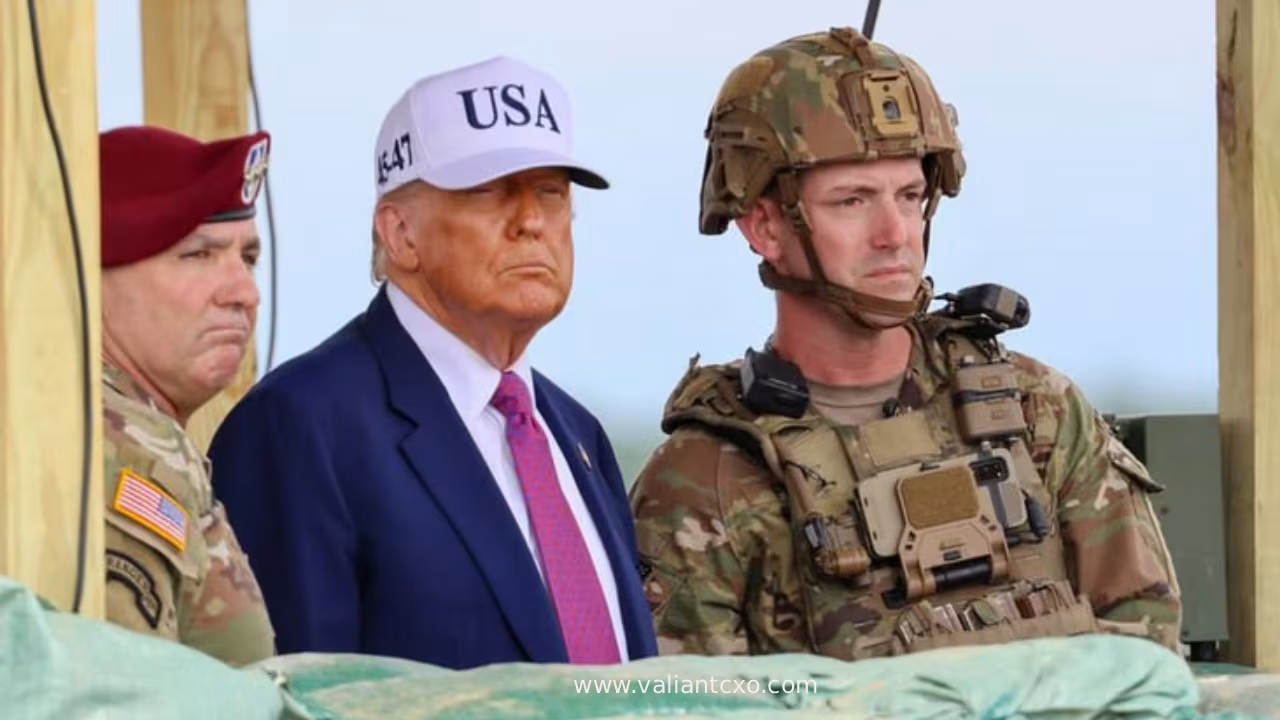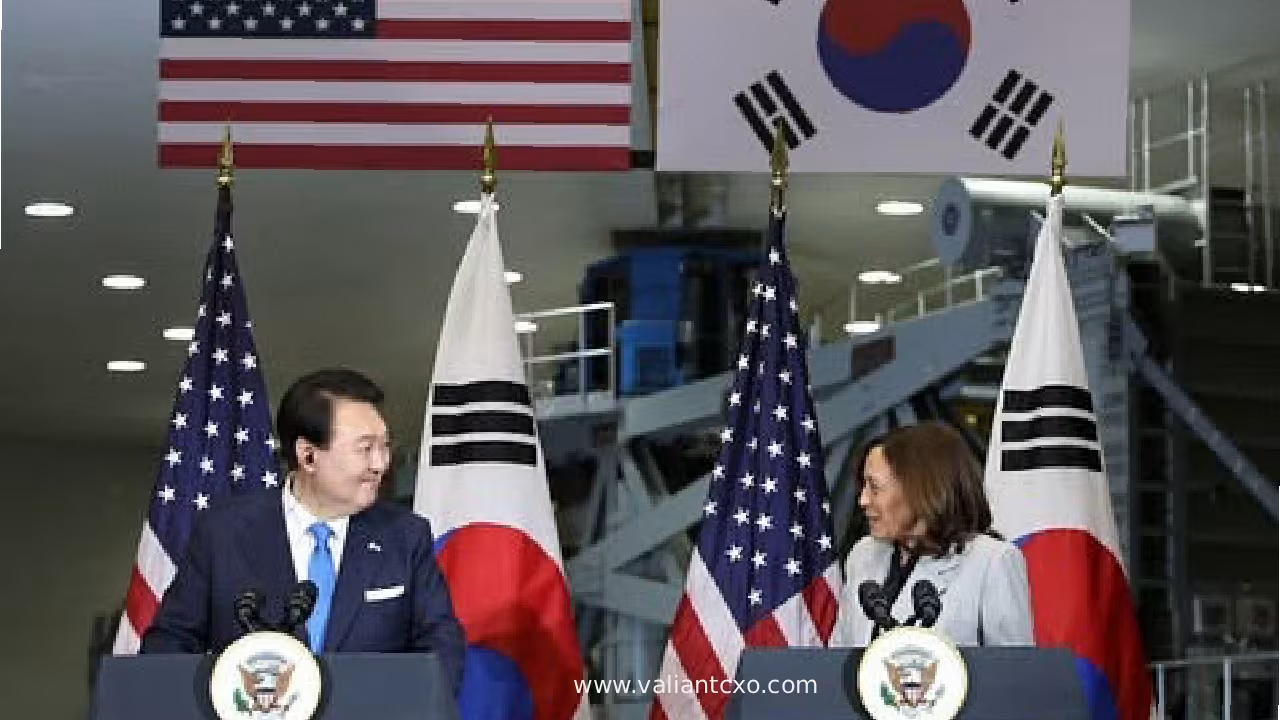
US North Korea relations 2026 are messier than most headlines let on — part diplomatic flirtation, part military stand-off, and part Trump doing what Trump does best: mixing personal chemistry with policy on the fly. One week he’s praising Kim Jong Un as “unthreatening and respectful.” The next, the Pentagon is still running military drills a stone’s throw from the DMZ.
Here’s the fast version before we dig in:
- Trump says Kim Jong Un has “responded” to his outreach for renewed talks, though no summit date exists yet.
- Washington and Pyongyang haven’t held direct high-level talks since diplomacy collapsed in 2019.
- North Korea has deepened its military alliance with Russia, sending troops and weapons to support the war in Ukraine.
- Trump’s decision to reduce joint drills with South Korea (see our full breakdown of Trump orders reduction of US South Korea joint drills) is reshaping alliance dynamics in real time.
- Analysts are split on whether a second Trump-Kim summit is realistic or just headline management.
The Short Backstory Nobody Explains Well
US North Korea Relations 2026 Trump and Kim actually met three times during Trump’s first term — Singapore in 2018, Hanoi in 2019, and a brief DMZ handshake later that year. Denuclearization talks fell apart in Hanoi when neither side would budge on sanctions relief versus nuclear concessions.
Since then? Radio silence, mostly. North Korea kept building its arsenal. It didn’t stop. It also cozied up hard with Moscow, signing a mutual defense pact and sending troops to fight in Ukraine.
That’s the backdrop for everything happening in 2026. Trump wants a redo. Kim’s negotiating position has changed dramatically since 2019 — and not in America’s favor.
What’s Actually New in US North Korea Relations 2026
Here’s the thing that makes this cycle different from Trump’s first-term overtures: Kim doesn’t need this relationship the way he once did.
In 2019, North Korea was isolated and sanctions-strapped. In 2026, Kim has Russian oil, Russian technology transfers, and a seat at the table with Moscow that gives him leverage he never had before. He’s negotiating from a position of relative strength, not desperation.
Trump, meanwhile, ordered the Pentagon to scale back joint exercises with South Korea, framing the move as a goodwill gesture toward Pyongyang. In my experience watching alliance politics, gestures like that only work if the other side reciprocates — and so far, North Korea’s response has been muted at best.
US North Korea Relations 2026 North Korea’s foreign ministry actually called this year’s Ulchi Freedom Shield exercise “a rehearsal for an aggressive war” just days before Trump’s announcement. That’s not exactly the tone of a regime racing toward a handshake.
Trump’s Personal Diplomacy vs. Institutional Reality
Trump told reporters in the Oval Office that Kim had responded to his request for a conversation, calling the exchange “very positive.” He offered zero specifics. North Korea offered zero confirmation.
That gap between presidential rhetoric and diplomatic substance is the defining feature of US North Korea relations 2026. Trump talks in terms of chemistry — “I understand him, he understands me.” State Department and Pentagon officials talk in terms of nuclear stockpiles, missile tests, and alliance commitments.
Both things can be true at once. Trump can genuinely want a summit while North Korea quietly keeps expanding its weapons program. That’s not contradiction — that’s just how this regime has operated for three decades.
Why the South Korea Drill Reduction Matters Here
You can’t talk about North Korea policy in 2026 without talking about South Korea, because Trump explicitly linked the two.
He ordered Defense Secretary Pete Hegseth to “substantially reduce” the Ulchi Freedom Shield exercises, arguing they were costly and sent a hostile signal to Kim. It’s a near-replay of 2018, when Trump suspended major exercises after his first Singapore summit — except this time, no summit has actually happened yet.
That’s the part that should raise eyebrows. Trump gave up leverage before securing anything in return. Whether that’s a savvy opening bid or a unilateral concession depends entirely on what happens next — and right now, nobody outside the Oval Office actually knows.
Comparing the Two Trump-Kim Diplomacy Eras
| Factor | 2018-2019 Diplomacy | 2026 Diplomacy |
|---|---|---|
| North Korea’s leverage | Weaker — heavily sanctioned, isolated | Stronger — backed by Russia, deeper military tech access |
| Military exercises | Suspended after Singapore summit | Reduced before any confirmed summit |
| Direct talks | Three in-person meetings held | No confirmed meeting yet, informal contact claimed |
| South Korea’s role | Active broker of talks | Coordinating with US but not driving diplomacy |
| Russia factor | Minimal involvement | Mutual defense treaty, troop deployments to Ukraine |
Step-by-Step: How to Track US North Korea Relations 2026 Without Getting Lost
If you’re new to this beat, here’s a simple system to follow the story without drowning in noise.
- Separate Trump’s statements from confirmed diplomatic events. A Truth Social post is not a summit announcement.
- Watch North Korean state media reactions. Pyongyang’s official responses (or silence) tell you more than Washington’s framing does.
- Track the South Korea drill story alongside it. Understanding Trump orders reduction of US South Korea joint drills gives you the military context behind the diplomatic push.
- Check for third-party mediators. South Korea, and occasionally China, often shape whether talks actually move forward.
- Follow the Russia angle closely. North Korea’s relationship with Moscow directly affects how much it needs a deal with Washington.
- Note sanctions activity. Any easing or tightening of sanctions is a much stronger signal than rhetoric.
Common Mistakes & How to Fix Them
Mistake #1: Assuming a Trump-Kim summit is imminent.
Trump has hinted at renewed talks before without follow-through. Fix: wait for an official White House or North Korean state announcement, not just Oval Office remarks.
Mistake #2: Overlooking Russia’s role in North Korea’s calculus.
Kim’s alliance with Moscow fundamentally changes his negotiating position compared to 2019. Fix: read North Korea policy stories alongside Ukraine war coverage — they’re now linked.
Mistake #3: Treating the South Korea drill reduction as unrelated news.
It’s not a separate story. Trump orders reduction of US South Korea joint drills specifically as part of his outreach to Pyongyang. Fix: read both stories together for the full picture.
Mistake #4: Assuming North Korea wants denuclearization talks the same way it did in 2019.
Kim has shown little appetite for giving up his arsenal, and his position has only strengthened since then. Fix: focus coverage on de-escalation and dialogue framing, not denuclearization promises.
Key Takeaways
- US North Korea relations 2026 are defined by informal outreach from Trump, not confirmed high-level talks.
- Kim Jong Un’s leverage has grown significantly since 2019, thanks largely to his alliance with Russia.
- Trump orders reduction of US South Korea joint drills as part of his broader effort to restart dialogue with Pyongyang.
- North Korea’s public rhetoric toward the drills remained hostile even as Trump pushed a friendlier tone.
- No confirmed summit date exists as of August 2026, despite Trump’s claims of “positive” contact with Kim.
- South Korea continues coordinating with Washington but isn’t driving this diplomatic push.
- Analysts remain split on whether renewed diplomacy is a genuine opening or a distraction from other political pressures.
So is a second Trump-Kim summit actually coming, or is this just another headline cycle that fizzles out? Nobody can say for certain yet — and that uncertainty is exactly the point. US North Korea relations 2026 sit at an odd intersection of genuine diplomatic curiosity and old, unresolved tension that never actually went away. Keep an eye on North Korea’s own statements, not just Washington’s, because that’s where the real signal lives. If you want the fuller military context driving this moment, our breakdown of Trump orders reduction of US South Korea joint drills lays out exactly how the alliance side of this story is shifting.
For ongoing analysis of North Korea’s weapons program and negotiating posture, the Council on Foreign Relations’ tracker on North Korea’s nuclear program is a solid resource. Reuters’ coverage of Trump’s comments on Kim Jong Un’s outreach adds direct quotes from the Oval Office exchange. And The New York Times’ reporting on how Trump’s overtures are straining the US-South Korea alliance fills in the alliance-side tension well.
FAQs
Has Trump actually met with Kim Jong Un again in 2026?
No confirmed in-person meeting has happened as of August 2026. Trump claims Kim responded positively to outreach, but neither side has announced a summit.
How does North Korea’s relationship with Russia affect US North Korea relations 2026?
North Korea’s mutual defense treaty with Russia and its troop deployments to Ukraine have given Kim significant leverage, reducing his need for sanctions relief from Washington compared to 2019.
Is the reduction of US South Korea joint drills connected to North Korea diplomacy?
Yes. Trump orders reduction of US South Korea joint drills explicitly as a goodwill gesture toward Pyongyang, framing the drills as unnecessarily hostile given his stated relationship with Kim.