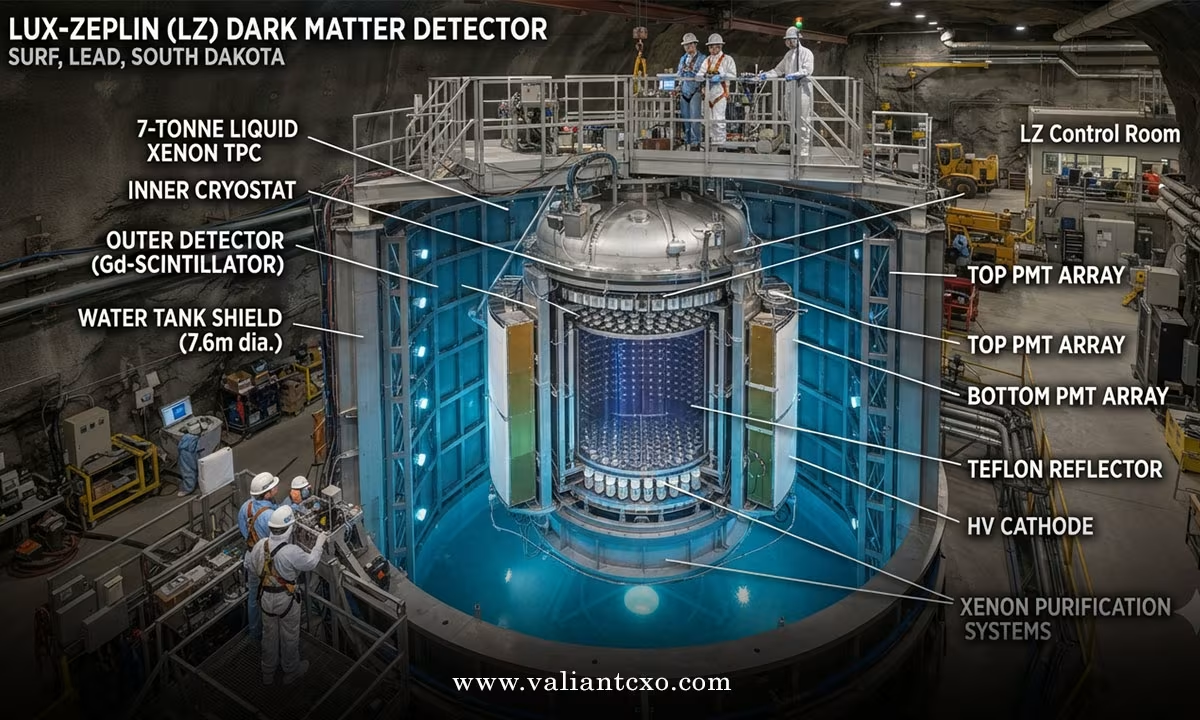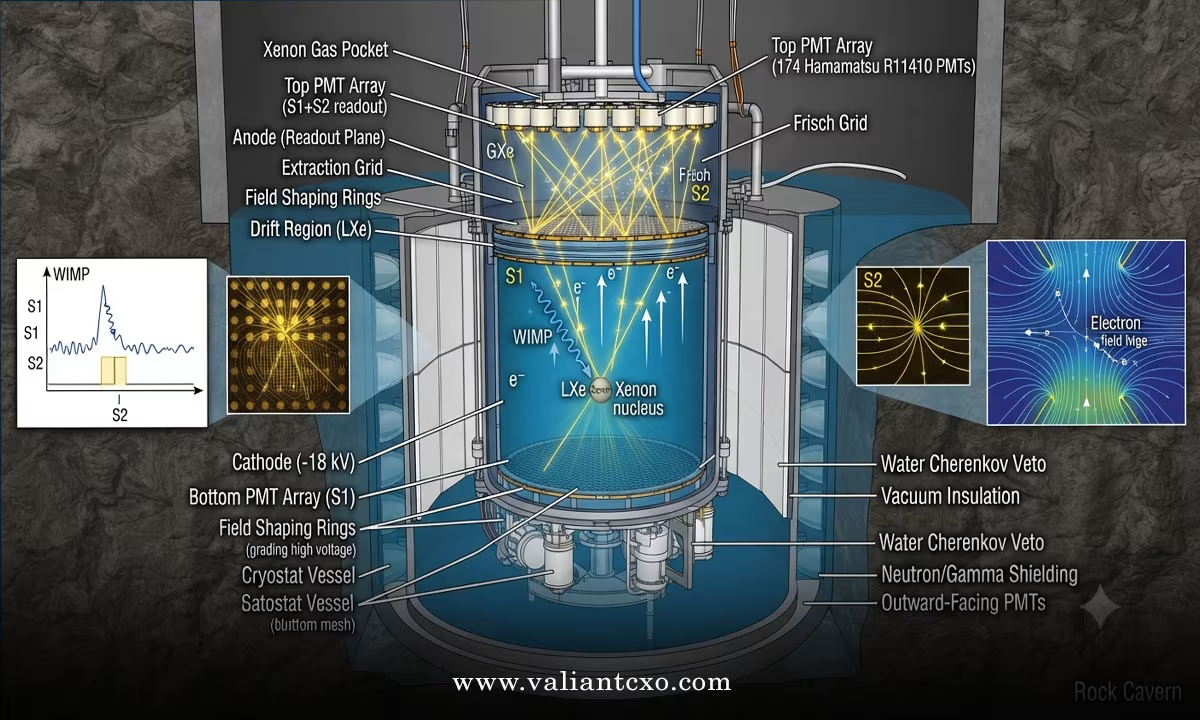
Liquid xenon time projection chamber detectors sit at the center of the most sensitive direct searches for dark matter right now. These dual-phase instruments turn a tank of ultra-pure liquid xenon into a three-dimensional particle camera that can spot nuclear recoils at the keV scale while rejecting backgrounds that would swamp almost any other technology.
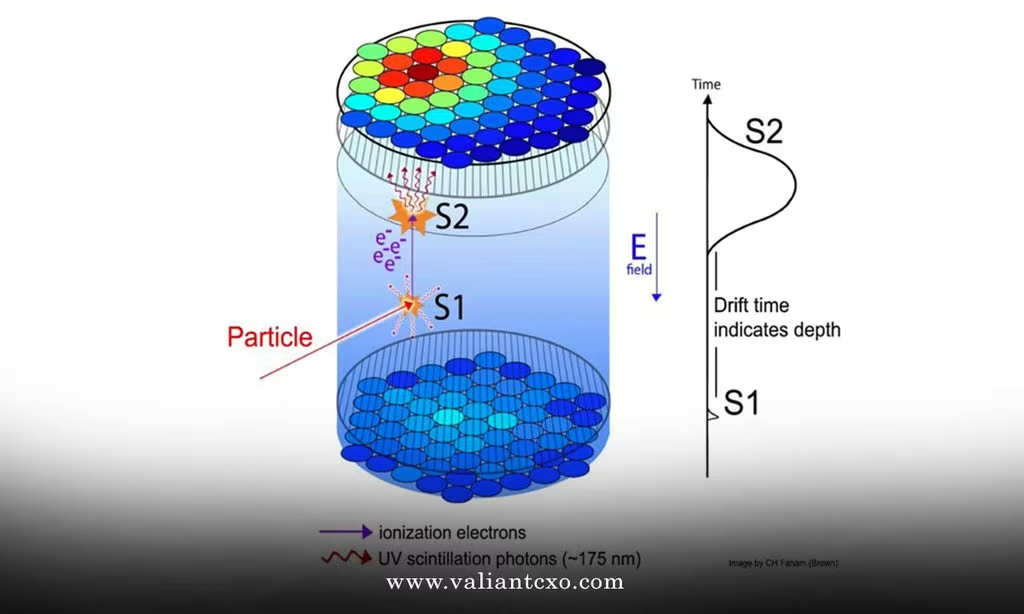
Here’s the core idea in plain terms. A particle hits a xenon nucleus or electron. Two things happen almost at once: a flash of scintillation light (the S1 signal) and a cloud of free electrons (the ionization signal). An electric field drifts those electrons upward through the liquid. At the liquid-gas interface a stronger field yanks them into a thin gas layer where they produce a second, amplified flash of light (the S2 signal). The time delay between S1 and S2 gives the depth coordinate. The pattern of light on the top photomultiplier array gives the horizontal position. Energy comes from the size of both signals. The ratio S2/S1 separates nuclear recoils from electron recoils with high efficiency.
That combination—position, energy, and particle type in one device—is why liquid xenon time projection chamber detectors dominate the field.
Why liquid xenon works so well
Xenon is dense. One tonne of liquid occupies roughly the volume of a small car engine. That density provides natural self-shielding; external gamma rays and neutrons die out before they reach the inner fiducial volume. Xenon is also transparent to its own 178 nm scintillation light, so the photons travel freely to the sensors. It has a high atomic mass, which boosts the coherent spin-independent scattering rate for WIMPs. Natural isotopes include odd-neutron species that open spin-dependent channels. And it can be purified to parts-per-trillion levels of radioactive contaminants using cryogenic distillation.
Two-phase operation adds the ionization channel that single-phase detectors lack. That extra handle is the difference between a 99 % background rejection and something far weaker.
Anatomy of a modern dual-phase TPC
A typical large detector looks like this:
- A cylindrical PTFE vessel lined with high-reflectivity walls
- Arrays of photomultiplier tubes (or newer silicon photomultipliers) at top and bottom
- Cathode, gate, and anode electrode grids that set the drift and extraction fields
- A liquid level held a few millimeters below the gate so electrons can extract cleanly
- An outer “skin” region of xenon instrumented for vetoes
- Surrounding neutron and muon vetoes (scintillator or water Cherenkov)
The active liquid mass in current experiments ranges from a few tonnes (PandaX-4T, XENONnT) to seven active tonnes inside the LUX-ZEPLIN cryostat. Total xenon inventory is higher because of the skin and circulation systems.
Electric fields are modest in the bulk (a few hundred V/cm) so recombination stays manageable, then jump to ~10 kV/cm for extraction. Electron lifetime must exceed the maximum drift time—several milliseconds in the largest detectors—so purity is non-negotiable.
Performance edges that matter
Position resolution reaches a few millimeters. Energy thresholds for nuclear recoils sit below 5 keV in the best runs, and ionization-only analyses push even lower. Electron-recoil rejection exceeds 99.5 % at 50 % nuclear-recoil acceptance in the classic WIMP window. Fiducialization rejects surface events and external backgrounds with surgical precision.
These numbers are why the current generation of liquid xenon time projection chamber detectors has set the tightest limits on spin-independent WIMP-nucleon scattering above ~5–10 GeV/c². The same instruments have also delivered the strongest observation yet of coherent elastic neutrino-nucleus scattering from solar ⁸B neutrinos and world-leading constraints on other rare processes.
Real-world examples and the LZ connection
The three large running experiments—LZ, XENONnT, and PandaX-4T—all rely on the same dual-phase liquid xenon TPC architecture. Differences appear mainly in size, purification strategy, and veto design. LZ, operating a mile underground at the Sanford Underground Research Facility, recently reported a single high-energy nuclear-recoil candidate in an extended analysis window. That result, discussed in detail under the LUX-ZEPLIN (LZ) experiment possible first dark matter WIMP signal, used precisely the S1–S2 discrimination and position reconstruction that define these detectors. The event survived every background model cut at 248 keV—an energy region where the technology’s rejection power is especially strong.
Future plans converge on the XLZD observatory, a multi-ten-tonne liquid xenon TPC that merges the expertise of the current collaborations. Target masses of 60–80 tonnes would push sensitivity into the neutrino fog for standard WIMPs while opening new windows on neutrinoless double-beta decay of ¹³⁶Xe and astrophysical neutrinos.
Practical advantages and remaining headaches
Advantages are clear: scalability, excellent discrimination, self-shielding, and isotopic flexibility. The technology has matured over two decades of iterative improvement from ZEPLIN and XENON10 through LUX to the present tonne-scale devices.
Challenges remain. Radon emanation from detector materials is the dominant irreducible background in the low-energy window; continuous cryogenic distillation has reduced it to levels comparable with solar neutrinos in the best systems. Electron lifetime and field uniformity must be maintained across larger volumes. High-voltage stability at the extraction field is non-trivial. Xenon itself is expensive and finite; efficient recovery and recycling systems are essential for any multi-ten-tonne experiment.
Calibration is another continuous effort. Neutron generators, deuterium-deuterium sources, and internal radioactive isotopes map the nuclear- and electron-recoil bands across the full energy range. Machine-learning tools now assist waveform analysis and background modeling, but the fundamental physics still rests on the dual scintillation-ionization measurement.
Looking ahead
Liquid xenon time projection chamber detectors will remain the workhorse for direct dark-matter searches for at least another decade. Incremental upgrades—better photosensors, doped targets such as hydrogen for light dark matter, or improved radon rejection—will keep sensitivity advancing. The ultimate goal is a detector large enough and clean enough that the irreducible neutrino background becomes the limiting floor. At that point the technology will have done its job: either delivering a confirmed WIMP signal or closing the classic parameter space with high confidence.
The single high-energy candidate reported by LZ shows both the power and the caution required. One event does not make a discovery, but the fact that a liquid xenon TPC can isolate such a rare interaction against vanishingly small backgrounds is exactly why the community continues to invest in the approach.
Key Takeaways
- Dual-phase liquid xenon TPCs measure both scintillation (S1) and ionization (S2) to reconstruct position, energy, and particle type.
- High density and purity give unmatched self-shielding and background rejection.
- Current detectors (LZ, XENONnT, PandaX-4T) set world-leading WIMP limits and have observed solar neutrinos via CEνNS.
- The same technology underpins the recent high-energy candidate discussed in the LUX-ZEPLIN (LZ) experiment possible first dark matter WIMP signal.
- Next-generation multi-ten-tonne instruments (XLZD) aim for the neutrino fog and broader rare-event physics.
- Radon control, electron lifetime, and high-voltage stability remain the primary engineering frontiers.
- Scalability and discrimination power keep liquid xenon the leading technology for the next decade of direct detection.
Anyone following the dark-matter search needs a working understanding of these detectors. The physics is straightforward once the S1–S2 principle clicks; the engineering that keeps a multi-tonne cryogenic system pure and stable for years is where the real craft lies.
FAQs
What makes liquid xenon time projection chamber detectors superior for dark matter searches?
Their dual-phase design measures both scintillation light (S1) and ionization (S2), delivering precise 3D position reconstruction, energy measurement, and strong nuclear-versus-electron recoil discrimination—capabilities that single-phase or other target detectors struggle to match at tonne scale.
How does the S1–S2 ratio work in a liquid xenon time projection chamber detector?
A particle interaction produces prompt scintillation (S1) and free electrons. The electrons drift upward under an electric field and create a delayed, amplified light flash (S2) in the gas phase. Nuclear recoils yield a lower S2/S1 ratio than electron recoils, enabling efficient background rejection.
Are liquid xenon time projection chamber detectors still improving?
Yes. Current experiments such as LZ continue to refine purity, radon rejection, and high-voltage stability, while next-generation designs like XLZD target 60–80 tonnes of active xenon to reach the neutrino fog and expand sensitivity to other rare processes.