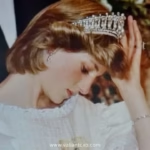
Piers Morgan sues Earl Spencer over claims in the new memoir Swan Song: Diana, My Sister. The broadcaster announced legal action on September 21, 2026, accusing Princess Diana’s brother of publishing “demonstrable lies” that damage his reputation and undermine Spencer’s credibility as a historian.
Here’s the quick rundown:
- Piers Morgan is suing Earl Charles Spencer and his publishers over passages in Swan Song that link him to 1993 gym photos of Diana and claim he reacted angrily to being barred from her 1997 funeral.
- Morgan says the timeline is wrong: he was still at The Sun when those photos ran in the Sunday Mirror, and he did not join the Daily Mirror until October 1995.
- The book dropped on September 22, 2026, timed to the approaching 30th anniversary of Diana’s death.
- Morgan wants the disputed sections removed and a donation made to the King’s Trust.
- This spat sits inside a bigger fight over who gets to shape the public memory of Diana, the media’s role in her final years, and lingering tensions between the Spencers and the Windsors.
The story broke fast. Morgan posted on X that he was instructing lawyers. Then he devoted a chunk of Piers Morgan Uncensored to dismantling the claims. If the earl can get basic facts about a living journalist this wrong, Morgan asked, why trust the rest of the book?
Why the Timeline Matters in Piers Morgan Sues Earl Spencer
Spencer’s book allegedly states that Morgan “and his Sunday Mirror counterpart” published the hidden-camera photos of Diana exercising in a leotard. Those pictures appeared in November 1993. Diana later took legal action against Mirror Group and the gym owner.
Morgan’s record is public and straightforward. He edited the showbiz column at The Sun in the early 1990s. He became editor of the News of the World in 1994. Only in October 1995 did he take over the Daily Mirror. The editor at the time of the gym photos was David Banks. Morgan has said he was “about as far removed from responsibility for the Mirror scoop as I could possibly have been.”
The funeral claim is the second flashpoint. Spencer writes that he called tabloid editors ahead of Diana’s Westminster Abbey service and asked them not to attend. Most agreed. Morgan, then at the Mirror, supposedly “snarled with annoyance” and hung up. Spencer ties that reaction to residual guilt over the earlier photos. Morgan calls the whole package fabricated.
In my experience covering media rows, these timeline errors are the kind of thing that trip up even careful writers. Memory is slippery after three decades. Documents and employment records are not.
What the Book Itself Claims
Swan Song: Diana, My Sister is Spencer’s first full-length account of his sister’s life from the inside. He has said he wanted to counter “untruths that have become accepted over time.” The publisher, Penguin, bills it as an intimate portrait timed for the 30th anniversary of her death in 1997.
Excerpts circulating before publication already stirred debate. Spencer revisits the media frenzy around Diana, the paparazzi pressure, and the royal response in the days after the Paris crash. He has also made pointed comments about King Charles that the Palace has disputed. Morgan, long a vocal critic of certain Spencer family narratives, saw the personal passages about him as a red line.
The legal move is still in its early stage. Morgan has said his solicitors will contact Spencer and Penguin. He wants the passages deleted and a charitable donation. Whether that becomes a full libel suit or settles quietly remains to be seen. British defamation law favors plaintiffs more than U.S. law does, especially when the statements are presented as fact rather than opinion.
Timeline of Key Events Around Piers Morgan Sues Earl Spencer
| Date | Event | Why It Matters |
|---|---|---|
| Nov 7, 1993 | Sunday Mirror publishes hidden-camera gym photos of Diana | Core of the disputed claim against Morgan |
| Oct 1995 | Morgan becomes editor of the Daily Mirror | Proves he was not at the paper when the photos ran |
| Sept 6, 1997 | Diana’s funeral at Westminster Abbey | Context for the alleged phone call about press invitations |
| Aug 2026 | Spencer announces Swan Song | Book framed as correcting the historical record |
| Sept 21, 2026 | Morgan announces legal action on X and on his show | Public trigger for the current dispute |
| Sept 22, 2026 | Swan Song published in UK, US, and other markets | Book hits shelves the day after the lawsuit threat |

How to Follow the Story Without Getting Lost
Piers Morgan sues Earl Spencer If you’re new to these royal-media clashes, here’s a practical way to stay oriented.
- Start with primary statements. Read Morgan’s X posts and the relevant segment of Piers Morgan Uncensored. Then check any response from Spencer’s camp or the publisher if one appears.
- Verify the employment timeline yourself. Morgan’s career moves are documented in major profiles and news archives. Cross-check the 1993 photo publication date against contemporary reports.
- Separate the personal grievance from the broader claims. The lawsuit is specifically about passages naming Morgan. The book’s other assertions about the royal family stand or fall on their own evidence.
- Watch the legal language carefully. “Taking legal action” can mean a formal letter before claim, a demand for correction, or an actual writ. Early reports often blur those stages.
- Note the anniversary context. The 30-year mark of Diana’s death is already generating a wave of books, documentaries, and commentary. This dispute is one piece of that larger conversation.
What I’d do if I were tracking this for a client: set alerts for both names plus the book title, pull the original 1993 Mirror coverage, and wait for any formal statement from Penguin. Speculation fills the gap until the lawyers speak.
Common Mistakes People Make When Reading Stories Like Piers Morgan Sues Earl Spencer
Piers Morgan sues Earl Spencer People often collapse decades into one continuous “tabloid era.” The gym photos and the funeral are four years apart. Morgan’s job titles changed in between. Treating them as one continuous episode muddies the facts.
Another trap: assuming every claim in a memoir is either pure truth or pure invention. Most fall somewhere in the middle—memory filtered through emotion, selective emphasis, and the passage of time. The legal question is narrower: did specific published statements about a living person meet the threshold for defamation?
A third mistake is treating the lawsuit itself as proof that the rest of the book is unreliable. Courts decide discrete claims. They do not issue blanket verdicts on an author’s entire credibility. Morgan is betting that a clear factual error on his own record will force readers to question everything else. That is a rhetorical move, not a legal finding.
Finally, U.S. readers sometimes import American First Amendment expectations into a British case. English libel law still places a heavier burden on the defendant to prove the truth of the statement. That difference shapes strategy on both sides.
The Bigger Picture: Media, Memory, and Money
Piers Morgan sues Earl Spencer This is not the first time Spencer and the press have clashed. In the 1990s he was vocal about media intrusion into Diana’s life. He has also criticized later coverage of Prince Harry and Meghan. At the same time, critics—including Morgan—point out that Spencer is now publishing a commercial memoir that revisits the same painful territory.
Morgan has called the enterprise hypocritical, noting Spencer’s past statements that he would never profit from his sister’s death. Spencer presents the book as an act of correction and tribute. Both positions can be true at once: people protect family memory and still monetize it.
For American audiences the story lands differently. Diana remains a cultural icon here. The media excesses of the 1990s feel distant to younger readers, yet the questions about privacy, truth, and who owns a public figure’s narrative are very much alive. Think of the endless documentaries, the podcasts, the competing biographies. Every new book resets the argument.
One useful analogy: this dispute is like two rival historians arguing over a single footnote that happens to name a living person. The footnote may be small on the page, but it carries real legal and reputational weight. Get the footnote wrong and the whole chapter comes under scrutiny.
Key Takeaways
- Piers Morgan is pursuing legal action against Earl Spencer and Penguin over specific claims in Swan Song about the 1993 gym photos and a 1997 funeral phone call.
- Morgan’s employment record shows he was not at the Daily Mirror when the photos were published.
- The book was released on September 22, 2026, just as the 30th anniversary of Diana’s death approaches.
- The dispute highlights ongoing tensions between the Spencer family narrative and other versions of Diana’s story.
- British defamation standards differ from U.S. ones; early legal steps often focus on correction and settlement rather than a full trial.
- Readers should separate the narrow factual dispute about Morgan from the broader historical claims in the memoir.
- Primary sources—Morgan’s statements, contemporary 1993 reporting, and official publication details—remain the clearest guide.
Piers Morgan sues Earl Spencer Stay sharp. Check the original employment dates and the publication record before accepting any single version of events. That habit will serve you well far beyond this particular row.
FAQs
What exactly is Piers Morgan suing Earl Spencer over?
Morgan says Spencer’s book falsely links him to the 1993 publication of hidden-camera photos of Princess Diana at a gym and misrepresents his reaction to being asked not to attend her funeral. He calls those passages demonstrable lies.
Has Earl Spencer responded to the lawsuit threat?
As of September 22, 2026, no detailed public response from Spencer or Penguin addressing the specific claims about Morgan had been widely reported. The focus remained on the book’s release.
Why does the timing of the gym photos matter so much in the Piers Morgan sues Earl Spencer dispute?
Because the photos ran in November 1993, nearly two years before Morgan became editor of the Daily Mirror. That gap is the core of his factual rebuttal and the foundation of any potential legal claim.