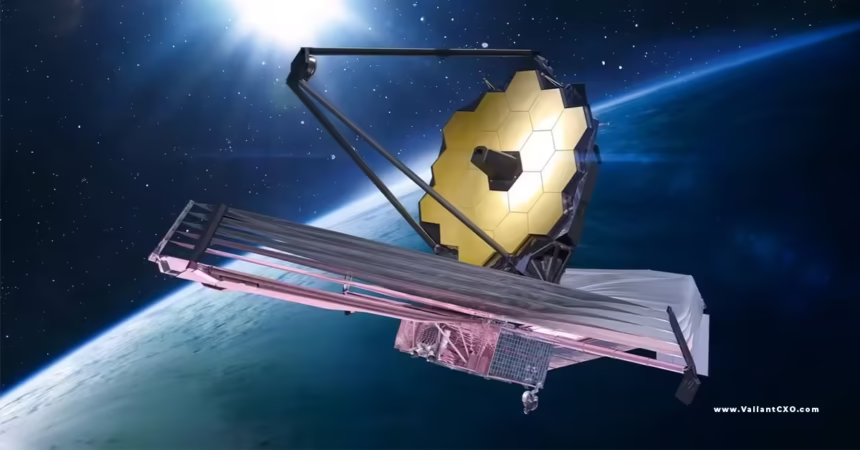
James Webb Space Telescope discoveries keep rewriting the cosmic timeline. Since first light in 2022 the observatory has delivered infrared views no previous telescope could match—galaxies that formed when the universe was only a few hundred million years old, atmospheres of distant worlds, and the precise host of the farthest known fast radio burst. The pace has not slowed. Fresh results in 2025 and 2026 continue to challenge textbooks and open new questions.
- Earliest galaxies appear brighter and more mature than models predicted
- “Little Red Dots” and early black holes force rethinks of growth timelines
- Detailed exoplanet atmospheres and debris disks reveal planet formation in action
- Solar-system targets show water, organics, and dynamic weather on nearby worlds
- Record-breaking high-redshift transients, including the host of FRB 20240304B most distant fast radio burst host galaxy explained
Why Infrared Changes Everything
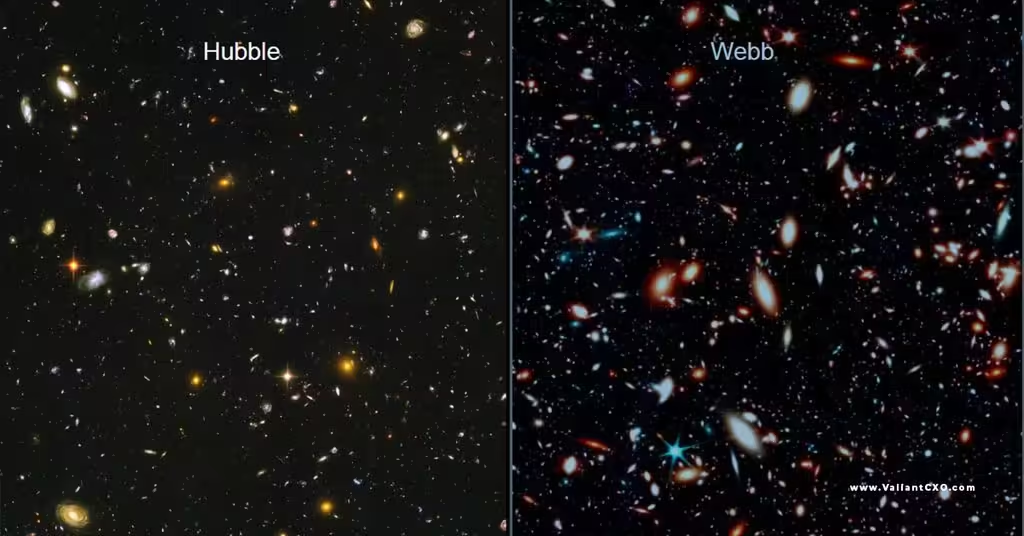
Webb sees wavelengths that pierce dust and stretch with cosmic expansion. That single capability lets it look farther back in time and deeper into star-forming clouds than Hubble ever could. The result is a steady stream of surprises rather than incremental improvements.
Earliest Galaxies and the Surprise of Rapid Growth
Deep fields such as JADES turned up galaxies already forming stars vigorously within 300–500 million years of the Big Bang. Some contain surprisingly high masses of stars and even dust. Standard models expected slower assembly. Webb data show the universe got organized faster than many theorists anticipated.
Little Red Dots—compact, red objects at high redshift—added another puzzle. Follow-up spectroscopy suggests some may be rapidly growing black holes still shrouded in gas and dust. In June 2026 Webb delivered the strongest evidence yet that a subset of these objects behave like “black hole stars,” further complicating the early growth story.
Planet Formation and Debris Disks
Closer to home, Webb has mapped extreme debris disks around young stars. These systems show the aftermath of giant impacts similar to the one that formed our Moon. Silica-rich dust points to high-energy collisions between planetary embryos. The telescope also tracked crystalline silicates being forged in the hot inner disks of protostars and then carried outward—explaining how outer solar-system comets can contain materials that require heat to form.
Atmospheres and Weather Beyond the Solar System
Gas-giant exoplanets now yield detailed chemical inventories: water, carbon dioxide, sulfur dioxide, even silica “snow.” Brown dwarfs such as WISE 0855 reveal shifting water clouds and convective upwelling of deeper gases—weather patterns that look familiar from Jupiter yet occur on objects cooler than any previously studied in this detail.
Rocky planets are next. Early hints of atmospheres fed by volcanic outgassing on lava worlds already appear in the data.
Solar System Science That Hits Close to Home
Webb has mapped carbon on Europa’s surface that likely rose from its subsurface ocean, spotted water vapor around main-belt comets, and tracked the aftermath of the DART asteroid impact. Combined with Hubble it has also uncovered dozens of tiny, pristine trans-Neptunian objects whose surfaces look surprisingly unchanged since formation.
High-Redshift Transients and the Cosmic Web
One of the most recent James Webb Space Telescope discoveries is the precise identification of the host galaxy of FRB 20240304B most distant fast radio burst host galaxy explained. Detected by MeerKAT in 2024 and confirmed by Webb in 2026, the burst sits at redshift 2.148—when the universe was only three billion years old. The host turned out to be a low-mass, metal-poor dwarf galaxy actively forming stars. That environment favors young magnetars over older merger scenarios and gives cosmologists a backlight that samples ionized gas across roughly 80 percent of cosmic history.
The same infrared sensitivity that found the faint host also lets Webb measure the chemical enrichment of galaxies at similar epochs, revealing how heavy elements were already widespread earlier than expected.
Comparison of Selected Landmark Results
| Discovery Area | Key Result | Approximate Epoch / Distance | Why It Matters |
|---|---|---|---|
| Early galaxies | Bright, massive systems | <500 Myr after Big Bang | Faster growth than predicted |
| Little Red Dots / BH seeds | Compact objects with rapid BH growth | z > 6–8 | Challenges black-hole formation models |
| Extreme debris disks | Silica-rich collision products | Young nearby stars | Window into giant-impact phase |
| Exoplanet atmospheres | Detailed chemistry & weather | 10–100s of light-years | Biosignature pathfinding |
| FRB host identification | Low-mass dwarf at z = 2.148 | ~3 Gyr after Big Bang | Probes cosmic noon baryons & progenitors |
Common Misconceptions and How to Avoid Them
Thinking every distant galaxy Webb finds is “the first” is a trap. Many are simply the brightest or best-studied examples at that epoch. Cross-check redshifts and look for independent confirmation.
Assuming infrared automatically means “early universe” ignores the solar-system and nearby-star programs that also deliver major results. Webb is a multi-purpose observatory.
Treating a single spectacular image as the full story undersells the spectroscopy. The real breakthroughs usually come from the spectra that quantify composition, temperature, and velocity.
Looking Ahead
Webb is still in its prime. Upcoming deep fields, continued monitoring of transients, and coordinated campaigns with next-generation radio arrays will keep the discovery rate high. The telescope has already shown that the first billion years of cosmic history were more dynamic—and more chemically advanced—than many models allowed. Every new data set tightens the constraints and opens fresh questions.
The practical takeaway is straightforward: follow the official NASA and ESA/Webb channels for the primary data releases. Secondary analyses appear weeks later on arXiv. For anyone tracking high-redshift science, the combination of infrared imaging and spectroscopy has become the gold standard.
Webb did not simply extend Hubble’s reach. It opened an entirely new observational window. The discoveries keep coming, and the universe continues to look more interesting—and more surprising—than we expected.
Key Takeaways
- Webb has revealed galaxies forming stars vigorously within the first 300–500 million years after the Big Bang, faster than most pre-launch models predicted.
- Compact “Little Red Dots” and early black-hole candidates challenge standard growth timelines for supermassive black holes.
- Extreme debris disks and crystalline silicates in protostellar systems provide direct windows into giant-impact phases of planet formation.
- Detailed atmospheric chemistry and weather patterns have been mapped on gas giants and cold brown dwarfs for the first time.
- Solar-system observations delivered carbon on Europa, water vapor on main-belt comets, and pristine tiny trans-Neptunian objects.
- The host galaxy of FRB 20240304B most distant fast radio burst host galaxy explained was pinpointed at redshift 2.148, doubling the previous FRB distance record.
- Infrared imaging plus spectroscopy together form the new gold standard for high-redshift and dusty-environment science.
Webb did not merely extend earlier telescopes; it opened an entirely new observational regime. The combination of sensitivity, resolution, and infrared reach continues to deliver results that force rapid updates to galaxy-formation, planet-formation, and transient-source models. Keep tracking the official NASA and ESA/Webb data releases—the next major surprises are already in the pipeline.
FAQs
What is the single most surprising category of James Webb Space Telescope discoveries so far?
The rapid appearance of relatively massive, chemically enriched galaxies less than 500 million years after the Big Bang ranks highest for most researchers, because it compresses the timeline for structure formation more than almost any other finding.
How does the FRB 20240304B most distant fast radio burst host galaxy explained fit into the broader list of Webb results?
It demonstrates Webb’s unique ability to locate extremely faint, high-redshift hosts that ground-based optical telescopes miss, while simultaneously supplying a probe of intergalactic gas across 80 percent of cosmic history.
Where should a beginner start to follow new James Webb Space Telescope discoveries?
Begin with the official NASA Webb science pages and ESA/Webb press releases; they publish the primary images, spectra, and plain-language summaries within hours of public release.