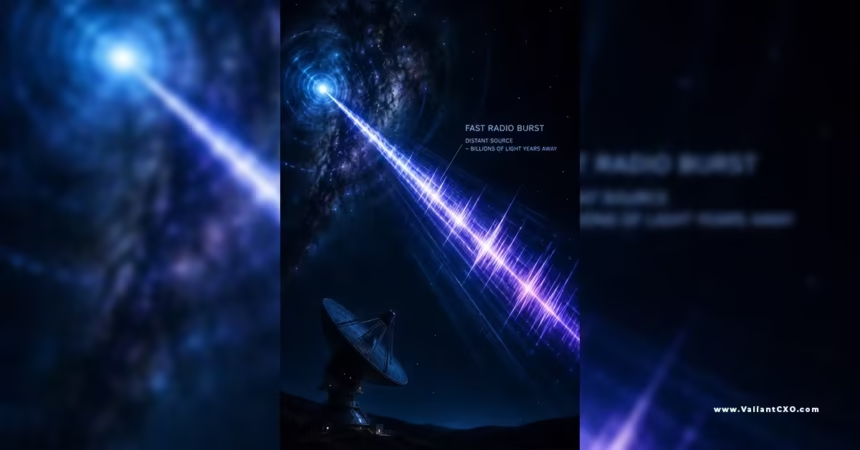
FRB 20240304B most distant fast radio burst host galaxy explained starts with a millisecond flash that left its source when the universe was barely three billion years old. That signal crossed more than ten billion light-years of expanding space before South Africa’s MeerKAT telescope caught it on 4 March 2024. James Webb later pinned the burst to a tiny, metal-poor dwarf galaxy still forming stars at cosmic noon. The result doubles the previous redshift record for localized FRBs and hands cosmologists a clean probe of ionized gas across roughly 80 percent of cosmic history.
- Detected by MeerKAT’s MeerTRAP system; confirmed host redshift z = 2.148
- Host is a low-mass (~10⁷ solar masses), clumpy, star-forming dwarf
- Favors young magnetars born in core-collapse supernovae
- Sightline pierces the Virgo Cluster plus a previously unknown group at z ≈ 0.3
- Opens a new window on galaxy evolution and the intergalactic medium at the peak of star formation
What Exactly Is FRB 20240304B?
Fast radio bursts are intense, millisecond-duration pulses of radio energy. Most arrive from distant galaxies and never repeat. FRB 20240304B stands out because its dispersion measure—the frequency-dependent delay caused by free electrons along the path—immediately flagged an extreme distance. After scattering correction the DM sits near 2458 pc cm⁻³. That number alone suggested a redshift well beyond previous records.
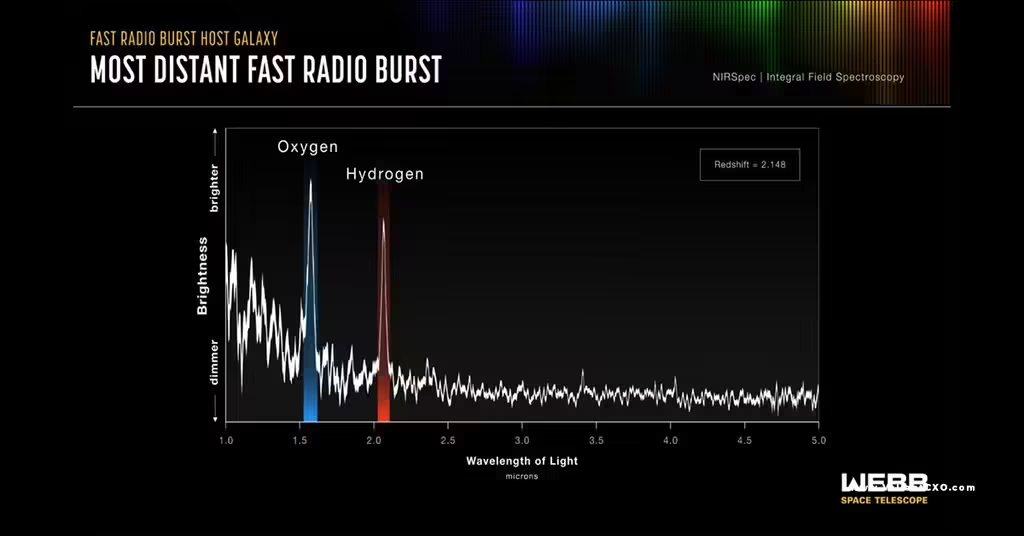
Ground-based optical searches drew blanks. The host was simply too faint and too far. Only Webb’s NIRCam could detect the galaxy; NIRSpec then measured the redshift from strong Hα and [O III] lines. The value 2.148 ± 0.001 places the event just three billion years after the Big Bang—right at the height of cosmic noon, when the universe’s star-formation rate peaked.
The Host Galaxy That Broke Expectations
Typical FRB hosts are massive, gas-rich spirals or irregulars. This one is different. Stellar mass clocks in around 10⁷ solar masses—roughly a thousand times lighter than the median FRB host. Star-formation rate is modest, about 0.2 solar masses per year, yet the specific star-formation rate is high. Metallicity sits at 10–20 percent of solar. The galaxy looks clumpy and young.
In my experience tracking transient hosts, that combination is a smoking gun for short delay times. Massive stars live only a few million to a few tens of millions of years before they explode. The resulting magnetar—a neutron star with a magnetic field strong enough to power coherent radio emission—can then fire off FRBs while the surrounding stellar population is still young. Neutron-star merger scenarios, which need gigayear delay times, struggle to fit this environment.
Here’s the thing: the host is not an outlier in the early universe; it is typical of the dwarf galaxies that dominated star formation at that epoch. FRB 20240304B simply found one that still exists in our light cone.
How the Signal Became a Cosmic Probe
As the radio pulse raced toward us it passed through every intervening structure. Two clear imprints stand out. One is the nearby Virgo Cluster, only 54 million light-years away. The other is a previously unknown galaxy group or cluster at redshift 0.3, about 3.5 billion light-years distant. Rotation measure data also show the magnetic field geometry along the entire line of sight.
That makes FRB 20240304B more than a record holder. It is a backlight that lights up the baryons that ordinary surveys miss. Roughly 80 percent of the universe’s ionized gas history is now sampled by a single pulse.
| Property | FRB 20240304B | Typical Localized FRB |
|---|---|---|
| Redshift | 2.148 | <1.0 |
| Lookback time | ~10.6–11 Gyr | <8 Gyr |
| Host stellar mass | ~10⁷ M☉ | ~10¹⁰ M☉ |
| Host type | Low-mass dwarf, star-forming | Massive star-forming galaxy |
| Preferred progenitor | Young magnetar | Mixed (magnetar or merger) |
| Cosmic probe reach | ~80 % of history | ~50 % of history |
Step-by-Step Action Plan for Beginners Who Want to Follow the Science
- Bookmark the NASA Webb science release page. Fresh images and spectra appear there first.
- Pull the arXiv preprint (or the final Science paper) and read only the abstract plus the host-galaxy section. Ignore the technical appendices until the main story clicks.
- Open a free tool such as NASA’s Ned Wright cosmology calculator. Plug in z = 2.148 and watch the lookback time and luminosity distance update in real time.
- Compare the host mass and star-formation rate with a few nearby FRBs (for example FRB 20121102A). The contrast jumps out immediately.
- Follow the MeerTRAP and CHIME/FRB collaboration accounts. New high-redshift candidates appear there weeks before formal papers.
What I’d do if I were teaching an undergrad seminar: assign students to measure the dispersion measure contribution from the Virgo Cluster alone and then subtract it. That single exercise turns an abstract number into a tangible intervening structure.
Common Mistakes & How to Fix Them
Mistake one: treating every FRB as identical. Fix—always check the host properties first. A low-mass, high-sSFR galaxy points to a young magnetar; an old elliptical points elsewhere.
Mistake two: confusing light-travel time with the age of the universe at emission. Fix—remember that at z = 2.148 the universe itself was only three billion years old; the photons then spent more than ten billion years in transit.
Mistake three: assuming the host must be bright enough for ground-based telescopes. Fix—Webb has changed the game. Many high-z hosts will remain invisible until space-based infrared spectroscopy is applied.
Mistake four: over-interpreting a single event. Fix—wait for the next two or three redshift-two FRBs. Patterns emerge only with a sample.
Why This Changes the Game for Cosmology
FRBs already map the missing baryons in the local universe. Pushing the same technique to cosmic noon lets us watch how those baryons were still being assembled into galaxies. The highly scattered nature of FRB 20240304B also hints that a larger population of distant bursts is currently below detection thresholds. Future surveys with SKA and next-generation CHIME expansions will start catching them.
One fresh analogy: think of the burst as a lighthouse beam that has traveled through every fog bank between the early universe and us. The fog (intergalactic plasma and magnetic fields) leaves its signature on the beam’s arrival time and polarization. We cannot visit those fog banks, but we can read the distortions they left.
Would you rather have a thousand nearby FRBs that tell you only about today’s universe, or a handful that reach back to the era when galaxies were still under construction? The answer is both—but the distant ones rewrite the textbook chapters on galaxy evolution.
Key Takeaways
- FRB 20240304B is the most distant localized fast radio burst, at redshift 2.148.
- Its host is an unexpectedly low-mass, metal-poor, star-forming dwarf galaxy.
- The environment strongly favors a young magnetar formed via core-collapse supernova.
- The sightline samples ionized gas and magnetic fields across ~80 % of cosmic time.
- Webb’s infrared capability was essential; ground-based facilities could not see the host.
- Future high-z FRBs will become standard tools for mapping baryons at cosmic noon.
- The discovery more than doubles the previous redshift reach of the FRB population.
The real payoff is simple: every new distant FRB turns the intergalactic medium into a laboratory we can actually measure. Keep an eye on the next MeerKAT and Webb campaigns. The frontier just moved outward by several billion light-years, and the data are only beginning to arrive.
FAQs
What makes FRB 20240304B most distant fast radio burst host galaxy explained different from earlier discoveries?
Its spectroscopic redshift of 2.148 places the burst at a time when the universe was only three billion years old—more than doubling the previous record for localized events and opening the cosmic-noon era to FRB studies.
Could FRB 20240304B most distant fast radio burst host galaxy explained have come from a neutron-star merger instead of a magnetar?
Unlikely. The host’s youth, low mass, and ongoing star formation imply a short delay between star formation and the burst, which matches magnetar birth far better than the gigayear timescales required for mergers.
Where can I see the actual images of the FRB 20240304B most distant fast radio burst host galaxy explained?
NASA’s James Webb Space Telescope science pages host the NIRCam image with the burst position marked and the NIRSpec spectrum that delivered the redshift. Both are publicly available.