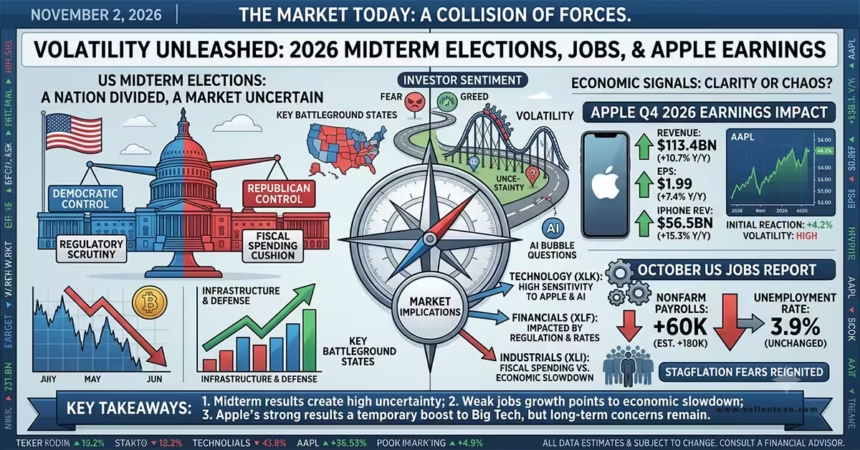
Stock market today November 2026 midterm elections jobs report Apple earnings impact sits at the center of a high-stakes week for investors. Futures bounced early Monday after a bruising Friday that left the S&P 500 at 7,580, the Dow near 51,770, and the Nasdaq Composite down nearly 3 percent on the day. Tech took the brunt after semiconductor weakness and questions around AI spending.
Here’s the quick read:
- Futures pointed higher into the open as traders digested the prior week’s losses and eyed the calendar.
- Midterm elections on Tuesday could shift control of the House and leave the Senate in play, with history favoring a post-vote relief rally once uncertainty fades.
- Apple reports after the close Monday—its first under CEO John Ternus—with Street expectations around $113 billion in revenue and EPS near $1.98–$2.00.
- October jobs data lands Friday; economists look for roughly 55,000–65,000 new nonfarm payrolls and an unemployment rate near 4.2 percent.
That combination of political risk, mega-cap earnings, and labor data rarely arrives in the same five-day window. The market treats it like a stress test.
What the Recent Selloff Actually Means
Last week’s drop was not random. Investors rotated out of high-valuation tech names after mixed big-tech results and concerns that AI infrastructure spending might slow. The Nasdaq took the hardest hit. Defensive sectors and the Dow held up better. Volatility climbed, with the VIX pushing toward 19.5.
In my experience, these kinds of rotations often mark a pause rather than a permanent regime change. The economy still shows resilience. Yields on the 10-year Treasury hovered near 4.93–4.95 percent. Oil pulled back slightly after recent gains. The setup heading into this week is classic late-cycle caution mixed with election-year noise.
stock market today November 2026 midterm elections jobs report Apple earnings impact: The Political Angle
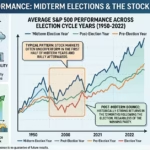
Midterm elections have a long track record. Markets tend to underperform earlier in the year, then firm once the results become clear. BlackRock and other institutional analyses show the S&P 500 has historically posted solid gains in the six to twelve months after midterms, often because gridlock reduces the odds of major tax or regulatory swings.
Polls and prediction markets lean toward Democrats gaining the House while the Senate remains competitive. A divided government has often proven constructive for equities. Unified control under either party can introduce bigger policy surprises. The real risk is not the outcome itself but a contested or delayed result that keeps uncertainty elevated past Election Day.
What usually happens is that the market prices the probability of gridlock in advance. Once votes are counted, the relief can be swift—even if the party in power loses seats. That pattern has held across multiple cycles since the 1950s.
Apple Earnings and the Broader Tech Reset
Apple reports after the close on Monday. Consensus sits near $113 billion in revenue and EPS of roughly $1.98 to $2.00, implying solid year-over-year growth driven by iPhone demand and Services. This is the first full quarter under the new leadership team, so guidance language will matter as much as the numbers.
A clean beat and constructive outlook could steady the broader Nasdaq. A miss or cautious tone on supply constraints or China demand would extend the recent tech pressure. Either way, Apple’s weight in major indexes means its reaction will influence the tone for the rest of the week.
Jobs Report Expectations and Fed Implications
Friday’s employment report covers October. The consensus range centers on 55,000 to 65,000 nonfarm payrolls, with unemployment expected to hold near 4.2 percent. Wage growth remains a key variable—still elevated enough to keep the Fed cautious but showing signs of gradual cooling.
A soft print would reinforce the view that labor-market tightness is easing without collapsing. A stronger number could push back rate-cut hopes and firm yields. Either outcome will be filtered through the political lens of the midterms that precede it.
Key Catalysts This Week
| Event | Date | Why It Matters | Likely Market Reaction Path |
|---|---|---|---|
| Apple earnings | Mon after close | Mega-cap guidance + leadership transition | Tech direction for the week |
| Midterm elections | Tuesday | House/Senate control and policy uncertainty | Volatility spike then potential relief |
| JOLTS job openings | Tuesday | Labor demand signal ahead of payrolls | Confirms or challenges soft-landing narrative |
| October jobs report | Friday 8:30 a.m. ET | Growth, wages, Fed path | Rate expectations and risk appetite |
Step-by-Step Action Plan for Beginners and Intermediate Investors
- Check your exposure. Look at how much of your portfolio sits in large-cap tech versus the broader market. Rebalance if concentration feels uncomfortable after last week’s moves.
- Size any new positions smaller than usual. Election weeks and major data days create noise. Keep dry powder.
- Focus on process, not prediction. Decide in advance what a “good” or “bad” Apple report or jobs number looks like for your holdings.
- Use limit orders and avoid chasing after-hours moves. Apple’s reaction often continues into the next session.
- Review cash and fixed-income allocations. Higher yields offer a real alternative if equity volatility stays elevated.
- Reassess after Friday’s data. The combination of election clarity and jobs numbers usually provides a clearer signal than any single event.
Common Mistakes and How to Fix Them
Chasing headlines is the classic error. Investors buy the “certainty” of a particular election outcome only to discover the market had already discounted most of it. Fix: treat politics as a volatility event, not a directional thesis.
Another frequent miss is over-weighting one data point. A single jobs print rarely changes the Fed’s path by itself. Fix: look at the three-month average and wage trend, not just the headline.
Panic selling into the open after a weak overnight futures session is common. Fix: if your time horizon is measured in years, use the noise to add selectively rather than exit.
Key Takeaways
- Futures opened the week higher after a tech-driven selloff left major indexes lower on the week.
- Midterms on Tuesday historically precede stronger equity performance once uncertainty clears.
- Apple’s Monday report sets the near-term tone for growth stocks.
- October jobs data on Friday will influence rate expectations and risk appetite.
- Divided government outcomes have often supported markets by limiting large policy swings.
- Position sizing and process matter more than trying to call the exact election result.
- Volatility is elevated but not extreme—use it rather than fear it.
The stock market today November 2026 midterm elections jobs report Apple earnings impact is a classic confluence week. Clarity arrives quickly once the votes are counted and the data is released. Stay disciplined, keep positions sized for the noise, and let the information flow rather than trying to front-run every headline. That approach has served investors well through prior election cycles and data-heavy periods alike.
FAQs
How does the stock market today November 2026 midterm elections jobs report Apple earnings impact typically play out historically?
Markets often experience elevated volatility into the vote and then firm once results are known. Post-midterm twelve-month returns have been positive across most cycles since 1950, with gridlock scenarios frequently supportive.
What should beginners watch most closely in the stock market today November 2026 midterm elections jobs report Apple earnings impact?
Apple’s guidance language and the unemployment rate plus wage growth in the Friday jobs report. Those two inputs tend to drive the largest near-term price action.
Can the stock market today November 2026 midterm elections jobs report Apple earnings impact create lasting sector shifts?
Short-term rotations are common, especially out of or into tech. Longer-term leadership usually depends more on earnings trends and interest-rate path than on any single election or data release.