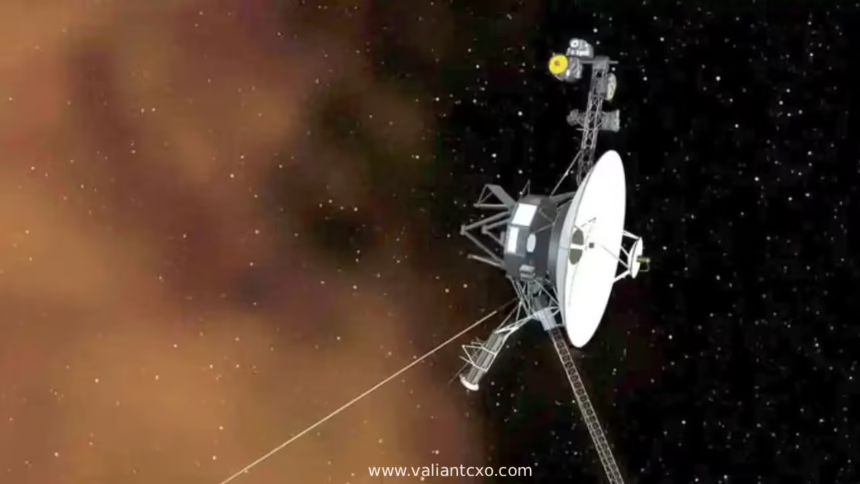
Voyager 1 one light day from Earth November 2026 marks a quiet but profound shift in human exploration. On November 18, 2026, at approximately 5:16 a.m. EST, the spacecraft will sit 16.09 billion miles from Earth—the distance light travels in a full day. From that moment on, every command and every reply will take 24 hours one way. No human-made object has ever operated this far.
Here’s the quick overview:
- November 18, 2026 is the date NASA projects Voyager 1 will reach one light-day.
- The distance equals roughly 25.89 billion kilometers or 173 astronomical units.
- Radio signals will take a full day to travel in each direction.
- The probe continues returning data from interstellar space with two instruments still active.
- This milestone arrives weeks after the [Voyager 1 thruster switch backup 2026](Voyager 1 thruster switch backup 2026) event that briefly silenced the spacecraft.
The numbers sound abstract until you sit with them. A message you send today arrives tomorrow. The answer you hope for arrives the day after that. Mission planning stretches into multi-day cycles. Patience becomes a required skill.
Why One Light-Day Matters More Than Raw Distance
Distance alone is impressive. Voyager 1 has held the title of farthest human-made object for decades. Crossing the one-light-day threshold changes the operating reality. Engineers lose the ability to respond in near real time. Fault protection systems—the same ones that activated during the recent thruster event—carry even more weight. The spacecraft must protect itself because help from Earth is a full day away.
Think of it like talking to someone on the opposite side of the planet with a permanent one-day lag on every sentence. You plan carefully. You speak clearly. You accept that surprises will resolve themselves before you can intervene.
The probe is currently traveling at about 38,000 miles per hour relative to the Sun. That speed has been remarkably steady for years. The light-day crossing is simply the next natural checkpoint on a trajectory set in 1977.
How We Got Here: A Timeline of Key Moments
Voyager 1 launched September 5, 1977. It flew past Jupiter in 1979 and Saturn in 1980. It crossed the heliopause into interstellar space in August 2012. Power has declined steadily. Instruments have been turned off one by one to stretch the remaining electricity from the radioisotope generators.
The most recent power-saving work, completed in September 2026, swapped three devices for lower-power alternatives. That effort bought critical time. Then came the mid-October communications pause linked to the thruster switch. The spacecraft recovered on its own. Now the light-day milestone sits just weeks ahead.
These events are connected. Every configuration change, every automatic response, and every power trade-off has been made with the knowledge that communication delays only grow longer.
Practical Reality After November 18
Voyager 1 one light day from Earth November 2026 Once Voyager 1 passes one light-day, operations shift in measurable ways:
- Command sequences must be written and verified further in advance.
- Telemetry analysis happens on data that is already a day old when it arrives.
- Any anomaly requires the spacecraft’s onboard systems to handle the immediate response.
- Science planning focuses on the two remaining instruments: the magnetometer and the plasma wave subsystem.
Voyager 1 one light day from Earth November 2026 The team at NASA’s Jet Propulsion Laboratory has prepared for this transition for years. The probe was designed with long light times in mind. Still, living the reality feels different from planning for it.
Comparison of Voyager 1 Distance Milestones
| Milestone | Approximate Date | Distance from Earth | One-Way Signal Time | Significance |
|---|---|---|---|---|
| Heliosphere exit | August 2012 | ~11.3 billion miles | ~17 hours | First spacecraft in interstellar space |
| Current (early Nov 2026) | November 2026 | ~16 billion miles | ~23 hours | Approaching light-day |
| One light-day | November 18, 2026 | 16.09 billion miles | 24 hours | Historic first for any human object |
| Future 20 billion miles | ~2030s | 20 billion miles | ~30 hours | Continued interstellar exploration |
What This Means for the Remaining Science
Voyager 1 one light day from Earth November 2026 Two instruments still operate. The magnetometer measures magnetic fields in the interstellar medium. The plasma wave subsystem listens to the charged particles surrounding the spacecraft. Both continue to return unique data that no other probe can provide.
Power remains the limiting factor. The generators lose about four watts each year. Every decision about heaters, transmitters, and instruments is a calculation against that slow decline. The September power swap and earlier instrument shutdowns were made to keep these final measurements coming as long as possible.
The light-day crossing does not change the science goals. It simply raises the cost of every mistake and every delay.
Looking Ahead After the Milestone
November 18 will pass without fanfare on the spacecraft itself. Voyager 1 will keep moving. The numbers on the status pages will tick past 16.09 billion miles and keep climbing. Mission managers will adjust timelines and verification processes. The public will see a new record in the history books.
For those who follow the mission closely, the date serves as a reminder. This 49-year-old machine is still teaching us how far careful engineering can reach. The same systems that handled the recent thruster switch will handle the longer light times. The same team that stretched the power supply will keep finding ways to listen a little longer.
The next time you look up at the night sky, remember that a small probe built before many of us were born is already a light-day away and still talking. That conversation is about to get slower—and more remarkable.
Key Takeaways
- Voyager 1 reaches one light-day from Earth on November 18, 2026.
- Signal travel time becomes a full 24 hours in each direction.
- The milestone follows closely after the thruster switch event and power-saving work of 2026.
- Only two science instruments remain active.
- Onboard fault protection grows more important as light times increase.
- The spacecraft continues its interstellar journey at roughly 38,000 mph.
- This is the first time any human-made object has operated at this distance.
Voyager 1 one light day from Earth November 2026 The probe keeps going. The data keeps arriving. The story of Voyager 1 one light day from Earth November 2026 is not an ending. It is simply the next measured step into the dark.
FAQs
When exactly does Voyager 1 reach one light-day from Earth?
NASA projects the moment for November 18, 2026, at approximately 5:16 a.m. EST, when the spacecraft will be 16.09 billion miles away.
How does the one-light-day milestone affect communication?
Every radio signal will take 24 hours to travel one way. Commands and data replies each require a full day in transit.
Is the thruster issue from October related to the light-day milestone?
The recent thruster switch demonstrated the value of onboard fault protection. That same autonomous capability becomes even more critical once light times stretch to a full day.