Real world asset tokenization explained is the process of turning ownership claims on physical or traditional financial assets into digital tokens that live on a blockchain. Instead of a paper certificate or a closed database entry, you get a programmable record that can settle in seconds, move between approved wallets, and plug into on-chain systems. As of late 2026 the distributed on-chain market sits in the $38–46 billion range (excluding stablecoins), with U.S. Treasuries still the largest slice.
Here’s the plain-English overview:
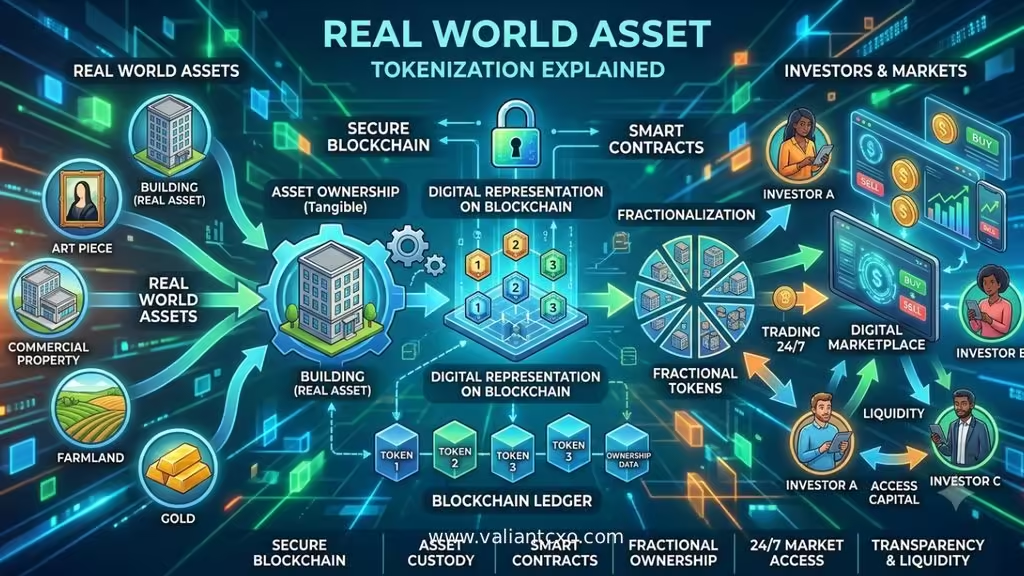
- Tokenization creates a digital claim on an off-chain asset—Treasuries, private credit, gold, energy contracts, or real estate—without replacing the legal ownership structure.
- The token is the record; the asset stays in the real world under a legal wrapper (usually an SPV, trust, or fund).
- Distributed value (tokens that can move between wallets) is far smaller than represented value (assets recorded on-chain but often restricted to an issuer’s platform).
- Benefits center on faster settlement, fractional ownership, and 24/7 accessibility. Risks center on legal enforceability, thin secondary liquidity, and custody of the underlying.
- Commodities such as energy have shown real traction; one clear case is the concentration that helps explain [Why XRP Ledger leads tokenized energy commodities $2.2B](Why XRP Ledger leads tokenized energy commodities $2.2B).
The gap between the marketing stories and the actual numbers is still wide. Real estate gets endless airtime yet remains a tiny fraction of the market. Treasuries and credit do the heavy lifting.
How real world asset tokenization actually works
Real world asset tokenization explained Start with the asset and the legal structure. An issuer creates a vehicle that owns the real-world asset. Token holders receive a claim on that vehicle—shares, notes, or units. The blockchain then records those claims as tokens.
Five practical layers show up in almost every production setup:
- Legal wrapper and documentation that define exactly what the token represents.
- Custody and proof-of-reserve arrangements for the underlying asset.
- Token issuance with transfer restrictions, freeze, and clawback controls where required.
- Oracles or reporting mechanisms that keep on-chain data tied to off-chain reality.
- Secondary venues or primary redemption paths so holders can exit.
Real world asset tokenization explained Without the first two layers the token is just code. Courts still enforce the claim, not smart contracts.
| Asset Class | Approximate Distributed Value (late 2026) | Role in Market | Liquidity Reality |
|---|---|---|---|
| U.S. Treasuries / MMFs | $14–15B | Largest single category, yield for idle cash | Strong primary, limited secondary |
| Private Credit | $8B range | Growing institutional allocation | Mostly primary redemption |
| Commodities (incl. gold & energy) | $5B+ range | Traceability and settlement use cases | Varies; energy often represented |
| Equities / Stocks | $3B+ range | Emerging but still small vs traditional | Thin secondary depth |
| Real Estate | Under $300M | High narrative, low actual share | Very limited |
Figures drawn from rwa.xyz and related trackers; methodologies differ between “distributed” and “represented” counts.
Why the market is growing—and where it still lags
Real world asset tokenization explained Settlement is the clearest win. Traditional securities can take days. Tokenized claims can settle in a single transaction. Fractional ownership lowers entry points in theory, though most institutional products still carry high minimums or accreditation rules. 24/7 transferability is real on public chains once the compliance gates are passed.
The lag sits in secondary liquidity. Most RWA tokens trade rarely. Redemption with the issuer remains the primary exit. That is fine for yield-seeking cash or long-hold credit; it is a problem if the pitch promised free-trading markets.
Real world asset tokenization explained Energy commodities illustrate both sides. Tokenized megawatt-hour contracts can deliver clean audit trails and fast settlement for industrial offtakers. At the same time, concentration in a handful of large positions—exactly the dynamic behind [Why XRP Ledger leads tokenized energy commodities $2.2B](Why XRP Ledger leads tokenized energy commodities $2.2B)—shows how one or two products can dominate a category’s reported numbers.
In my experience the teams that succeed treat tokenization as an operational upgrade, not a marketing event. They map the physical or financial lifecycle first, then decide what belongs on-chain.
Step-by-step action plan for beginners
- Decide which asset class and jurisdiction you actually care about. The legal rules drive everything else.
- Study the difference between distributed and represented value on current dashboards such as rwa.xyz.
- Read one complete product prospectus or token documentation end-to-end so you see the claim language.
- Map the off-chain custody and audit process—who holds the gold, the Treasuries, or the energy contracts, and how often it is verified.
- Compare settlement and transfer rules against the traditional version of the same asset.
- Test a small, non-critical position only after the legal and operational questions are answered.
Common mistakes and how to fix them
Real world asset tokenization explained Confusing the token with the asset itself. Fix: the token is a claim record. Enforcement still runs through courts and the legal wrapper.
Treating headline market size as liquid, tradable value. Fix: separate distributed value from represented value and look at actual transfer volume.
Assuming fractional ownership automatically creates retail access. Fix: most products remain restricted by securities rules.
Ignoring secondary-market depth. Fix: plan the exit path (redemption or trading venue) before issuance.
Key Takeaways
- Real world asset tokenization turns legal claims on off-chain assets into on-chain records that settle faster and can be programmed.
- Distributed on-chain value sits in the high tens of billions in 2026; Treasuries dominate.
- Legal structure and custody matter more than the blockchain chosen.
- Settlement speed and operational efficiency are the proven benefits today.
- Secondary liquidity remains the biggest practical bottleneck.
- Commodities, especially energy, demonstrate both the opportunity and the concentration risk.
- Always verify the exact claim the token represents before treating it as ownership.
Real world asset tokenization explained Tokenization is not magic. It is infrastructure. When the legal wrapper, custody, and on-chain controls line up with real operational needs, the result is cleaner settlement and clearer records. When they do not, the token simply adds another layer of complexity. The practical next step is to pick one asset class you already understand and walk the claim documentation from start to finish.
FAQs
What is the difference between distributed and represented RWA value?
Distributed value counts tokens that can transfer between eligible wallets. Represented value includes assets recorded on-chain but often kept inside an issuer’s closed system. The gap between the two is large.
Is real estate a major part of RWA tokenization in 2026?
No. Despite heavy coverage, real estate remains a small fraction of tracked distributed value—well under one percent in most dashboards.
How does energy fit into real world asset tokenization?
Energy contracts can be tokenized as claims on physical power generation or delivery. Certain ledgers have seen outsized activity in this category; see the data behind [Why XRP Ledger leads tokenized energy commodities $2.2B](Why XRP Ledger leads tokenized energy commodities $2.2B) for one concrete example.