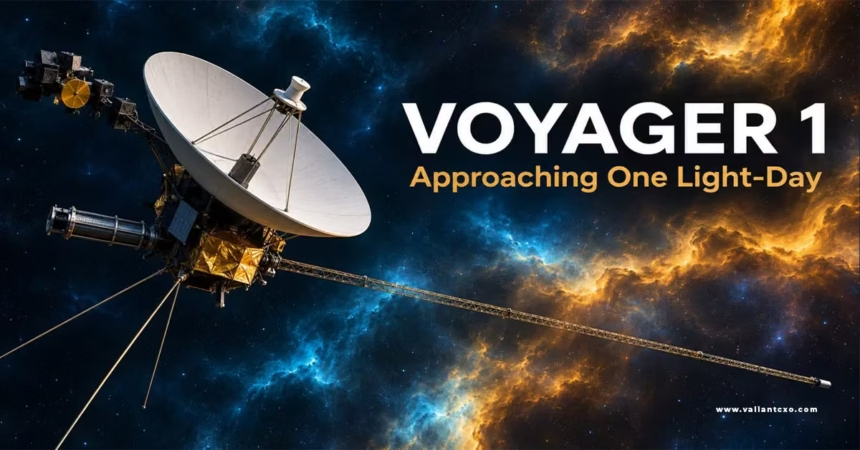
Voyager 1 one light-day from Earth November 2026 is a real, finished milestone, not a forecast. Here’s the quick version:
- What happened: On November 18, 2026, at 5:16:07 a.m. Eastern (10:16:07 UTC), NASA’s Voyager 1 reached a distance where a radio signal needs a full 24 hours to arrive.
- How far: Roughly 25.9 billion kilometers, or about 16.1 billion miles.
- Why it’s historic: No other human-made object has ever gotten this far from home.
- What’s next: Voyager 2 won’t hit the same mark until around November 2035.
Keep reading for what a light-day actually means, and how to talk about it without sounding like a press release.
What Is a Light-Day, Really?
Light moves at about 299,792 kilometers per second. Give it 24 hours and it covers roughly 25.9 billion kilometers. That’s your light-day.
Simple definition. Hard to feel.
Here’s the analogy I like. Imagine shouting across a canyon, except the echo takes two full days to come back. You’d say your sentence, go to bed, wake up, go to work, and only the next evening would the other side even hear you. That’s the conversation NASA’s Deep Space Network now has with Voyager 1. A command goes out and takes a day to land. The reply takes another day to return.
Round trip: 48 hours. Every single exchange.
The Voyager 1 One Light-Day From Earth November 2026 Timeline
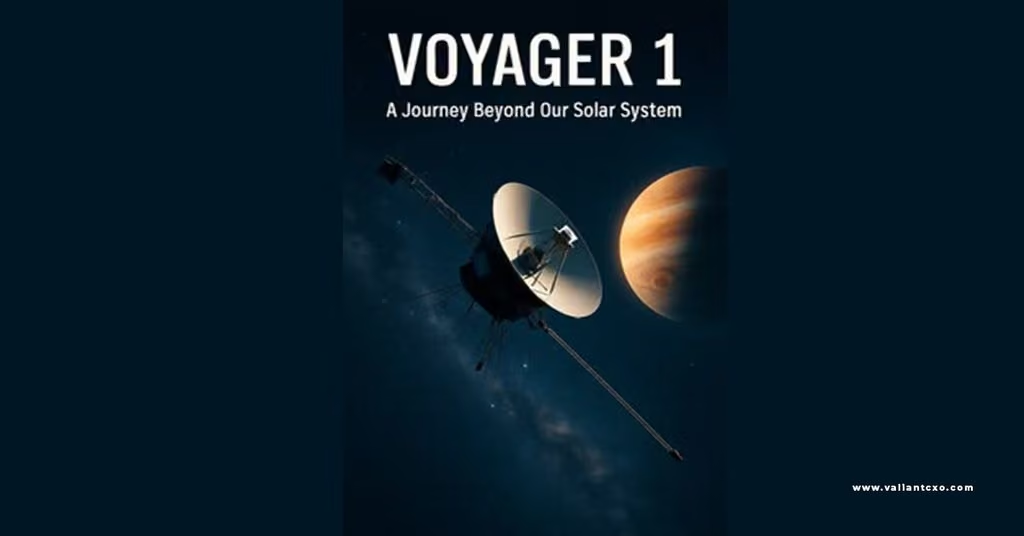
Voyager 1 launched on September 5, 1977. It flew past Jupiter and Saturn, then kept going. According to NASA’s Voyager mission page, the pair of probes are still tracked daily as they push through interstellar space.
The probe crossed the heliopause, the boundary of the Sun’s magnetic influence, back in 2012. It cruises at about 17 kilometers per second. Reports pegged the journey to one light-day at 49 years, 2 months and 11 days.
Is that fast? By any human standard, absurdly. By cosmic standards, it’s a crawl.
Voyager 2 took a longer road because it visited Uranus and Neptune. That detour is why its own one-light-day moment sits near November 2035, per Science News’ coverage of the milestone. And honestly, whether it’s still alive by then is an open question.
Putting the Distance in Context
Numbers this big slide right off your brain. A comparison table helps.
| Benchmark | One-Way Signal Time | Why It Matters |
|---|---|---|
| Earth to Moon | About 1.3 seconds | Apollo-era conversations had a noticeable lag |
| Earth to Sun | About 8 minutes 20 seconds | The baseline for “sunlight is old news” |
| Earth to Pluto (average) | About 5.5 hours | The edge of what most people picture as “the solar system” |
| Voyager 1, Nov. 18, 2026 | 24 hours | First human-made object to reach this mark |
| Voyager 2 (projected) | 24 hours, around Nov. 2035 | Depends on the probe staying operational |
| Nearest star system | More than 4 years | Voyager 1 is still nowhere close |
The kicker? One light-year is about 365 light-days. Voyager 1 has covered one of them in nearly five decades. Do the math and the “interstellar” label starts to feel generous.
Why This Milestone Is Bigger Than a Round Number
Fair pushback: a light-day is an arbitrary line. We picked “24 hours” because humans like days.
True. But arbitrary lines still mark real change. Think of a marathon’s 20-mile wall. Nothing physical happens there, yet everyone knows what it means.
Here’s what I’d tell a friend who rolls their eyes at “just a number”:
- It’s a communication milestone. Engineers can’t joystick this thing. Every command is a message in a bottle.
- It’s an engineering-longevity milestone. A 1970s machine with less computing power than a modern car key is still returning data.
- It’s a cultural milestone. Voyager carries the Golden Record, humanity’s time capsule, farther than anything we’ve built.
Opinion, to be clear: I think the longevity angle is the real story. Distance is just what longevity looks like on a map.
Step-by-Step: How to Follow Voyager 1 One Light-Day From Earth November 2026 as a Beginner
You don’t need a telescope. You can’t see Voyager 1 with one anyway. Here’s an action plan.
- Start with NASA’s live tracker. NASA’s Voyager pages show current distance and signal travel time, updated continuously.
- Learn one number. Memorize “25.9 billion kilometers.” It anchors everything else.
- Convert it to your life. If you drive 65 mph nonstop, you’d need many millions of years to cover that. Pick your own comparison and it sticks.
- Read one quality news summary. EarthSky’s explainer on the November 18 milestone is a friendly starting point.
- Look up the Pale Blue Dot photo. Voyager 1 took it in 1990, and it’s the emotional hook for this whole story.
- Share it with one person. Teaching it is how you lock it in.
What usually happens is that people skip step 3, then forget the number by dinner. Don’t skip it.
Common Mistakes (and How to Fix Them)
Mistake 1: Thinking Voyager 1 left the solar system entirely.
It crossed the heliopause in 2012, so it’s in interstellar space. But the Sun’s gravity still binds the far, icy Oort cloud region around it. Fix: say “left the heliosphere,” not “left the solar system.”
Mistake 2: Assuming it’s close to another star.
It isn’t. Not even remotely. Fix: remember the nearest star system is more than four light-years away, and a light-day is a tiny slice of one.
Mistake 3: Believing we can steer it in real time.
With a 24-hour one-way delay, nothing is real time. Fix: picture mailing a letter, not making a phone call.
Mistake 4: Treating the date as a prediction.
Plenty of articles ran “will reach” headlines for months. As of today, the milestone has happened. Fix: check the publish date and use the past tense.
Mistake 5: Assuming the mission is safe forever.
Reports note the spacecraft’s power supply is expected to run out in the early 2030s. Fix: treat every new Voyager milestone as a bonus, not a guarantee.
What Voyager 1 One Light-Day From Earth November 2026 Tells Us About the Future
I’ve watched space stories spike and vanish for years. The ones that stick share one trait: a human-scale hook on a cosmic fact.
This is one of those. A day is something everyone understands.
So what does it hint at for what comes next? Probably more patience in deep-space missions, and more autonomy built into spacecraft. When your commands take a day to arrive, the machine has to make smarter decisions on its own. If I were advising a student interested in this field, I’d say: learn autonomous systems. That’s where the future leans.
Key Takeaways
- Voyager 1 reached one light-day from Earth on November 18, 2026, at about 5:16 a.m. Eastern.
- That equals roughly 25.9 billion kilometers (about 16.1 billion miles).
- A signal now takes 24 hours one way and 48 hours round trip.
- Voyager 1 is the first human-made object to hit this mark; Voyager 2 is projected for around 2035.
- The probe launched September 5, 1977, and entered interstellar space in 2012.
- Power is expected to fade in the early 2030s, so every extra year is a gift.
- Even at this distance, the nearest star is still more than four light-years away.
Final Thoughts
A 49-year-old machine just made a day-long phone call. That’s the whole story, and it’s a good one.
Next step: open NASA’s Voyager tracker today, note the live distance, and tell one person what a light-day actually means. Ten minutes, and you’ll understand more than most headlines convey.
FAQs
What does Voyager 1 one light-day from Earth November 2026 actually mean?
It means the spacecraft reached a distance where radio waves, which travel at light speed, need a full 24 hours to cross the gap. It happened on November 18, 2026.
Can I see Voyager 1 from my backyard in the USA?
No. It’s far too faint and distant for any backyard telescope. You can follow it through NASA’s online tracking tools and imagery instead.
Will Voyager 1 keep sending data after the one light-day mark?
For now, yes. After the Voyager 1 one light-day from Earth November 2026 milestone, the probe keeps following NASA commands, though its power is expected to run out in the early 2030s.