ASOS Snowflake data breach push notification hack 2026 hit customers hard when unauthorized alerts popped up on their phones claiming hackers had fully compromised the retailer’s Snowflake instance.
Here’s the quick rundown:
- Hackers sent push notifications through the official ASOS app on October 6, 2026, demanding engagement or they’d leak data.
- The message referenced a Snowflake instance and linked to a Telegram channel run by a group calling itself Xuanye.
- ASOS confirmed unauthorized activity on third-party communication platforms and said basic personal info (names, contact details) may have been accessed.
- Payment cards and passwords appear unaffected. Snowflake reported no platform compromise.
- Shares dropped about 10% as the news spread.
This wasn’t a quiet backend incident. It was loud, public, and designed to pressure the company in front of its own customers.
What actually happened in the ASOS Snowflake data breach push notification hack 2026
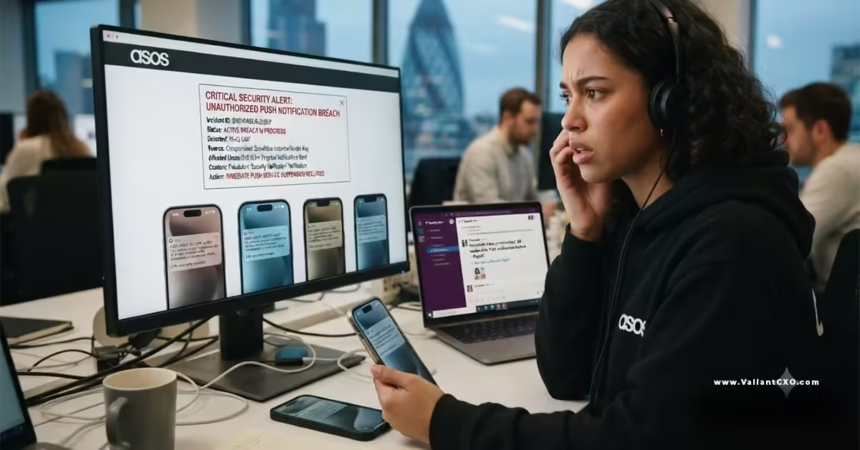
On the morning of October 6, 2026, ASOS app users across the UK (and some elsewhere) woke up to a push notification that looked official. The header screamed “ASOS HACKED.” The body addressed the company’s data protection officer and IT team: “We have fully compromised the Snowflake instance. Engage with us, or we will leak it.” A link pointed to a Telegram channel.
ASOS later confirmed an “unauthorised customer notification” went out around 10 a.m. BST. The company restricted access to the notification platforms, started an investigation with external specialists, and contacted authorities. In statements to customers and media, ASOS said basic personal information including names and contact details may have been accessed. It does not believe payment-card details or account passwords were hit. The website and app kept running.
Snowflake, the cloud data platform named in the alert, said its own investigation found no compromise of its platform. The National Cyber Security Centre offered assistance. Shares in ASOS fell roughly 10% on the day.
The group claiming responsibility, Xuanye, posted on Telegram that payment information was safe and the app remained usable. They also claimed customer data sat on their servers for a set period. No independent evidence of a full Snowflake breach has been published so far.
Sending a push notification through the official app requires access to the messaging infrastructure ASOS uses, not just a data warehouse. That points to compromise of third-party communication tools rather than (or in addition to) the Snowflake environment itself.
Why the ASOS Snowflake data breach push notification hack 2026 matters for everyday shoppers
Most data breaches stay behind the curtain. This one didn’t. Customers saw the threat on their lock screens. That visibility creates panic even when the actual data exposure looks limited.
Names and contact details are useful for phishing. Attackers who already know you shop at ASOS can craft more convincing follow-up messages. The Telegram link itself was a risk—anyone who clicked stepped into attacker-controlled territory.
In my experience, these public extortion plays often aim at two audiences at once: the company (pay or we dump) and the customers (create noise and pressure). The more visible the pressure, the faster the company might feel forced to respond.
Step-by-step action plan if you got the notification
Here’s what I’d do right now if this landed on my phone.
- Do not click the link in the notification. Delete or dismiss it. ASOS has already told customers to ignore it.
- Open the official ASOS app or site only through your usual bookmark or app icon. Check for any official in-app message from the company.
- Change your ASOS password if you haven’t updated it recently. Use a unique one. Turn on two-factor authentication if it’s available.
- Review any saved payment cards or addresses in your account and remove anything you don’t actively need.
- Watch your email and texts for follow-up phishing that mentions the breach. Legitimate ASOS messages will not ask you to click external links or enter credentials on third-party pages.
- Consider placing a free credit freeze or fraud alert with the major credit bureaus if you live in the US and want extra caution. Names and emails alone rarely trigger immediate account takeovers, but layered protection never hurts.
- Keep an eye on official ASOS updates through the app or their verified channels rather than random social media posts.
That’s the practical short list. Most people who received the alert will not face direct financial loss from this incident based on current statements.
Common mistakes & how to fix them after the ASOS Snowflake data breach push notification hack 2026
Mistake 1: Clicking the Telegram link out of curiosity.
Fix: Assume any external link in a breach-related alert is hostile until proven otherwise. Close it.
Mistake 2: Reusing the same password across shopping sites.
Fix: Generate a unique password for ASOS immediately and store it in a password manager.
Mistake 3: Ignoring the official company email that followed.
Fix: ASOS sent follow-up guidance. Read it. It confirms what was and wasn’t exposed.
Mistake 4: Panicking and deleting the entire app without checking statements.
Fix: The app itself was not reported as compromised for users. Restricting notification platforms is different from malware on your device.
Mistake 5: Assuming payment cards are automatically safe forever.
Fix: Monitor statements for a few weeks. Card data was not believed to be accessed, but habits matter more than single incidents.

What the data exposure actually looks like
| Data Type | Status According to ASOS | Practical Risk Level | What You Should Do |
|---|---|---|---|
| Name & contact details | May have been accessed | Medium (phishing fuel) | Watch for targeted scams |
| Payment-card information | Not believed impacted | Low | Monitor statements anyway |
| Account passwords | Not believed impacted | Low | Still change if reused elsewhere |
| Order history / browsing | Unconfirmed | Unknown | No specific action needed yet |
This table reflects the company’s public statements as of early reporting. Investigations continue.
How this fits the broader pattern of Snowflake-related incidents
Snowflake customers have been targeted before in large-scale campaigns. The 2024 wave hit multiple high-profile organizations through stolen credentials and misconfigured access. Attackers love cloud data platforms because one set of credentials can unlock large volumes of information.
The ASOS case stands out because of the push-notification theater. Most previous incidents stayed quieter until data appeared on dark-web forums. Here the attackers used the company’s own customer channel as a loudspeaker. That tactic raises the stakes for every retailer that relies on third-party messaging tools.
Think of it like someone breaking into the building’s intercom system and broadcasting threats over the speakers instead of just stealing files from the filing cabinet. The noise itself becomes part of the attack.
Practical lessons for shoppers and small teams
If you run any online store or handle customer data, this incident is a reminder that third-party tools sit on the critical path. Notification platforms, email providers, and analytics services can become the weak link even when the core database stays locked.
What I’d do if I managed a similar stack:
- Require hardware keys or strong MFA on every admin account that can send customer messages.
- Segment notification credentials so a compromise of one tool does not equal total access.
- Run regular access reviews on third-party integrations.
- Have a pre-written customer statement ready for exactly this kind of public event.
For individual shoppers the lesson is simpler. Treat every unexpected alert that asks you to engage or click as suspicious until the company confirms it through a separate, trusted channel.
Key Takeaways
- The ASOS Snowflake data breach push notification hack 2026 involved unauthorized alerts sent through the official app on October 6.
- Basic personal information may have been accessed; payment cards and passwords are not believed to be impacted.
- Snowflake stated it found no compromise of its own platform.
- Do not click any external links in the original notification.
- Change your ASOS password and enable extra account protections.
- Monitor for phishing that references the incident.
- Official updates from ASOS remain the only reliable source of truth right now.
- Visibility of the attack was part of the pressure strategy.
Stay skeptical of any follow-up messages that demand urgency. Check the official ASOS channels, update your credentials, and keep an eye on your statements. That covers the practical response for most people affected by the ASOS Snowflake data breach push notification hack 2026.
FAQs
What should I do if I received the ASOS Snowflake data breach push notification hack 2026 alert?
Ignore the original message, do not click the link, change your password, and follow only official ASOS guidance issued after the event.
Did the ASOS Snowflake data breach push notification hack 2026 expose my credit card?
ASOS has stated it does not believe payment-card information was impacted. Still monitor your statements as standard practice.
Is the ASOS app safe to use after the 2026 incident?
The company reported the website and app operating normally. Restricting the notification platforms does not equate to malware on customer devices.