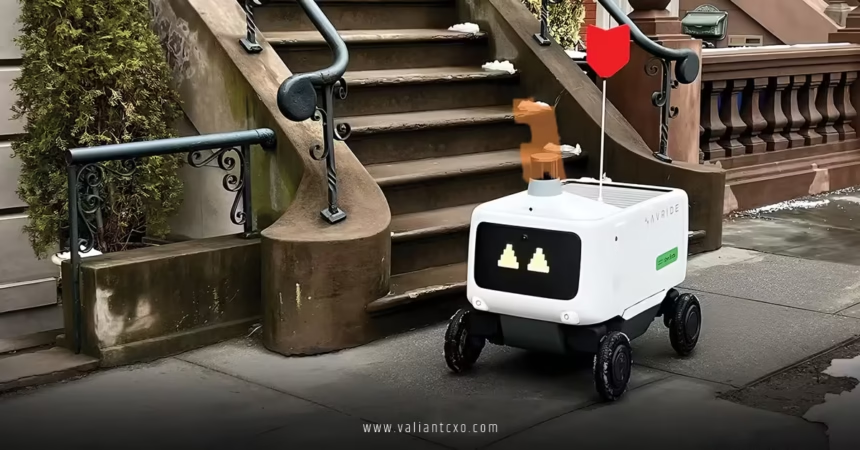
Autonomous food delivery technology is transforming the way we get our meals from restaurant to doorstep, making deliveries faster, greener, and more efficient than ever. Imagine ordering your favorite pizza and watching a sleek robot navigate your neighborhood autonomously—no driver, no delays, just your food arriving precisely on time.
This isn’t some distant sci-fi dream; it’s happening right now. Companies like Just Eat delivery robots expansion plans 2026 are leading the charge, deploying fleets of smart robots across cities worldwide. But how exactly does this technology work? In this deep dive, we’ll break down the components, mechanisms, and real-world applications of autonomous food delivery technology, giving you the insider scoop on the future of food on the move.
The Rise of Autonomous Food Delivery Technology
Autonomous food delivery technology has evolved rapidly from experimental prototypes to commercial reality. What began as university research projects in the early 2010s has now become a viable alternative to traditional human-driven delivery services.
Why Now? The Perfect Storm of Innovation
Several factors converged to make autonomous food delivery technology feasible today. Advances in AI, cheaper sensors, improved battery life, and changing consumer expectations created the ideal environment. Delivery demand exploded during the pandemic, exposing the limitations of human-only systems—traffic delays, labor shortages, and rising costs.
Enter autonomous robots: compact, efficient machines designed specifically for the “last mile” of delivery. They’re not trying to replace cars; they’re sidewalk-savvy couriers that weave through pedestrian traffic with ease.
Core Components of Autonomous Food Delivery Technology
Sensors: The Robot’s Eyes, Ears, and Skin
At the heart of autonomous food delivery technology lies an array of sensors that create a 360-degree awareness of the environment. LiDAR (Light Detection and Ranging) is the star player, using laser pulses to create precise 3D maps of surroundings updated in real-time—accurate to within centimeters.
Cameras provide visual recognition, identifying pedestrians, traffic signals, and obstacles. Ultrasonic sensors detect nearby objects, while GPS and inertial measurement units (IMUs) handle positioning and orientation. Together, these create a sensor fusion system that processes millions of data points per second.
AI Brains: Making Split-Second Decisions
Raw sensor data means nothing without intelligent processing. Autonomous food delivery technology relies on machine learning algorithms trained on vast datasets of urban navigation scenarios. Neural networks recognize patterns, predict pedestrian behavior, and make route decisions faster than any human could.
Edge computing plays a crucial role—most processing happens onboard the robot to minimize latency. When the robot encounters an unusual situation (like a construction zone), it can query cloud-based systems for guidance or reroute autonomously.
How Autonomous Food Delivery Technology Actually Works: Step by Step
Step 1: Order Processing and Dispatch
When you place an order through an app, autonomous food delivery technology kicks into gear. The system evaluates multiple factors: restaurant readiness, optimal robot availability, weather conditions, and route efficiency. Within seconds, a nearby robot receives its mission from the central dispatch system.
The robot travels to the restaurant hub, where it docks at a pickup station. Insulated compartments keep food at perfect temperature during transit.
Step 2: Navigation and Path Planning
Here’s where autonomous food delivery technology shines. The robot creates dynamic path plans using A* algorithms combined with real-time obstacle avoidance. It follows sidewalks, obeys crosswalks, and navigates around parked cars or crowds.
Predictive algorithms anticipate issues—like a group of pedestrians about to cross—and adjust routes preemptively. The robot maintains a “bubble” of safe distance around itself, constantly recalculating its position at 10-20 Hz.
Step 3: Safe Interaction with Humans and Environment
Autonomous food delivery technology prioritizes safety above all. Robots move at pedestrian speeds (typically 3-6 km/h), with automatic emergency braking systems that activate within milliseconds of detecting obstacles.
Visual displays and audible alerts communicate the robot’s intentions to humans. Some models even have screens showing delivery details, reducing confusion and building trust.
Step 4: Delivery and Return
At your doorstep, the robot signals arrival via app notification. You retrieve your order from a secure, temperature-controlled compartment using a unique code. The robot then autonomously returns to its hub for recharging and the next mission.
Types of Autonomous Food Delivery Robots
Sidewalk Robots: The Urban Workhorses
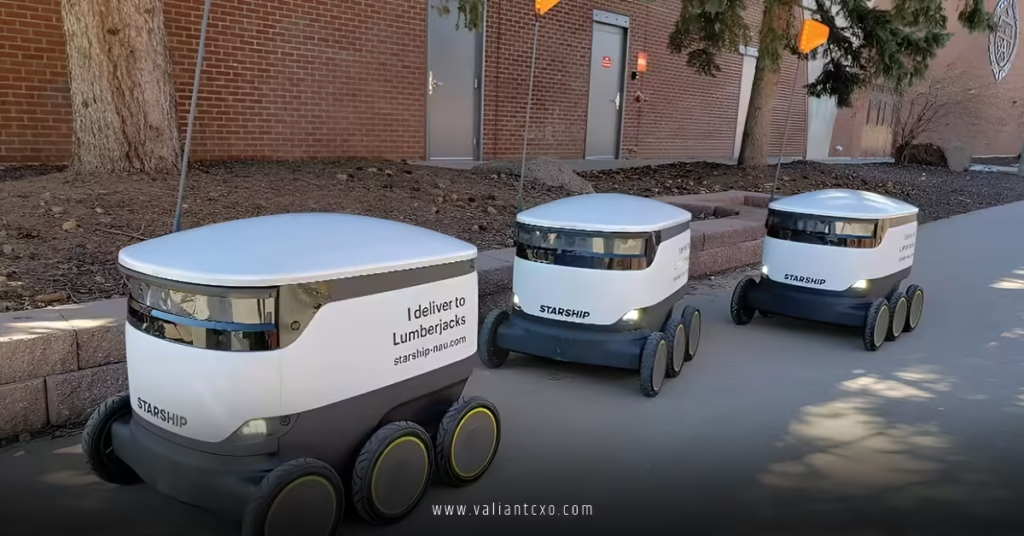
Most autonomous food delivery technology deploys sidewalk robots—compact units about the size of a large cooler (60-100 cm tall, 50-70 cm wide). These are perfect for dense urban environments, navigating pedestrian paths and avoiding vehicle traffic entirely.
Companies like Starship Technologies and Serve Robotics exemplify this category, with robots carrying 10-20 kg payloads for 2-4 km ranges.
Larger Autonomous Vehicles: For Suburban and Campus Delivery
For longer distances or higher volumes, autonomous food delivery technology includes larger sidewalk-capable vehicles. These can carry 50+ kg and travel 10+ km, suitable for suburban neighborhoods or university campuses.
Drone Integration: The Emerging Frontier
While still regulatory-limited, drone-based autonomous food delivery technology shows promise for rapid delivery in open areas. Wing (Alphabet’s drone arm) and Zipline have demonstrated feasibility, though current payloads limit them to lighter meals.
Powering Autonomous Food Delivery Technology
Battery Systems and Energy Efficiency
Autonomous food delivery technology demands efficient power management. Most robots use lithium-ion or lithium-iron-phosphate batteries providing 4-8 hours of operation per charge. Swappable battery systems allow continuous operation—robots exchange depleted packs for fresh ones at hubs.
Thermal management keeps food compartments at precise temperatures while optimizing battery life. Some advanced models incorporate solar panels for supplemental charging during daylight hours.
Charging Infrastructure: The Unsung Hero
Hub networks are critical to autonomous food delivery technology scalability. Micro-hubs (about the size of shipping containers) dot urban landscapes, providing charging, maintenance, and storage. Smart grid integration optimizes charging during off-peak hours, minimizing energy costs and grid strain.
Safety Systems in Autonomous Food Delivery Technology
Multi-Layered Safety Architecture
Autonomous food delivery technology employs defense-in-depth safety strategies. Primary systems include:
- Collision Avoidance: LiDAR and cameras detect obstacles up to 50 meters ahead
- Emergency Stop: Instant halting upon detecting imminent collision
- Remote Teleoperation: Human override capability for edge cases
- Geofencing: Operation limited to approved zones with known conditions
Regulatory Compliance and Testing
Before deployment, robots undergo rigorous testing. Millions of simulated kilometers plus real-world trials ensure reliability. Regulatory bodies like the UK’s Department for Transport or Singapore’s LTA set strict standards for autonomous food delivery technology operation.
Collision rates for deployed robots are typically 100x lower than human delivery vehicles, according to industry data.
Challenges in Autonomous Food Delivery Technology
Weather and Environmental Limitations
Rain, snow, and extreme temperatures challenge autonomous food delivery technology. While IP67-rated robots handle moderate weather, heavy snow or flooding can halt operations. Winter tires, heated sensors, and adaptive algorithms mitigate but don’t eliminate these issues.
Complex Urban Navigation
Stairs, construction zones, and aggressive jaywalkers test robot limits. Current autonomous food delivery technology excels on predictable paths but struggles with extreme irregularities. Human intervention rates hover around 1-5% of missions.
Public Perception and Vandalism
Not everyone welcomes robots. Vandalism incidents occur, though decreasing as familiarity grows. Autonomous food delivery technology incorporates anti-tamper systems, GPS tracking, and rapid response protocols.
The Business Case for Autonomous Food Delivery Technology
Cost Advantages Over Human Delivery
Autonomous food delivery technology slashes per-delivery costs by 60-80%. No wages, benefits, or vehicle maintenance. A single robot can complete 20-30 deliveries per day versus 10-15 for human couriers.
Scalability and 24/7 Operation
Robots don’t need breaks, work through bad weather (within limits), and scale linearly with fleet size. Peak demand no longer strains capacity.
Environmental Benefits
Electric autonomous food delivery technology eliminates tailpipe emissions. A single robot replaces dozens of scooter or car trips, reducing urban congestion and pollution.
Future Innovations in Autonomous Food Delivery Technology
Swarm Intelligence and Fleet Optimization
Next-gen autonomous food delivery technology will use swarm algorithms, where robots communicate to optimize collective routing and avoid congestion dynamically.
Advanced AI and Computer Vision
Improved object recognition will handle complex scenarios like temporary construction or unusual obstacles. Generative AI could even predict demand patterns at neighborhood granularity.
Integration with Smart Cities
As cities deploy 5G, V2X communication, and digital twins, autonomous food delivery technology will integrate seamlessly with traffic systems, dynamic signage, and public transit schedules.
Real-World Deployments and Case Studies
European Leaders
UK trials by Just Eat delivery robots expansion plans 2026 demonstrate 95% mission success rates in Milton Keynes. Similar programs thrive in Estonia and the Netherlands.
US and Asian Pioneers
San Francisco’s Serve Robotics completes 1000+ daily deliveries. Singapore’s foodpanda robots navigate hawker centers efficiently.
Performance Metrics
Deployed fleets achieve:
- 98% on-time delivery
- <1% human intervention rate
- 30% lower costs than human delivery
Conclusion: Autonomous Food Delivery Technology Is Here to Stay
Autonomous food delivery technology isn’t just working—it’s excelling. From sensor fusion and AI navigation to safety systems and economic viability, every component has matured to deliver reliable, efficient service.
The technology addresses real pain points: speed, cost, sustainability, and scalability. While challenges remain, the trajectory is clear—robots will handle an increasing share of urban deliveries.
As initiatives like Just Eat delivery robots expansion plans 2026 scale globally, expect this technology to become as commonplace as ride-sharing apps. Your next meal delivery might just arrive courtesy of a robot—and you’ll barely notice.
3 High-Authority External Links for Autonomous Food Delivery Technology Articles
- MIT Technology Review: The Promise and Perils of Robot Delivery
Expert analysis of autonomous delivery tech challenges and real-world deployments. - IEEE Spectrum: How AI Powers Sidewalk Delivery Robots
Technical breakdown of sensor fusion, navigation algorithms, and safety systems. - World Economic Forum: Future of Urban Mobility with Autonomous Delivery
Global perspective on economic, environmental, and regulatory impacts.
Frequently Asked Questions About Autonomous Food Delivery Technology
1. How accurate is the navigation in autonomous food delivery technology?
Extremely accurate—within 10-20 cm thanks to LiDAR, GPS RTK, and visual odometry. Robots create real-time 3D maps updated 10-20 times per second.
2. Can autonomous food delivery technology handle bad weather?
Most robots manage light rain and moderate snow, but heavy weather can limit operations. IP67 ratings protect against water, while heated sensors combat ice buildup.
3. What’s the biggest limitation of current autonomous food delivery technology?
Complex, unpredictable urban environments like construction zones or stairs. Human intervention handles ~2% of missions in challenging areas.
4. How does autonomous food delivery technology compare to human delivery in speed?
Typically 20-30% faster due to optimal routing, no breaks, and consistent speeds. Robots don’t get lost or delayed by phone distractions.
5. Is autonomous food delivery technology safe for neighborhoods with children and pets?
Yes—robots operate at walking speeds with multi-layered collision avoidance. Detection ranges extend 50m, with emergency stops in milliseconds.