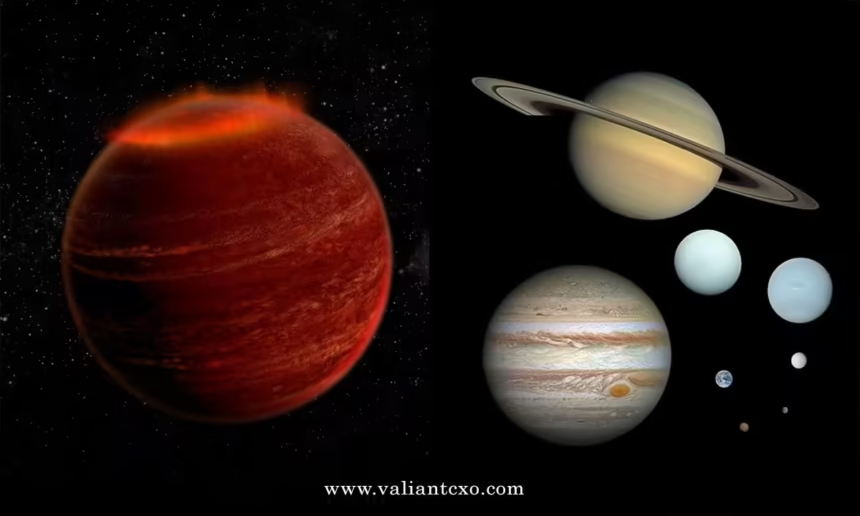
Brown dwarf vs planet definition debates used to be niche, insider astronomy arguments. Now they’re front-page science, thanks to one big disruptor: the James Webb Space Telescope redefines dividing line between planets and stars 2026 moment that’s forcing everyone to redraw the map.
This guide breaks down, in plain English, where the line used to be, what brown dwarfs and planets actually are, and how Webb’s data is changing the rules.
Quick Summary: Brown Dwarf vs Planet at a Glance
- Planets: Lower-mass objects that orbit stars and don’t fuse hydrogen in their cores.
- Brown dwarfs: “Failed stars” that are more massive than giant planets and can briefly fuse deuterium, but never sustain hydrogen fusion like true stars.
- The classic dividing line: around 13 Jupiter masses (the deuterium-burning limit).
- In practice, formation history and environment matter almost as much as mass.
- As James Webb Space Telescope redefines dividing line between planets and stars 2026, astronomers are moving toward a more nuanced, multi-factor definition.
What Is a Brown Dwarf?
Think of a brown dwarf as a star that never quite made it out of training camp.
Core Traits of Brown Dwarfs
- Mass range
Roughly between about 13 and 80 Jupiter masses. - Fusion behavior
- Can fuse deuterium (a heavy form of hydrogen) for a while.
- Too light to sustain regular hydrogen fusion, which is what powers true stars.
- Formation
Usually form like stars: from the collapse of a gas cloud, not by building up in a disk like planets do. - Light and heat
- Start relatively hot and bright in infrared.
- Gradually cool and fade over time.
They’re often described as “failed stars,” but that undersells how interesting they are. Brown dwarfs live in the gray zone: more than a planet, less than a star.
What Is a Planet?
Sounds obvious, right? But once you leave our solar system, the word “planet” gets surprisingly complicated.
Core Traits of Planets (Astrophysical Context)
- Mass range
Below the deuterium-burning limit—so typically under ~13 Jupiter masses. - No sustained fusion
Planets don’t generate energy via core fusion the way stars and brown dwarfs do. - Formation
- Form in protoplanetary disks around young stars.
- Grow by accreting dust, rock, gas, and ice.
- Orbital behavior
- Usually orbit a star or brown dwarf.
- Some are “free-floating,” likely ejected from systems after forming.
For exoplanets, organizations like NASA generally treat anything under the deuterium-burning limit and in a star-like orbit as a planet, but real cases are messier.
Brown Dwarf vs Planet Definition: The Classic Rule
For years, the brown dwarf vs planet definition was sold as a simple mass story:
- Below ~13 Jupiter masses → planet
- Above ~13 Jupiter masses but below ~80 Jupiter masses → brown dwarf
- Above ~80 Jupiter masses → hydrogen-burning star
Why 13 Jupiter masses? Because that’s roughly where an object can start fusing deuterium in its core. Deuterium fusion is short-lived and weaker than normal hydrogen fusion, but it’s a highly specific physical threshold.
On paper, that’s clean. In the sky, not so much.
Why Mass Alone Fails in the Real Universe
Here’s the thing: galaxies don’t care about our neat categories.
Astronomers now regularly find objects that:
- Sit near the 13 Jupiter-mass boundary.
- Look planet-like in some ways and brown-dwarfy in others.
- Were likely born in ways that don’t match their “assigned” category.
Two big problems with a mass-only brown dwarf vs planet definition:
- Uncertain mass estimates
For distant objects, mass is often estimated indirectly with models. That introduces uncertainty. - Formation ambiguity
An object at 15 Jupiter masses could have:- Formed in a disk like a giant planet, or
- Collapsed like a tiny star.
Same mass, very different origin stories.
That’s where James Webb Space Telescope redefines dividing line between planets and stars 2026 becomes more than a headline—Webb finally gives astronomers the detail they need to sort these edge cases more honestly.
How James Webb Is Changing the Brown Dwarf vs Planet Definition
1. Seeing Fainter, Cooler Objects
Webb’s infrared sensitivity lets it detect:
- Older, cooled-off brown dwarfs.
- Massive exoplanets far from their stars.
- Free-floating planetary-mass objects in young star-forming regions.
These are exactly the troublemakers living on the border between “planet” and “brown dwarf.”
2. Reading Atmospheric Fingerprints
With high-resolution spectra, Webb can distinguish:
- Planet-like atmospheres
Rich in water vapor, methane, complex clouds. - Brown dwarf atmospheres
Often hotter, showing different molecular signatures and cloud structures.
Those atmospheric fingerprints reveal thermal history and hint at formation pathway—key ingredients in a more nuanced brown dwarf vs planet definition.
3. Adding Formation History to the Definition
Thanks to Webb’s data on young systems and star-forming regions, astronomers can better ask:
- Did this object build up in a disk?
- Or did it collapse directly from a gas cloud?
So the emerging thinking looks more like:
- Planet
- Typically under ~13 Jupiter masses.
- Formed in a disk around a star.
- No significant deuterium burning.
- Brown dwarf
- Typically above ~13 Jupiter masses.
- Formed like a star, from direct collapse.
- Briefly burned deuterium at some point.
Mass still matters. But it’s not the only thing that matters.
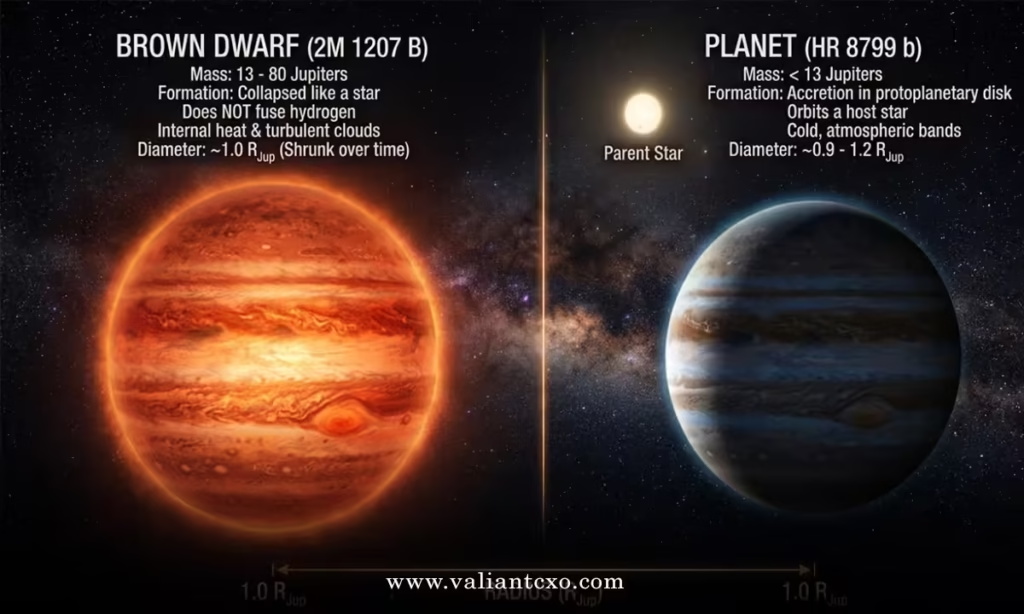
Side-by-Side: Brown Dwarf vs Planet
Here’s a quick comparison you can actually use.
| Property | Planet | Brown Dwarf |
|---|---|---|
| Typical Mass | Up to ~13 Jupiter masses | ~13–80 Jupiter masses |
| Deuterium Fusion | No sustained deuterium burning | Yes, briefly in early life |
| Hydrogen Fusion | Never | Never sustained; that’s stars only |
| Formation Mechanism | Builds up in a disk around a star | Forms like a star from cloud collapse |
| Typical Location | Orbits a star or brown dwarf; some ejected | Often isolated or in loose systems |
| Light Emission | Shines by reflected or re-radiated starlight | Emits its own infrared light, cooling over time |
| Example Type | Hot Jupiters, cold gas giants, rocky planets | Cool T/Y-type dwarfs, young warm brown dwarfs |
Why the Definition Fight Actually Matters
You might wonder: is this just astronomers arguing over labels?
Not really. In my experience, definition fights usually signal something deeper: the underlying science is evolving fast.
Here’s what’s at stake with the brown dwarf vs planet definition:
- Exoplanet counts
Change the definition, and suddenly some “planets” become brown dwarfs, and some brown dwarfs get moved onto planet lists. - Target selection for life searches
Telescopes looking for potentially habitable worlds need to prioritize truly planet-like objects, not just anything under a certain mass. - Textbooks and public understanding
Students and space fans want clean explanations. Webb is forcing teachers and writers to acknowledge that nature doesn’t always play by simple rules.
When James Webb Space Telescope redefines dividing line between planets and stars 2026, it’s not about trendy new terminology. It’s about aligning the brown dwarf vs planet definition with what the data actually says.
How Scientists Currently Classify Borderline Objects
Here’s what usually happens with a weird object near the planet–brown dwarf boundary:
- Estimate mass and radius
Using observed brightness, spectra, and models. - Check environment
- Is it part of a star-forming region?
- Does it orbit a star or sit alone?
- Analyze the spectrum
Look for clues about temperature, composition, and clouds. - Model its evolution
Compare to theoretical tracks for cooling brown dwarfs vs giant planets. - Assign a working label
Sometimes “planet,” sometimes “brown dwarf,” sometimes “planetary-mass object” when the team isn’t ready to commit.
Definitions here are practical, not sacred. As new data—especially from Webb—arrives, objects can and do get reclassified.
Common Misconceptions About Brown Dwarf vs Planet
Let’s clean up a few myths that come up repeatedly.
Myth 1: “Anything under 13 Jupiter masses is always a planet.”
Not necessarily.
If an object formed directly from cloud collapse and never orbited a star, some astronomers may still treat it as a very low-mass brown dwarf or a star-like object, even if it’s under the traditional fusion threshold.
Myth 2: “All brown dwarfs are too hot to resemble planets.”
Over time, brown dwarfs cool and can reach temperatures similar to giant planets. Some old brown dwarfs can be as cool as a gas giant, making the line even blurrier without formation data.
Myth 3: “Free-floating objects must be brown dwarfs.”
Some are. Others are probably ejected planets that formed in a disk and later got kicked out by gravitational interactions. The label depends on their origin, not just where they ended up.
Myth 4: “Definitions changing means scientists were wrong.”
What usually happens is that new tools reveal more detail. Webb is the new tool; the definitions are being sharpened to match reality, not scrapped because the older work was useless.
How to Use Brown Dwarf vs Planet Definition in Your Own Content
If you create space content—blogs, YouTube scripts, classroom material—here’s how to sound accurate without drowning in jargon.
- Lead with mass, add formation
- “This object is near the planet–brown dwarf boundary at around X Jupiter masses.”
- “Most evidence suggests it formed like a [planet/star], so astronomers currently treat it as a [planet/brown dwarf].”
- Use flexible terms for edge cases
- “Planetary-mass object”
- “Brown dwarf candidate”
- “Boundary object between planets and brown dwarfs”
- Connect to the bigger story
When appropriate, link into how the James Webb Space Telescope redefines dividing line between planets and stars 2026, so readers see that the debate isn’t random—it’s driven by better data. - Be explicit about uncertainty
Phrases like “current best estimate,” “most researchers classify it as…,” and “future observations may refine this” are honest and trustworthy.
What I’d Do If I Wanted a Rock-Solid Understanding
If I were starting fresh and wanted a genuinely deep grip on brown dwarf vs planet definition (without getting lost in grad-school-level math), I’d:
- Master the mass thresholds first
- Deuterium-burning limit (~13 Jupiter masses).
- Hydrogen-burning limit (~80 Jupiter masses).
- Study a few real examples
Look up a known giant exoplanet near the mass limit and a low-mass brown dwarf and compare:- Mass
- Temperature
- Formation environment
- How catalogs label them
- Follow Webb-based discoveries for 6–12 months
Pay attention to any object described as “at the planet–brown dwarf boundary” and how scientists talk about its classification. - Watch how words are used differently in different contexts
- Outreach articles might simplify.
- Technical papers are more precise and cautious.
Over time, you start to see the brown dwarf vs planet definition not as a single hard line, but as a zone where physics, formation history, and convention all intersect.
Key Takeaways
- Brown dwarfs are substellar objects between roughly 13 and 80 Jupiter masses that can briefly fuse deuterium but never sustain hydrogen fusion like stars.
- Planets are lower-mass bodies (typically under ~13 Jupiter masses) that don’t fuse in their cores and usually form in disks around stars.
- The classic brown dwarf vs planet definition based strictly on a 13 Jupiter-mass cut is too simplistic for many real objects.
- Formation history—star-like collapse vs disk-based growth—now plays a major role in how astronomers classify borderline cases.
- As James Webb Space Telescope redefines dividing line between planets and stars 2026, high-precision spectra and infrared imaging are exposing many objects that don’t fit cleanly into old categories.
- For creators, teachers, and students, the smart move is to talk about mass and formation pathway, and to be comfortable acknowledging uncertainty near the boundary.
FAQs
1. What is the brown dwarf vs planet definition in simple terms?
A planet forms in a disk around a star and does not fuse deuterium or hydrogen in its core, while a brown dwarf is heavier, forms more like a star, and may briefly burn deuterium.
2. Why is the brown dwarf vs planet definition changing in 2026?
Because James Webb is finding borderline objects with mixed traits, so astronomers are using mass, formation history, and atmospheric data instead of just one cutoff.
3. Does the brown dwarf vs planet definition affect exoplanet counts?
Yes. Some objects near the mass boundary may be reclassified, which can change planet catalogs and how scientists describe those worlds.