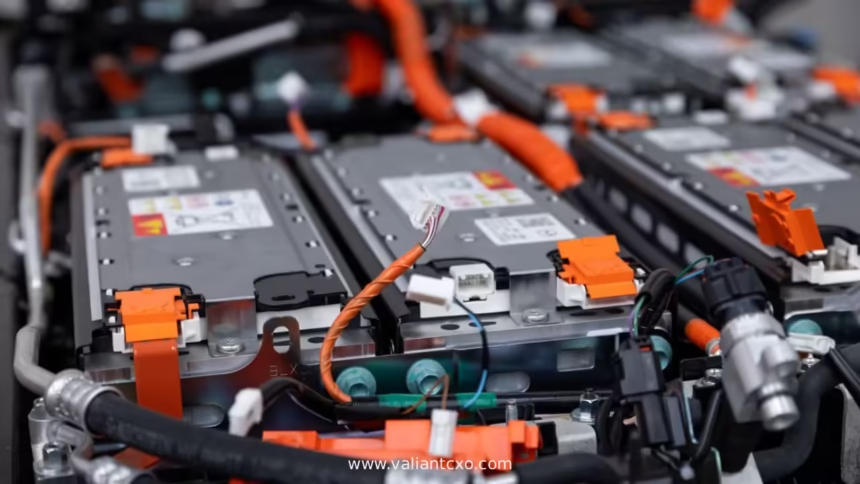
EV battery types explained starts with one hard truth: not all packs are created equal, and the chemistry under the floorboard shapes everything from range and charge speed to safety, cost, and how the car holds up after 100,000 miles.
Here’s the quick overview for 2026 buyers:
- Lithium iron phosphate (LFP) now dominates volume sales thanks to lower cost and strong safety.
- Nickel-based packs (NMC/NCA) still lead on energy density and cold-weather performance in many premium models.
- Sodium-ion is emerging as a budget alternative, especially for shorter-range or cold-climate use.
- Solid-state remains the big future promise, with limited commercial activity tied to the solid state battery commercial release date 2027.
- Choosing the right type depends on your driving needs, climate, and budget—not marketing slogans.
EV battery types explained Walk onto any dealership lot and you’ll hear claims about “next-gen” batteries. Most of the time those claims hide simple chemistry differences. Understanding the main EV battery types explained here keeps you from overpaying or underestimating real-world trade-offs.
The Core Chemistries You’ll Actually Encounter
EV battery types explained Today’s electric vehicles almost all run on lithium-ion technology, but the cathode chemistry creates the real differences.
Lithium Iron Phosphate (LFP)
LFP skips expensive nickel and cobalt. The result is a pack that costs less, resists thermal runaway better, and often lasts longer under daily cycling. Energy density sits lower, so pure range numbers look shorter unless the manufacturer uses clever cell-to-pack packaging. Expect strong performance in moderate climates and excellent value for city or mixed commuting. Many mainstream models from Chinese makers and a growing number of Western brands now default to LFP for standard-range versions.
Nickel-Manganese-Cobalt (NMC) and Nickel-Cobalt-Aluminum (NCA)
These deliver higher energy density. You get more miles from the same weight and better cold-weather retention. The trade-off shows up in higher material cost and a greater need for careful thermal management. Premium long-range EVs and many vehicles sold in North America still lean on these chemistries. They remain the practical choice when highway range or winter performance sits at the top of your list.
Sodium-Ion
Sodium is far more abundant than lithium. Early commercial cells deliver solid cycle life and strong low-temperature behavior at a competitive cost. Energy density trails both LFP and NMC, so these packs suit entry-level city cars, commercial fleets, and stationary storage more than long-haul road-trip machines. 2026 has seen the first meaningful vehicle deployments, mainly in China so far.
Solid-State and Semi-Solid Approaches
True solid-state batteries replace the liquid electrolyte with a solid material. The potential gains—higher energy density, faster charging, and dramatically lower fire risk—are significant. As of late 2026, fully solid-state packs remain limited. The solid state battery commercial release date 2027 marks the expected start of low-volume and pilot vehicle introductions from several major players, with broader availability still years away. Semi-solid or “condensed” designs already appear in some models as a bridge technology.
Side-by-Side Comparison of Main EV Battery Types
| Chemistry | Energy Density | Cost Level | Cycle Life | Safety Profile | Best Fit |
|---|---|---|---|---|---|
| LFP | Moderate | Lowest | Excellent | Very strong | Everyday commuting, value models |
| NMC / NCA | High | Higher | Good | Needs careful management | Long-range, premium EVs |
| Sodium-Ion | Lower | Low | Strong | Promising | Budget & cold-climate use |
| Solid-State | Highest (projected) | Highest early | Excellent (projected) | Excellent | Future premium (from 2027) |
Figures reflect typical 2026 production cells, not laboratory records.
How to Choose the Right Battery Type — Step-by-Step Action Plan
- List your real driving pattern. Daily commute under 40 miles? LFP usually wins on cost and longevity. Frequent 300-mile highway trips? Prioritize NMC energy density.
- Factor in your climate. Cold winters punish LFP more than NMC or sodium-ion. Hot climates favor LFP’s thermal stability.
- Check the warranty fine print. Look for degradation guarantees (often 70% capacity after 8 years or 100,000+ miles) rather than marketing cycle numbers.
- Compare total cost of ownership, not just sticker price. A cheaper LFP pack that holds capacity longer can beat a higher-range NMC option over time.
- Ask specifically about chemistry. Sales teams sometimes blur “lithium-ion” and “solid-state.” Demand the cathode type.
- Watch the solid state battery commercial release date 2027 window if you want early access to next-generation performance, but plan for limited supply and premium pricing at first.
Common Mistakes & How to Fix Them
Mistake: Assuming higher range always equals better battery.
Fix: Higher energy density often costs more and can sacrifice cycle life or safety margins. Match the chemistry to actual needs.
Mistake: Treating every “solid-state” claim as identical.
Fix: Many early announcements refer to semi-solid designs. True all-solid-state vehicles remain scarce until the solid state battery commercial release date 2027 and beyond.
Mistake: Ignoring temperature performance.
Fix: Request real-world cold-weather range data for your region rather than relying on ideal lab numbers.
Mistake: Focusing only on upfront price.
Fix: Calculate expected battery health after five to eight years of ownership. LFP’s longevity often improves residual value.
Mistake: Believing one chemistry will dominate forever.
Fix: The market is fragmenting by use case. LFP for volume, nickel-based for performance, sodium-ion for cost-sensitive segments, and solid-state for the next leap.
Key Takeaways
- LFP has become the volume workhorse for good reason: cost, safety, and durability.
- NMC and NCA still deliver the longest real-world ranges for many drivers.
- Sodium-ion offers a promising low-cost path, especially where lithium supply or cold weather matters.
- Solid-state technology is advancing, with the solid state battery commercial release date 2027 serving as the next major checkpoint for limited vehicles.
- No single chemistry wins every category—match the battery to your driving profile.
- Always verify the exact chemistry and warranty terms before signing.
- Early solid-state buyers should expect premium pricing and restricted availability.
- Current lithium-ion options already deliver excellent performance for the vast majority of owners.
Understanding EV battery types explained this way cuts through the noise. You stop chasing the highest laboratory number and start choosing the pack that actually fits how you drive. For most buyers right now, a well-engineered LFP or NMC pack remains the practical, available choice. Those watching the next leap should keep an eye on progress around the solid state battery commercial release date 2027 and plan purchase timing accordingly.
EV battery types explained If you’re shopping this year, start by identifying your non-negotiables—range, climate resilience, or lowest ownership cost—then let the chemistry data guide the shortlist.
FAQs
What is the most common EV battery type in 2026?
LFP has overtaken nickel-based chemistries in global volume, driven heavily by Chinese production and growing adoption in affordable models worldwide.
Should I wait for solid-state batteries?
Only if you specifically need the projected gains in density and safety and can accept higher cost plus limited early availability tied to the solid state battery commercial release date 2027. Excellent lithium-ion options exist today.
How do I know which chemistry is in a specific car?
Ask the dealer or check the manufacturer’s technical specifications. Look for explicit mentions of LFP, NMC, NCA, or sodium-ion rather than generic “lithium-ion” language.