Falcon 9 booster landing techniques represent one of the most impressive engineering achievements in modern spaceflight. What once seemed like science fiction—catching a massive rocket stage falling from space and gently setting it down on a tiny target—has become almost routine for SpaceX. These techniques enable the company to reuse boosters dozens of times, slashing launch costs and making frequent missions like Starlink deployments possible.
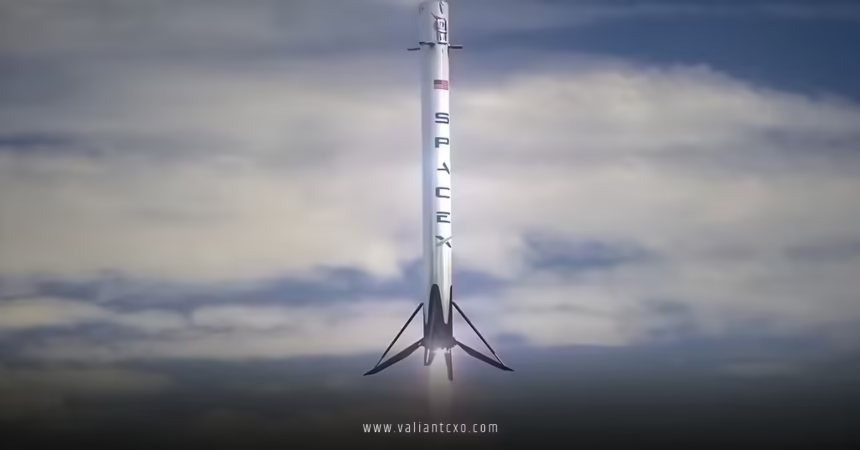
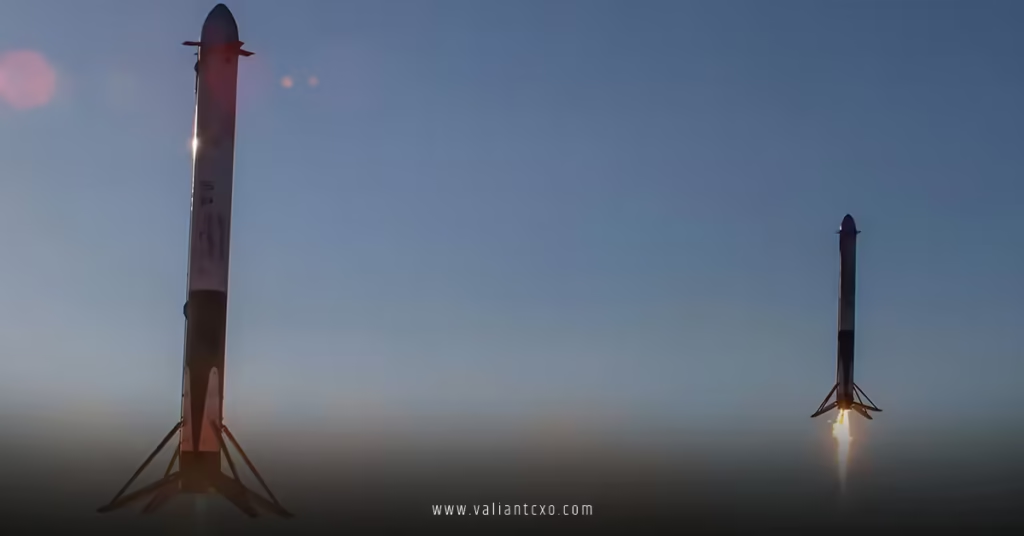
Take the recent SpaceX Starlink 6-110 launch Cape Canaveral February 24 2026 photos as a perfect example. On February 24, 2026, booster B1092 completed its 10th successful flight and touched down flawlessly on the droneship Just Read the Instructions in the Atlantic. The stunning photos from that twilight launch show the booster’s engines lighting up for the final burn, legs deployed, and a perfect vertical touchdown amid dramatic sky colors. It’s a textbook demonstration of how refined these landing techniques have become.
In this article, we’ll break down exactly how Falcon 9 boosters return home safely, the key technologies involved, the step-by-step process, and why these methods matter so much for the future of space travel.
Why Falcon 9 Booster Landing Techniques Changed Everything
Before SpaceX cracked reusable rockets, every launch discarded the first stage like a single-use soda can. That approach was expensive and wasteful. Falcon 9 booster landing techniques flipped the script by making the most powerful part of the rocket—the first stage—recoverable and reflown.
By early 2026, SpaceX had achieved over 575 successful booster landings out of roughly 600 attempts, pushing the success rate for Block 5 boosters above 98.9%. Some boosters, like veterans in the fleet, have flown 10+ times. This reusability isn’t just cool; it’s what allows SpaceX to launch nearly every other day, building massive constellations like Starlink without breaking the bank.
Think of it like turning a disposable rocket into an airplane: fly, land, refuel, repeat. The savings are enormous, and the reliability is astonishing.
Core Components Powering Falcon 9 Booster Landing Techniques
Several clever systems work together to guide the booster back to Earth with pinpoint accuracy. Here’s what makes it possible:
1. Grid Fins: Steering at Hypersonic Speeds
The four titanium grid fins at the top of the interstage act like control surfaces on a fighter jet—but for a rocket plummeting at thousands of miles per hour. These fins move independently to shift the center of pressure, allowing precise steering during the high-speed reentry phase when aerodynamic forces are brutal.
During reentry, the booster reaches hypersonic speeds, and the grid fins bite into the thin upper atmosphere to flip and orient the stage engines-down for the burns. Without them, the booster would tumble uncontrollably.
2. Cold Gas Nitrogen Thrusters: Fine Attitude Control
Small cold gas thrusters (using compressed nitrogen) provide quick, low-thrust adjustments when grid fins alone aren’t enough—especially right after stage separation or during the flip maneuver. They help rotate the booster 180 degrees so the engines point toward the direction of travel for the boostback or entry burns.
These thrusters are lightweight and reliable, perfect for vacuum or near-vacuum conditions early in descent.
3. Merlin Engines: The Heavy Lifters for Powered Descent
The nine Merlin 1D engines on the first stage aren’t just for liftoff. One to three relight for controlled descent. The engines can throttle deeply (down to about 40% thrust) and gimbal for steering.
The key burns include:
- Boostback burn (for RTLS landings): Reverses horizontal velocity to head back to the launch site.
- Reentry burn: Slows the booster and protects it from heat by reducing speed before peak heating.
- Landing burn: The final dramatic single-engine (sometimes three) burn that kills velocity to near-zero at touchdown.
The landing burn is especially critical—it’s short, intense, and must perfectly time throttle changes to hover briefly and settle softly.
Step-by-Step: The Falcon 9 Booster Landing Sequence
Here’s how a typical landing unfolds, using the SpaceX Starlink 6-110 launch Cape Canaveral February 24 2026 photos mission as reference:
- Liftoff and Ascent — Booster powers the rocket to ~65-80 km altitude.
- Stage Separation — At MECO (main engine cutoff), the second stage ignites, and the booster separates.
- Flip Maneuver — Cold gas thrusters rotate the booster 180° to engines-down orientation.
- Boostback Burn (if returning to land) — One or more engines fire to cancel downrange velocity and aim back toward LZ-1 or the droneship.
- Reentry Phase — Grid fins steer through hypersonic descent. The booster orients heat shield (engine side) forward to manage plasma and heat.
- Entry Burn — Engines relight to bleed off speed and reduce heating.
- Final Descent — The booster coasts briefly, then performs the landing burn. Legs deploy seconds before touchdown.
- Touchdown — Velocity drops to ~0 m/s, legs absorb the impact, and the booster stands tall.
For drone ship landings like Starlink 6-110, the target is a moving platform ~300-600 km offshore. The booster must predict ship position, account for waves, and adjust trajectory autonomously.
The guidance uses convex optimization algorithms—pre-computed on the ground with tools like CVXGEN—to solve thrust vectoring and throttle problems in real time. This ensures the booster can handle wind, engine variations, or sensor noise while achieving zero velocity exactly at the pad.
Land vs. Drone Ship: Subtle Differences in Techniques
- Return to Launch Site (RTLS): Shorter flight path, more fuel for boostback. Used when payload mass allows it. Requires precise timing since the landing pad doesn’t move.
- Drone Ship (ASDS): Longer downrange distance, less boostback needed, but the target floats and rocks. SpaceX stations ships like Just Read the Instructions precisely, and the booster uses GPS, radar, and onboard sensors for final alignment.
In the February 24, 2026 Starlink mission, the droneship landing highlighted how mature these techniques are—even on a veteran booster’s 10th flight.
Challenges Overcome and Current Reliability
Early attempts (2013–2015) saw explosions, tip-overs, and hard splashdowns. SpaceX iterated rapidly: added legs, improved grid fins, refined burns.
By 2026, landing success exceeds 97% overall and nears 99% for newer Block 5 boosters. Weather, sea state, and fuel margins remain risks, but autonomous flight software handles most variables better than any human pilot could.
Why These Techniques Matter Beyond SpaceX
Falcon 9 booster landing techniques prove reusability works at scale. Lower costs mean more science, more satellites for internet access, better Earth observation, and stepping stones to Mars.
Every successful landing—like the one immortalized in the SpaceX Starlink 6-110 launch Cape Canaveral February 24 2026 photos—pushes the industry forward. Competitors are chasing similar capabilities, but SpaceX’s lead remains huge.
Conclusion
Falcon 9 booster landing techniques combine grid fins, thrusters, relightable engines, and smart software into a system that’s reliable, precise, and revolutionary. From early ocean soft landings to routine drone ship touchdowns like the February 24, 2026 Starlink mission, these methods have transformed spaceflight economics and frequency.
Next time you see a booster descend engines blazing in launch footage, remember the decades of engineering behind that “routine” touchdown. It’s not magic—it’s mastery.
Here are three high-authority external links for deeper reading:
- SpaceX Falcon 9 Overview
- Wikipedia: Falcon 9 First-Stage Landing Tests
- Spaceflight Now Launch Coverage
FAQs
What are the main Falcon 9 booster landing techniques used today?
Falcon 9 booster landing techniques rely on grid fins for steering, cold gas thrusters for attitude control, and relightable Merlin engines for boostback, entry, and final landing burns.
How accurate are Falcon 9 booster landings?
Modern Falcon 9 booster landing techniques achieve accuracy within tens of meters, often landing within 10 meters of the target center on droneships or pads.
Why do some missions use drone ships instead of landing on land?
Drone ship landings allow heavier payloads since less fuel is needed for boostback. Techniques are similar, but the moving target adds complexity.
How many times can a Falcon 9 booster land using these techniques?
With current Falcon 9 booster landing techniques, boosters regularly achieve 10+ flights. Some have exceeded 20 reflights by 2026.
Did the booster from the SpaceX Starlink 6-110 launch use standard landing techniques?
Yes, the booster in the SpaceX Starlink 6-110 launch Cape Canaveral February 24 2026 photos followed classic techniques: entry burn, final single-engine landing burn, and precise droneship touchdown on its 10th flight.