History of AMC American Motors Corporation muscle cars in the 1970s is one of the most fascinating underdog stories in automotive lore. While the Big Three – GM, Ford, and Chrysler – threw haymakers with Hemis, big-block Chevelles, and Boss Mustangs, little American Motors Corporation (AMC) from Kenosha, Wisconsin, quietly built some of the wildest, most rebellious muscle machines of the decade. They didn’t have bottomless budgets, but what they lacked in cash they made up for in pure audacity. Let’s dive deep into this rollercoaster decade for AMC muscle.
The Storm Before the Calm: AMC Enters the 1970s Riding High
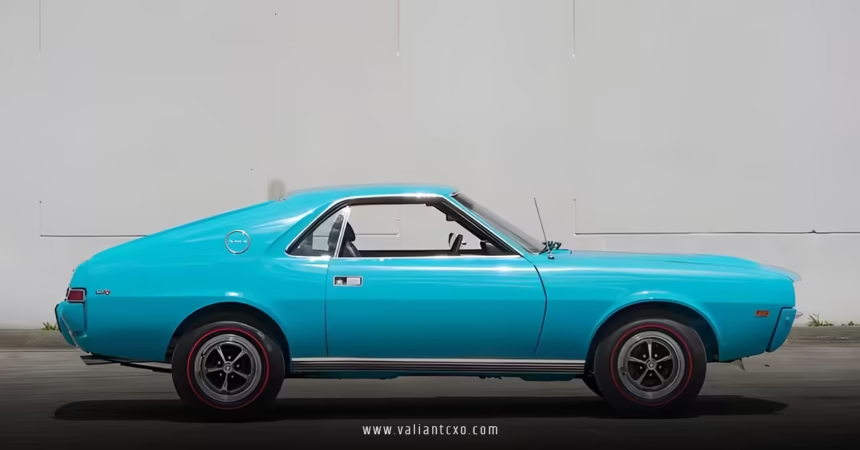
When 1970 dawned, AMC was still buzzing from the late-1960s success of the AMX and Javelin. The stunning two-seater AMX had shocked the industry in 1968 by beating Corvette in some road tests, and the pony-car Javelin gave pony-car buyers a stylish alternative to Camaros and Mustangs. The history of AMC American Motors Corporation muscle cars in the 1970s really begins with the carry-over momentum from those late-60s icons.
The 1970 Javelin and AMX both received a dramatic restyle – longer, lower, wider, with bulging fenders that looked like they swallowed a couple of footballs. Under the hood? You could still order the ferocious 390 cubic-inch V8 pumping out 315 horsepower in “Go Package” trim. The new Mark Donohue Signature Edition Javelin even came with a massive rear spoiler that looked like it belonged on a Trans-Am racer – because it basically did.
1970: The Rebel Machine – Patriotism on Four Wheels
Perhaps the single boldest statement in the entire history of AMC American Motors Corporation muscle cars in the 1970s was the 1970 Rebel Machine. Imagine this: a midsize car painted red, white, and blue with a giant hood scoop and “THE MACHINE” spelled out in huge letters on the air cleaner. AMC literally told buyers, “If you’re man enough to handle 340 horsepower and 430 lb-ft of torque, step right up.” Only 2,326 were built, and today they’re holy grails among collectors.
The Dark Clouds Gather: Emissions, Insurance, and the Energy Crisis
By 1971, the party was getting shut down. Insurance companies started treating anything with more than two barrels of carburetion like it was radioactive. Federal emissions standards strangled horsepower. Then came the October 1973 OPEC oil embargo. Suddenly, gas shot past 50 cents a gallon – outrageous money back then – and buyers panicked.
AMC’s response? Fight like hell, then get clever.
1971–1974: The Last True Muscle AMXs and Javelins
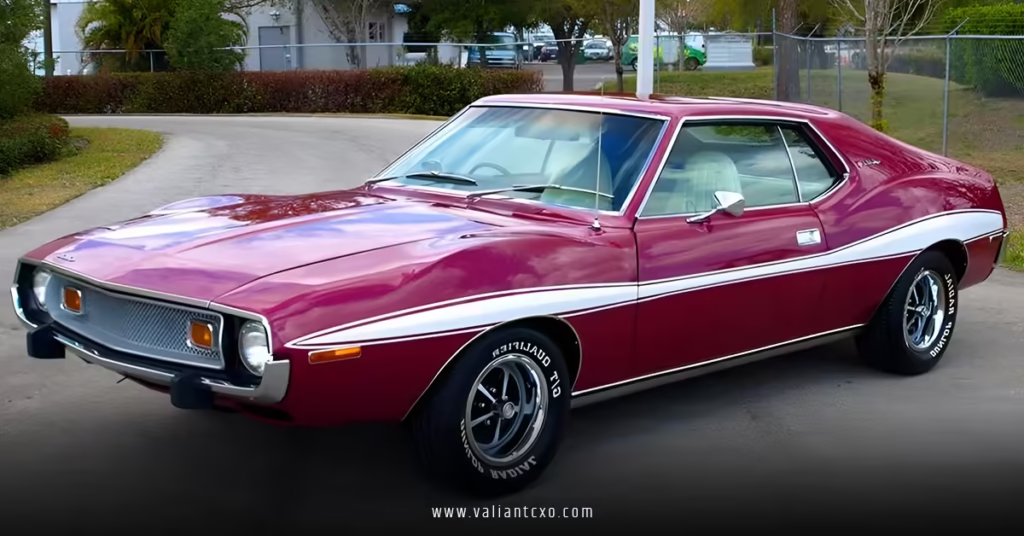
The two-seater AMX name disappeared after 1970, but AMC kept the spirit alive by turning the Javelin into the Javelin AMX. The 1971 model marked the pinnacle: you could still order a 401 cubic-inch V8 rated at 335 gross horsepower (about 260 net – still brutal). The Pierre Cardin interior option – yes, the fashion designer – featured wild multi-color stripes that made the inside look like a disco exploded.
In 1972, horsepower ratings switched to the more honest net figures, and suddenly that same 401 “dropped” to 255 hp on paper. Never mind that it still shredded tires with ease. The 1973–1974 Javelins kept the bulging fenders and gorgeous fastback roofline, but big-block power faded away after ’74.
The SC/360 and SC/1: Forgotten Screamer Hornets
While everyone remembers the Javelin and Rebel Machine, the history of AMC American Motors Corporation muscle cars in the 1970s also includes two insane compact Hornets that almost nobody talks about.
- 1971 Hornet SC/360: A 360 V8 shoehorned into the little Hornet body. 0-60 in the low 7-second range. Only 784 built.
- 1970–1971 SC/1 Hornet: Custom coachwork by a California company that turned Hornets into mini-muscle machines with wild paint and hood scoops.
These were sleepers that could embarrass many so-called muscle cars at stoplights.
1972–1974 Matador Coupe: The Flying Brick That Could
When the Javelin died after 1974, AMC needed a new performance image car. Enter the bizarre but beautiful 1974 Matador Coupe – a car that looked like a bar of soap on steroids. Critics hated the looks, but the X-model with 360 or 401 power could still run mid-14s in the quarter mile. James Bond even drove a Matador Coupe in “The Man with the Golden Gun” (with an AMC Hornet doing that insane corkscrew jump).
The Gremlin That Ate Mustangs: Levi’s Edition and V8 Madness
No conversation about the history of AMC American Motors Corporation muscle cars in the 1970s is complete without the Gremlin. Launched April 1, 1970 (yes, really), most people laughed… until they saw a Gremlin X with the 304 V8 option. 0-60 in under 9 seconds from a car that looked like it was designed with a hacksaw.
AMC even offered a Levi’s Gremlin with denim interior and copper rivets. Pure 1970s excess.
How AMC Survived When Others Gave Up
Here’s what makes the history of AMC American Motors Corporation muscle cars in the 1970s so remarkable: while Pontiac killed the GTO in 1974, Plymouth dropped the Road Runner nameplate into the gutter, and Chevrolet turned the Camaro into a rolling insurance seminar, AMC kept offering V8s well into 1979.
The 1978 AMX (now a trim package on the Concord) still had a 258 inline-six or optional 304 V8. The 1979 Spirit AMX brought back the name with a wild hood decal and available 4-speed manual. Even the 1980 Eagle SX/4 – an all-wheel-drive lifted coupe – could be ordered with the old 258 six that traced its roots to the muscle era.
The Trans Am Racing Legacy You Never Heard Of
AMC never had factory racing budgets like Chevrolet, but privateers campaigned Javelins and AMXs in SCCA Trans-Am with shocking success. Penske Racing fielded Javelins driven by Mark Donohue and George Follmer. In 1971, AMC finished second in the manufacturers’ championship – beating Ford and Chrysler with a fraction of the money.
Key Models That Defined the Decade
Let’s break down the heavy hitters that wrote the history of AMC American Motors Corporation muscle cars in the 1970s:
1970 Rebel Machine
- 340 hp 390 V8
- Red/white/blue paint mandatory
- Hood-mounted tachometer
1971–1974 Javelin AMX 401
- Last true big-block pony car
- 0-60 in 6.5 seconds (1971)
- Pierre Cardin interiors
1971 Hornet SC/360
- Compact sleeper supreme
- Twin-Grip differential standard
1974 Matador X 401
- 0-60 in 7.3 seconds when most “performance” cars wheezed
1979 Spirit AMX
- The final factory AMC muscle car
- GT package with flares and spoilers
Why AMC Muscle Cars Are Exploding in Value Today
Walk into any car show in 2025 and watch jaws drop when a pristine Rebel Machine or SC/360 Hornet rolls in. These cars were built in tiny numbers. Many were driven hard and put away wet. Survivors are rare.
A 1970 Rebel Machine sold for $135,000 in 2024. Nice Javelin AMXs regularly crack six figures. Even Gremlin Xs are pushing $40,000 when equipped with the V8 and 4-speed.
Why? Because collectors finally realized the history of AMC American Motors Corporation muscle cars in the 1970s is the story of pure passion beating corporate spreadsheets.
Conclusion: The Little Company That Refused to Die
The history of AMC American Motors Corporation muscle cars in the 1970s isn’t about dominating sales charts. It’s about a scrappy independent refusing to surrender its soul while Detroit’s giants rolled over for emissions lawyers and insurance actuaries. From the outrageous Rebel Machine to the final Spirit AMX, AMC kept the flame alive when everyone else was snuffing it out.
Next time someone tells you muscle cars died in 1972, hand them a photo of a 1974 Javelin AMX 401 or a bright blue Gremlin X laying twin stripes. Tell them the real story – the one that happened in Kenosha while the rest of the industry was busy building malaise.
AMC didn’t just survive the 1970s. They thumbed their nose at it.
Want to own a piece of this rebellious history? Start hunting. The secret’s out, and these cars aren’t getting any cheaper.
FAQs About the History of AMC American Motors Corporation Muscle Cars in the 1970s
Q: What was the fastest AMC muscle car produced in the 1970s?
The 1971 Javelin AMX with the 401 V8 and close-ratio 4-speed is generally considered the quickest, running 0-60 in about 6.0–6.5 seconds in period tests.
Q: Why did AMC paint the Rebel Machine red, white, and blue?
Pure marketing genius. In 1970, patriotism sold. AMC marketed it as “The All-American Supercar” to contrast with imported competition and appeal to buyers tired of corporate sameness.
Q: Are 1970s AMC muscle cars reliable today?
Surprisingly yes. The 304, 360, and 401 engines are bulletproof if maintained. Parts availability through the AMCA club and aftermarket is excellent.
Q: What’s the rarest AMC muscle car from the 1970s?
The 1971 Hornet SC/360 with only 784 units produced, followed closely by the 1970 Rebel Machine at 2,326 examples.
Q: Did any 1970s AMC muscle car win major racing championships?
While factory support was limited, AMC-powered cars won the 1971 and 1972 SCCA Trans-Am championships in privateer hands, and the Javelin finished 2nd in manufacturer points in 1971, 1972, and 1973.
Read More:valiantcxo.com