How to check Microsoft 365 service health status is a question every admin, IT manager, and remote worker needs answered fast — especially after the Microsoft 365 outage recovery not going as expected cause explained November 2026 incident proved just how quickly things can unravel. When email dies and Teams calls freeze mid-sentence, you don’t need theories. You need facts, in real time, from a source that doesn’t lie to you.
Here’s the good news: Microsoft actually gives you several reliable ways to check this. Most people just don’t know they exist.
Quick Overview:
- Primary tool: The Microsoft 365 admin center’s Service Health dashboard — the official, most detailed source.
- No-login option: The public Microsoft 365 Status page and social account for a fast outside check.
- Crowd-sourced backup: Downdetector, useful when Microsoft’s own status tools are themselves affected.
- Why it matters: Catching an outage early means you can switch communication channels before your whole team grinds to a halt.
- Real-world lesson: The November 2026 outage showed even Microsoft’s own fixes can fail — so monitoring status in real time, not after the fact, is what separates smooth recoveries from chaotic ones.
Why Checking Microsoft 365 Service Health Status Actually Matters
Here’s the thing — most people only think to check service health after they’ve spent twenty minutes blaming their Wi-Fi. That’s backward.
In my experience, the teams that handle outages best are the ones who check status first, panic never. During the November 2026 outage, when Microsoft’s recovery attempts weren’t going as expected, the admins who were already watching the Service Health dashboard pivoted to phone calls and Slack within minutes. Everyone else sat refreshing Outlook like it owed them money.
Knowing where to look, before anything breaks, is half the battle.
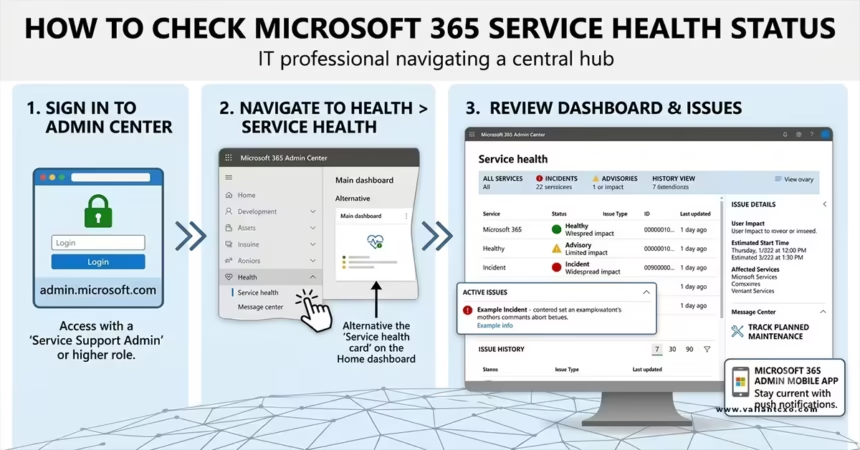
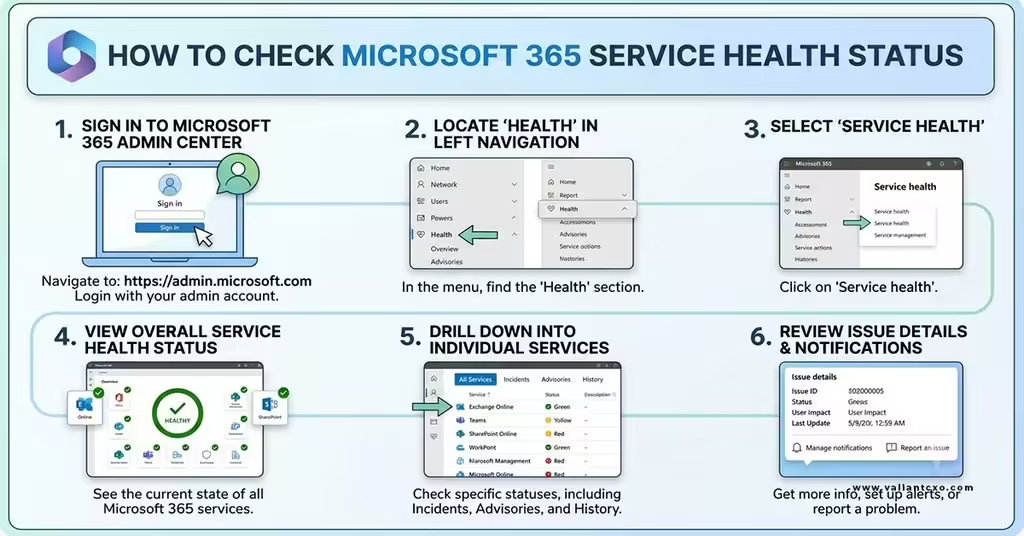
Method 1: The Microsoft 365 Admin Center (Most Reliable)
If you’re an admin — even for a small business — this is your primary weapon.
- Go to the Microsoft 365 admin center and sign in with an administrator account.
- In the left navigation, click Health, then select Service health.
- You’ll see a live dashboard broken down by service: Exchange Online, Teams, SharePoint, OneDrive, and more.
- Click any flagged service for incident details, estimated resolution timelines, and Microsoft’s own engineering notes.
This is exactly the dashboard that showed the “elevated load” messaging during the Microsoft 365 outage recovery not going as expected cause explained November 2026 event — real incident IDs, real timestamps, no guesswork.
Who Can Access the Admin Center Service Health Page
Not everyone in your organization has access by default. Microsoft restricts it to specific roles [1]:
- Global Administrator
- Service Administrator
- Global Reader
- Helpdesk Administrator
If you’re not in IT, ask whoever manages your Microsoft 365 tenant to bookmark this page — it should be checked first during any slowdown.
Method 2: The Public Microsoft 365 Status Page (No Login Needed)
Not an admin? No problem. Microsoft runs a public-facing status page at status.cloud.microsoft that doesn’t require any sign-in.
It’s lighter on detail than the admin center, but it’ll confirm whether Microsoft itself has acknowledged a problem — which matters, because sometimes the issue really is on your end.
The Microsoft 365 Status Account (Fastest Public Updates)
Microsoft also posts real-time updates through its official Microsoft 365 Status account, which is often the fastest public channel during a live incident. During major outages, this is usually where Microsoft confirms an issue before the admin center dashboard fully updates for every tenant.
Method 3: Downdetector — The Crowd-Sourced Gut Check
Downdetector isn’t official, but it’s genuinely useful — especially in that weird window when Microsoft’s own status tools are slow to update or, ironically, affected by the same outage.
It pulls real-time user reports and plots them on a map, so you can see if outages are isolated to your region or hitting the whole country.
Is it perfect? No. Is it a great gut-check before you escalate internally? Absolutely.
Microsoft 365 Status-Checking Tools Compared
| Tool | Login Required? | Detail Level | Best For |
|---|---|---|---|
| Admin Center Service Health | Yes (admin role) | High — incident IDs, timelines, root cause notes | IT teams, business admins |
| Public Status Page (status.cloud.microsoft) | No | Moderate — confirms active incidents | Everyday employees, remote workers |
| Microsoft 365 Status (official account) | No | Moderate — fast public updates | Quick real-time confirmation |
| Downdetector | No | Low-moderate — crowd-sourced reports | Second opinion, regional spread check |
Step-by-Step Action Plan: What To Do the Moment You Suspect an Outage
- Check the public status page first if you don’t have admin access — it takes ten seconds.
- Have your admin check the Service Health dashboard for full incident details and estimated timelines.
- Cross-check Downdetector if Microsoft’s own tools seem slow or inconsistent — that mismatch is itself a signal.
- Switch your team to a backup channel immediately — don’t wait for official confirmation if multiple people report the same issue.
- Document timestamps. This matters for SLA claims and for understanding later whether recovery is actually going as expected or stalling out.
- Re-check status every 30 minutes, not every 2 minutes — hammering dashboards doesn’t speed anything up.
Common Mistakes & How to Fix Them
Mistake 1: Only checking Downdetector and assuming it’s gospel. Fix: Treat it as a second opinion, not the primary source. Always verify against Microsoft’s own admin center or status page.
Mistake 2: Not knowing your admin role permissions ahead of time. Fix: Confirm who in your org has Service Health access before an outage hits — not during one.
Mistake 3: Assuming “all clear” from the status page means everything’s fully back. Fix: Remember the Microsoft 365 outage recovery not going as expected cause explained November 2026 incident — Microsoft marked multiple “fixed” stages that later needed more work. Wait for full confirmation before resuming critical workflows.
Mistake 4: Ignoring regional outage patterns. Fix: Use Downdetector’s map feature to check if it’s a localized ISP issue versus a true Microsoft-side failure.
Key Takeaways
- The Microsoft 365 admin center’s Service Health dashboard is the most detailed, authoritative source for outage information.
- Public options like status.cloud.microsoft and the official Microsoft 365 Status account work without any admin login.
- Downdetector is a solid crowd-sourced backup, particularly useful when Microsoft’s own tools lag.
- Checking status early — not after your whole team notices — is what separates a smooth pivot from total chaos.
- The November 2026 outage proved that even Microsoft’s confirmed fixes can fail, so don’t fully relax the moment a status page says “resolved.”
- Build a habit of checking service health first, troubleshooting your own setup second.
Knowing exactly where to look the second something feels off is a small habit that saves hours of frustration. Bookmark the admin center dashboard and the public status page today, before the next outage forces your hand.
FAQs
Can I check Microsoft 365 service health status without being an IT admin?
Yes — use the public status page at status.cloud.microsoft or the official Microsoft 365 Status account; both work without any admin login.
Why did Microsoft’s status updates seem inconsistent during the November 2026 outage?
Based on Microsoft’s own public statements, this ties directly back to the Microsoft 365 outage recovery not going as expected cause explained November 2026 incident, where fixes Microsoft believed would work didn’t hold, causing status updates to shift multiple times in one day.
What’s the fastest way to confirm a Microsoft 365 outage is real and not just my internet?
Check status.cloud.microsoft or Downdetector first — if both confirm issues and you have admin access, the Service Health dashboard will give you full incident detail within minutes.