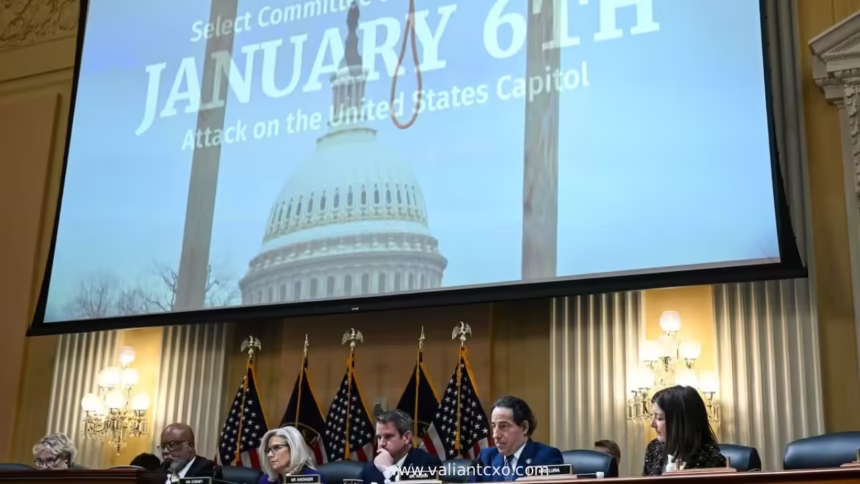
January 6 Capitol attack investigation timeline stretches from the chaotic afternoon of the breach itself through years of the largest federal criminal probe in U.S. history, multiple congressional inquiries, a special counsel indictment, Supreme Court delays, and eventual pardons. The federal effort ultimately charged more than 1,500 people and produced the August 2023 case against Donald Trump that Jack Smith later defended in Senate testimony.
Here is the essential sequence, stripped of the noise.
Immediate Response: January–December 2021
The Justice Department opened its investigation the day after the attack. Acting U.S. Attorney Michael Sherwin stated publicly that prosecutors would not rule out charges against anyone, including the former president. FBI field offices across the country began identifying rioters through video, social media, and tip lines. By the end of 2021, hundreds of arrests had already occurred, mostly for trespassing, assault on officers, and related offenses. Parallel work by the House of Representatives laid the groundwork for a select committee that would later formalize in mid-2021.
Early internal FBI activity also included a preliminary inquiry known as Rampart Twelve that examined certain congressional tours occurring around the same period. That inquiry closed in early 2022 without producing charges against members of Congress.
Expansion and the House Select Committee: 2022
By March 2022 the investigation had widened beyond individual rioters. Prosecutors began examining the planning and funding of the “Stop the Steal” rally and the broader effort to challenge the electoral count. Subpoenas went out to people linked to those efforts.
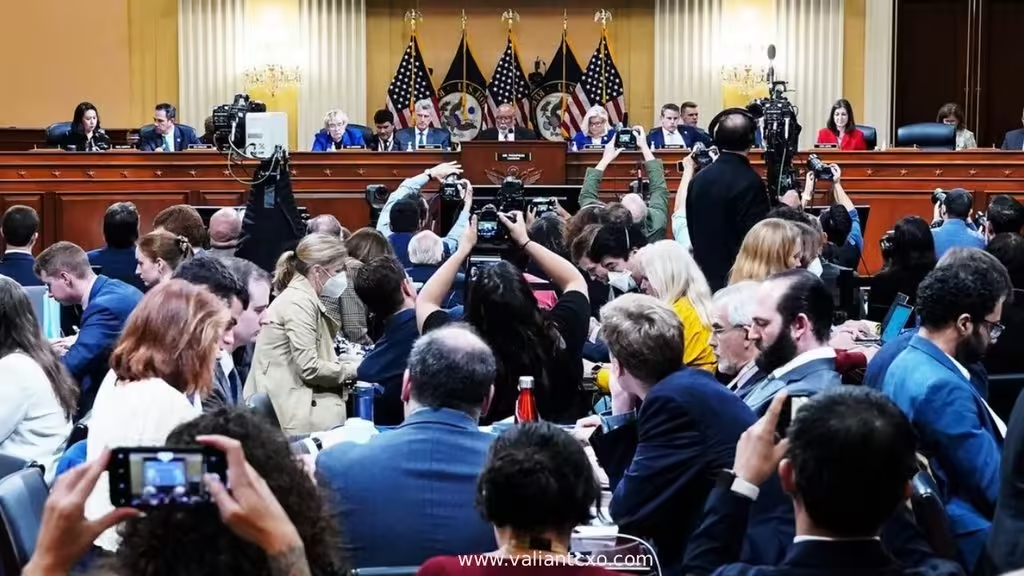
The House Select Committee to Investigate the January 6 Attack held public hearings through the summer and fall. On December 19, 2022, the committee released its final report and referred Trump and several associates to the Justice Department for potential prosecution on charges that included conspiracy to defraud the United States and obstruction of an official proceeding.
Three days earlier, on November 18, Attorney General Merrick Garland appointed Jack Smith as special counsel. Smith received authority over both the election-interference investigation and the separate classified-documents case.
Special Counsel Phase and Indictment: 2023
Smith’s team moved quickly once it took control. High-ranking former Trump officials, including Mark Meadows and Mike Pence, received grand-jury subpoenas. Former White House counsel Pat Cipollone and others testified after courts rejected broad executive-privilege claims.
On August 1, 2023, a federal grand jury in Washington, D.C., returned a four-count indictment against Trump. The charges centered on an alleged conspiracy to overturn the 2020 election results and obstruct the January 6 certification. The indictment detailed pressure on state officials, the fake-elector scheme in multiple states, pressure on the vice president, and the exploitation of the Capitol violence.
Separately, the broader DOJ effort continued charging and convicting rank-and-file participants. Leaders of the Proud Boys and Oath Keepers faced seditious-conspiracy convictions, with sentences reaching 22 years for Enrique Tarrio.
Legal Headwinds and Dismissal: 2024–Early 2025
January 6 Capitol attack investigation timeline The case against Trump encountered successive delays. In December 2023 Smith asked the Supreme Court to resolve the presidential-immunity question on an expedited basis. The Court declined, waited for lower-court rulings, and heard arguments in April 2024. On July 1, 2024, the Court issued a decision granting substantial immunity for official acts, forcing Smith to revise the indictment and limiting usable evidence.
A superseding indictment followed in August 2024. Trial never occurred. After Trump won the 2024 election, Justice Department policy against prosecuting a sitting president led to the dismissal of the case. Smith’s final report on the election-interference investigation, released in January 2025, stated that the admissible evidence would have been sufficient to obtain and sustain a conviction but for the election result.
On January 20, 2025, Trump issued broad clemency covering the vast majority of January 6 defendants, with commutations for those convicted of the most serious conspiracy charges.
Oversight Continues: 2025–2026
Congressional interest did not end with the pardons. Republican-led committees examined investigative tactics, including the collection of phone toll records from members of Congress and the origins of related FBI inquiries. On September 29, 2026, Smith appeared before the Senate Judiciary Committee and stood by both the election case and the documents case. That appearance, covered in detail in the piece Jack Smith defends Trump probes Senate testimony, remains the most recent high-profile public accounting of the investigation’s core decisions.
By mid-2026 the overall federal tally stood at roughly 1,575 arrests and more than 1,270 convictions. A handful of residual matters, including the still-pending pipe-bomb investigation, continued under the new administration.
Key Phases at a Glance
| Period | Focus | Major Milestone |
|---|---|---|
| Jan–Dec 2021 | Rioter identification and early arrests | DOJ investigation opens; hundreds charged |
| 2022 | Expansion + House Select Committee | Smith appointed; House referrals issued |
| 2023 | Special counsel grand jury work | Trump indictment on Aug. 1 |
| 2024 | Immunity litigation and superseding indictment | Supreme Court decision; case paused |
| 2025 | Dismissal and clemency | Cases dropped; mass pardons |
| 2026 | Congressional oversight | Smith Senate testimony |
What the Timeline Shows and What It Does Not
The January 6 Capitol attack investigation timeline demonstrates both the scale of the federal response and the speed with which political change can terminate even the most resource-intensive cases. Individual rioter prosecutions moved relatively quickly. The case against the former president did not. Court delays, immunity litigation, and the 2024 election result proved decisive.
Anyone trying to understand the later Senate hearing should start with this chronology. The evidence Smith cited in 2026 was developed across the phases listed above. The phone-record subpoenas that drew sharp questioning in the hearing grew out of the same conspiracy theory that underpinned the August 2023 indictment.
Practical Next Steps
Read the primary charging documents and Smith’s January 2025 report if you want the government’s own account of the evidence. Compare those materials with the House Select Committee report and the later Republican oversight findings. The differences in emphasis are instructive. For the most recent public defense of the charging decisions themselves, the September 2026 Senate appearance remains essential reading.
The investigation is closed for nearly all practical purposes. The arguments about its legitimacy are not.
Key Takeaways
- The January 6 Capitol attack investigation timeline began the day after the breach and became the largest federal criminal probe in U.S. history, producing more than 1,500 arrests.
- Early 2021 focused on individual rioters; by 2022 the effort expanded to rally planning, funding, and the broader effort to challenge the electoral count.
- Jack Smith’s appointment on November 18, 2022, and the August 1, 2023, indictment of Donald Trump marked the peak of the special-counsel phase.
- Supreme Court immunity rulings in 2024 and Trump’s 2024 election victory led to dismissal of the case against him under longstanding Justice Department policy.
- Mass pardons issued on January 20, 2025, effectively closed most remaining prosecutions.
- Congressional oversight continued into 2026, culminating in Smith’s public defense of the investigation.
- The timeline shows rapid progress on street-level cases and repeated legal and political obstacles on the highest-level case.
- Primary documents—the indictment, Smith’s final report, and the House Select Committee findings—remain the clearest sources for evaluating the evidence itself.
FAQs
What is the most important turning point in the January 6 Capitol attack investigation timeline?
The appointment of Jack Smith as special counsel in November 2022 and the subsequent August 2023 indictment of Donald Trump shifted the probe from primarily street-level rioters to the alleged coordinated effort to overturn the 2020 election results.
How does the January 6 Capitol attack investigation timeline connect to Jack Smith defends Trump probes Senate testimony?
Smith’s September 29, 2026, Senate appearance was the latest public accounting of decisions made throughout the multi-year investigation; he reaffirmed the evidence developed from 2021 through 2023 and rejected claims that the probe was driven by partisanship.
Why did the case against Trump end even though the broader January 6 Capitol attack investigation timeline produced hundreds of convictions?
Justice Department policy bars prosecution of a sitting president. After the 2024 election the case was dismissed on that ground, separate from the merits of the underlying evidence.