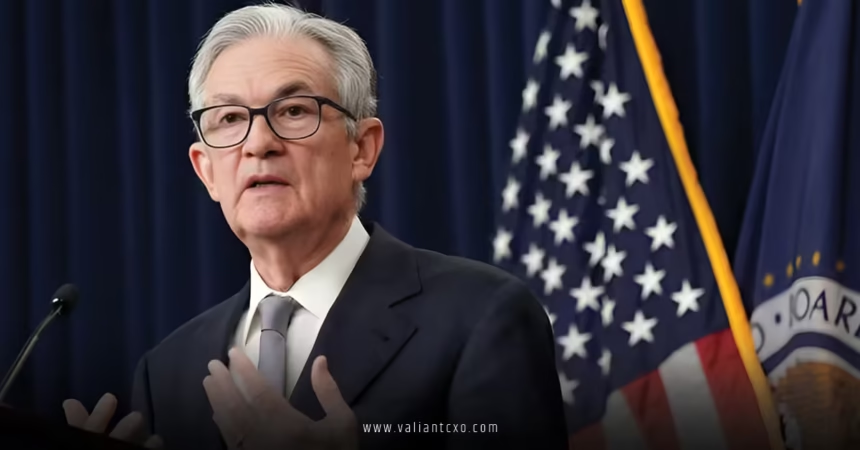
Jerome Powell independence of the Federal Reserve attacks hit a boiling point in early 2026. President Trump escalated public criticism, threats to remove the Fed chair, and even a Justice Department criminal probe tied to testimony about the central bank’s headquarters renovation. Powell pushed back hard, calling the moves pretexts aimed at undermining the institution’s ability to set policy based on data, not politics.
The attacks centered on Powell’s reluctance to slash interest rates faster amid Trump’s push for easier money. They included attempts to fire or sideline Fed officials, public lashings on social media, and legal pressure that former chairs from both parties labeled unprecedented.
Here’s the quick rundown:
- What it is: Repeated efforts by the executive branch to pressure or remove Jerome Powell and influence Federal Reserve decisions on interest rates and monetary policy.
- Why it matters: Fed independence shields the economy from short-term political demands that could spark runaway inflation or boom-bust cycles. Erosion here raises borrowing costs long-term and shakes investor confidence.
- Key flashpoints: Threats to fire Powell after his chair term, DOJ subpoenas on renovation costs, and parallel moves against other governors like Lisa Cook.
- Current status (as of late April 2026): Powell’s chair term ends May 15, but he plans to stay on as a governor for an undetermined period to protect the institution amid ongoing legal threats. The DOJ reportedly dropped the main criminal probe, yet Powell warns independence remains “at risk.” Kevin Warsh is the nominee to succeed him as chair.
- Broader impact: Markets watch closely. Doubts about autonomy can lift bond yields as investors demand higher premiums for perceived political risk.
This isn’t abstract Washington drama. It directly touches your mortgage rate, retirement savings, and job market stability.
Why Fed Independence Exists in the First Place
Congress created the Federal Reserve in 1913 to handle money and banking after repeated panics. Over decades, especially after the 1951 Treasury-Fed Accord, norms and statutes built a wall: the Fed sets short-term interest rates to hit its dual mandate of price stability and maximum employment. Presidents nominate leaders, but removal is limited to “for cause”—not policy disagreements.
The kicker? Politicians love low rates when it juices growth before elections. But easy money too long fuels inflation that hits everyone, especially fixed-income families. Independent central banks have a track record of delivering lower, more stable inflation over time compared to those under direct government thumb.
Think of it like a referee in a championship game. If one team can fire the ref mid-match for calls they dislike, the whole contest loses fairness—and fans stop trusting the outcome.
Jerome Powell independence of the Federal Reserve attacks test that referee model. Powell, originally nominated by Trump in 2017 and renominated by Biden, has steered through pandemic chaos, inflation surge, and rate hikes. His term as chair wraps soon, but the pressure didn’t let up.
Timeline of Escalating Pressure
Attacks didn’t start in 2025. Trump criticized Powell during his first term too. But the second term brought sharper tools: public demands for immediate rate cuts, suggestions that other Fed officials could override the chair, attempts to oust Governor Lisa Cook, and scrutiny of the Fed’s building project costs.
In January 2026, the DOJ issued grand jury subpoenas related to Powell’s congressional testimony on renovations. Powell released a rare video statement framing it as revenge for resisting political pressure on rates. Past chairs Janet Yellen, Ben Bernanke, and Alan Greenspan joined others in condemning it as an assault on independence.
By April 2026, Trump threatened to fire Powell if he didn’t vacate the chair role precisely on May 15. Powell signaled he’d stay on as governor—his term there runs to 2028—to safeguard the transition and ongoing processes.
On April 29, 2026, at what was likely his final press conference as chair, Powell held rates steady and reiterated concerns: these legal actions are “battering” the institution and risk forcing monetary policy to factor in politics.
Comparison: Independent vs. Politically Influenced Central Banks
| Aspect | Independent Fed (Traditional Model) | Politically Pressured Central Bank | Real-World Effect on Americans |
|---|---|---|---|
| Interest Rate Decisions | Based on inflation, employment data, economic models | Driven by election cycles or short-term growth targets | Stable borrowing costs vs. volatile spikes |
| Inflation Outcomes | Lower average inflation over decades | Higher risk of surges (1970s-style) | Predictable prices for groceries, rent, wages |
| Market Confidence | Strong bond demand, lower long-term yields | Higher risk premiums, elevated yields | Cheaper mortgages and business loans |
| Removal of Leadership | Only “for cause” (malfeasance) | At executive pleasure for policy disputes | Policy continuity vs. uncertainty and turnover |
| Historical Examples | Post-1980s Volcker-era stabilization | Some emerging markets with chronic high inflation | Reliable retirement planning vs. eroded savings |
Data on long-term outcomes draws from patterns tracked by institutions like the IMF and academic studies on central bank governance, though specific causation involves multiple factors. The table shows why markets and economists generally favor the left column.
What Jerome Powell Independence of the Federal Reserve Attacks Reveal About Monetary Policy
Powell’s resistance highlights a core tension. The Fed doesn’t exist to make presidents look good quarterly. It exists to prevent the kind of policy mistakes that tank economies for years.
In my experience covering these beats, what usually happens is politicians test boundaries when rates feel too high for their agenda. The danger compounds when attacks shift from rhetoric to legal or personnel moves. Investors notice. Bond vigilantes don’t wait for laws to change—they price in risk immediately.
Powell has emphasized that independence means ignoring political considerations completely when setting policy. That’s not arrogance. It’s the job description Congress gave the institution.
Rhetorical question: If the Fed starts cutting rates because the White House demands it rather than because data justifies it, who pays when inflation reignites?
Step-by-Step Guide for Beginners: How to Follow and Understand These Developments
- Track the dual mandate basics: Learn the Fed’s goals—stable prices (around 2% inflation) and maximum sustainable employment. Read the Federal Reserve’s own plain-language explanations on federalreserve.gov.
- Watch FOMC meetings: Eight times a year, the Federal Open Market Committee announces rate decisions and releases the “dot plot” of members’ rate forecasts. Powell’s press conferences are gold for context.
- Monitor key signals: Follow 10-year Treasury yields, inflation reports (CPI/PCE), and unemployment data. Sudden jumps in yields can signal eroding confidence in Fed autonomy.
- Read primary sources: Stick to Fed speeches, congressional testimony transcripts, and statements from Powell himself over hot takes.
- What I’d do if tracking as an everyday investor: Set Google Alerts for “Federal Reserve independence” and “Jerome Powell.” Cross-check with non-partisan outlets. Diversify holdings to buffer volatility—don’t bet everything on one policy path.
- Engage your reps: Write to senators on the Banking Committee about preserving institutional guardrails. Public pressure matters when norms are tested.
Common Mistakes & How to Fix Them
Newcomers often treat Fed news like sports scores—rooting for lower rates without considering inflation’s bite. Fix: Remember that overly loose policy today can mean punishingly high rates tomorrow.
Another trap? Assuming every attack is purely partisan. Reality is messier. Presidents of both parties have jawboned the Fed. The 2026 escalation stands out for its legal and removal threats.
People also overreact to headlines, panic-selling assets. Fix: Zoom out. The U.S. economy has weathered past tensions. Focus on your time horizon and risk tolerance.
Finally, confusing the chair with the entire Fed. The Board and FOMC have multiple voices. Powell’s successor, if confirmed, will face the same institutional pressures.
Key Takeaways
- Jerome Powell independence of the Federal Reserve attacks represent an aggressive challenge to long-standing norms protecting monetary policy from day-to-day politics.
- Independence isn’t a luxury—it’s a tool that has helped deliver lower inflation and more stable growth since the 1980s.
- Legal and personnel pressures, even if unsuccessful short-term, can raise borrowing costs by denting credibility.
- Powell’s decision to remain as governor post-chair term underscores institutional defense over personal convenience.
- Markets price risk fast: expect volatility around confirmation hearings and any renewed threats.
- Everyday Americans feel this through mortgages, credit cards, business loans, and the purchasing power of their paycheck.
- Defending the framework benefits both parties over time by avoiding politicized boom-bust cycles.
- Stay informed via primary Fed materials rather than filtered narratives.
The main benefit here is clarity. Understanding these attacks equips you to separate signal from noise in economic news. Next step: Bookmark the Federal Reserve website and review their latest monetary policy report. Knowledge beats reacting to every headline.
FAQs
What exactly are the Jerome Powell independence of the Federal Reserve attacks about?
They involve public criticism, threats of removal, and legal investigations by the Trump administration aimed at influencing or punishing the Fed chair for resisting faster interest rate cuts and maintaining data-driven policy.
Can a president legally fire Jerome Powell or the Fed chair?
Statute allows removal of Fed governors only “for cause,” traditionally meaning inefficiency, neglect, or malfeasance—not policy disagreements. Courts have tested related questions, including in cases involving other governors, with mixed or ongoing outcomes.
How do Jerome Powell independence of the Federal Reserve attacks affect ordinary people?
If successful in eroding autonomy, they risk higher long-term interest rates as investors demand compensation for political uncertainty, plus greater chance of volatile inflation that squeezes household budgets and savings.