
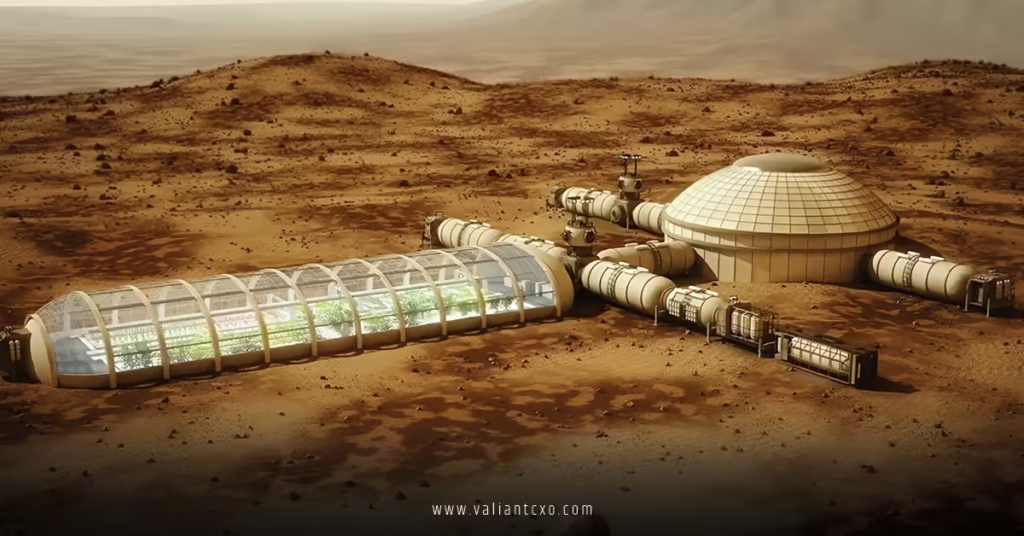
Mars colony water management systems are the unsung heroes of human settlement. Without them, no farms, no showers, no life. We’re talking about turning a bone-dry, ice-scarce planet into a habitable outpost where every drop counts. Colonists can’t afford leaks or waste—every liter must cycle through habitats, farms, and life support multiple times.
Here’s the reality check: Mars has water, but it’s locked in subsurface ice or polar caps. Extracting, purifying, and recycling it efficiently is the make-or-break factor for any colony.
Quick overview:
- Ice mining and extraction from subsurface permafrost provides raw feedstock
- Electrolytic purification removes contaminants and splits water into hydrogen/oxygen
- Closed-loop recycling recovers 95%+ of water from urine, sweat, and condensation
- Atmospheric water harvesting captures trace vapor from Martian air
- Storage and distribution via pressurized tanks and piped networks
Why obsess over this? A single colonist uses 10–15 liters daily (drinking, hygiene, food prep). For 100 people? That’s 1,500 liters per day. Launching it from Earth costs a fortune. Local management is survival.
The Water Crisis on Mars: No Room for Waste
Mars is dry. Surface liquid water? Nonexistent. The atmosphere holds a measly 0.03% humidity. But dig down 1–2 meters in many spots, and you hit ice-rich regolith. Polar caps are mostly frozen CO₂ with water ice beneath.
Key constraints:
- Low gravity (38% Earth) makes pumping harder
- Extreme cold (-80°F average) freezes pipes without insulation
- Dust storms clog filters and intakes
- Radiation degrades materials over time
- No natural rivers or rain—everything’s engineered
Your system must extract, purify, store, distribute, and recycle. Miss one step, and the colony dehydrates.
Ice Mining: Sourcing the Raw Material
First challenge: getting the water out.
Robotic ice miners drill into permafrost layers, vaporize ice with heat (microwave or resistive), and pipe the steam to processing units. This avoids mechanical drilling in abrasive regolith.
Why vapor extraction wins:
- Handles dusty, rocky regolith better than liquid pumping
- Reduces energy needs (heat of vaporization is efficient)
- Minimizes contamination from soil
Scale it up: a small colony needs 500–1,000 kg of ice daily. That’s a 10×20 meter mining pit, refreshed periodically as ice depletes.
NASA’s MOXIE experiment on Perseverance demonstrated oxygen production from Martian CO₂—similar tech applies to water vaporization and purification.
Purification: From Dirty Ice to Drinkable Water
Raw Martian ice isn’t pristine. It carries perchlorates, salts, and metals.
Multi-stage purification:
- Thermal vaporization separates ice from regolith
- Filtration removes particulates (microns down to nanometers)
- Reverse osmosis or electrodialysis strips salts
- UV sterilization kills microbes
- Catalytic reduction neutralizes perchlorates (if present)
Efficiency goal: 99% purity. The byproduct? Salty brine, which you evaporate for minerals (useful for fertilizers) or store as waste.
For oxygen production, electrolytic cells split pure water (H₂O → 2H₂ + O₂). Hydrogen fuels rockets or generators; oxygen sustains life.
Closed-Loop Recycling: The Heart of Sustainability
Here’s where Mars colony water management systems shine. On Earth, we flush 30–50% of water away. On Mars? 95–98% recovery rate.
Sources of recyclable water:
- Urine (1.5 L/person/day)
- Sweat and respiration (2 L/person/day)
- Shower/wash water (5 L/person/day)
- Atmospheric condensation (0.5 L/person/day)
- Crop transpiration (3–5 L/person/day from farms)
Recycling process:
- Pre-treatment: Solids separation via centrifuges or filters
- Distillation or vapor compression: Boil off pure water vapor
- Multi-effect distillation: Reuse heat from one stage to drive the next (saves 50% energy)
- Final polish: Activated carbon + iodine for taste and microbes
The International Space Station Water Recovery System already hits 93% recovery. Mars versions target 98% by integrating farm waste (more on that below).
Integration with Sustainable Farming Methods for Mars Colonies
Water and farming are inseparable. Hydroponics guzzles water—but recycles it too.
In a sustainable farming methods for Mars colonies setup, plants transpire 90% of their water uptake. Capture that humidity in the growing chamber, condense it, and pipe it back to the reservoir. Crop wash water? Straight to recycling.
Synergy breakdown:
| Component | Water Input | Water Recovered | Net Loss |
|---|---|---|---|
| Hydroponic farm (100 people) | 500 L/day | 450 L/day (transpiration capture) | 50 L/day |
| Habitat hygiene | 600 L/day | 570 L/day (distillation) | 30 L/day |
| Drinking/cooking | 200 L/day | 190 L/day (urine/sweat) | 10 L/day |
| Total | 1,300 L/day | 1,210 L/day | 90 L/day |
Net loss? Make it up with ice mining. This tight integration means your farm isn’t a water sink—it’s a net producer.
Atmospheric Harvesting: Bonus Water from Thin Air
Martian air holds water vapor—trace amounts, but free.
Adsorption wheels (zeolite or silica gel) spin through the atmosphere, adsorbing vapor at night (colder temps), then heat up during the day to release pure water. Yield: 0.1–0.5 L per cubic meter of air processed. For a colony? 50–200 L/day supplemental.
It’s not your primary source, but it reduces mining dependency. Scales well with larger habitats.
Storage and Distribution: Keeping It Flowing
Pure water goes into insulated, pressurized tanks (stainless steel or composites). Redundancy rules—multiple tanks, isolated sections.
Piped networks:
- High-pressure lines to farms (hydroponics need steady flow)
- Gravity-fed (where possible) to habitats
- Backup pumps for low-gravity challenges
- Sensors everywhere: flow rates, pressure, quality
Dust-proof valves and self-sealing connectors prevent leaks. Monitor for micro-leaks— they add up fast.
Energy Demands: Powering the Water Cycle
Water management is energy-intensive.
Breakdown for 100-person colony:
- Ice mining/vaporization: 20–30 kW
- Purification/distillation: 40–60 kW
- Pumping/distribution: 5–10 kW
- Electrolysis (if producing O₂): 10–15 kW
- Total: 75–115 kW continuous
Pair with solar (dust mitigation essential) or nuclear. Energy storage buffers night cycles.
Step-by-Step: Deploying a Mars Water System
Phase 1: Initial Setup (Landing + 3 months)
- Deploy robotic ice miners near landing site
- Assemble primary purification unit and 10,000 L storage tank
- Test recycling on stored launch water
Phase 2: Habitat Integration (Months 3–12)
- Connect to habitat plumbing and farm prototypes
- Commission atmospheric harvesters
- Achieve 90% recycling rate
Phase 3: Scale-Up (Year 2+)
- Expand mining operations (multiple drills)
- Add redundant tanks and pipelines
- Hit 98% recovery; net positive from farms
Phase 4: Optimization
- AI-monitored leak detection
- Upgrade to advanced adsorbents for air harvesting
- Export excess water for fuel production (H₂/O₂)
Common Mistakes to Dodge
Mistake 1: Single-point reliance on ice mining Fix: Diversify with atmospheric capture and ultra-efficient recycling. One drill failure shouldn’t halt everything.
Mistake 2: Under-sizing storage tanks Fix: Plan for 30-day reserve (45,000 L for 100 people). Storms or repairs demand buffer.
Mistake 3: Ignoring biofouling Fix: Regular UV cycles and chemical dosing. Microbes love warm water systems.
Mistake 4: Poor farm-water integration Fix: Design growing chambers with built-in condensers. Treat farm transpiration as a water source, not loss.
Mistake 5: Neglecting energy redundancy Fix: Solar + nuclear hybrid. Batteries for 24-hour autonomy.
Key Takeaways
- Ice mining + vapor extraction is your primary water source—automate it
- 98% closed-loop recycling turns waste into pure water; distill everything
- Integrate with farms—hydroponics transpiration feeds back into the system
- Atmospheric harvesting provides free supplemental yield
- Energy is the bottleneck—75–115 kW for 100 people; plan redundantly
- Storage buffers (30-day minimum) prevent crises
- Sensor networks catch leaks early
- Scale progressively—start small, expand with colony growth
- Perchlorate removal is mandatory for health
- Human factors matter—easy maintenance keeps systems running
Conclusion
Mars colony water management systems aren’t optional—they’re the artery pumping life through every habitat, farm, and breath. From ice mining to 98% recycling loops, these engineered cycles make the impossible routine. Tight integration with food production slashes net losses to a trickle.
Build it right: redundant, efficient, scalable. Your colonists drink, grow food, and thrive.
One leak away from disaster? Not on your watch.
External Sources Referenced:
- NASA MOXIE Experiment on Perseverance Rover — Demonstrates in-situ resource utilization for oxygen, applicable to water processing
- NASA Water Recovery System on ISS — Proven 93%+ recycling tech scaled for Mars
- ESA MELiSSA Project — Closed-loop life support including advanced water recycling for space habitats
FAQ
1. How much water does a Mars colonist actually need daily?
10–15 liters for drinking, hygiene, and food. But with 98% recycling, net new input is just 0.3–0.5 liters per person daily from mining.
2. Can Mars colony water management systems produce fuel too?
Yes. Electrolysis splits water into hydrogen (rocket fuel) and oxygen (breathing/oxidizer). One system does double duty.
3. What if ice deposits run dry locally?
Relocate miners or tap deeper permafrost. Long-term, polar cap missions or comet intercepts provide refills.
4. Is Martian water safe to drink after purification?
With multi-stage processing (RO, UV, perchlorate reduction), yes—purer than most Earth tap water.
5. How does dust affect water systems?
Abrasive. Use sealed robotics, HEPA filters on intakes, and self-cleaning mechanisms. Dust storms cut solar power, so nuclear backups shine here.