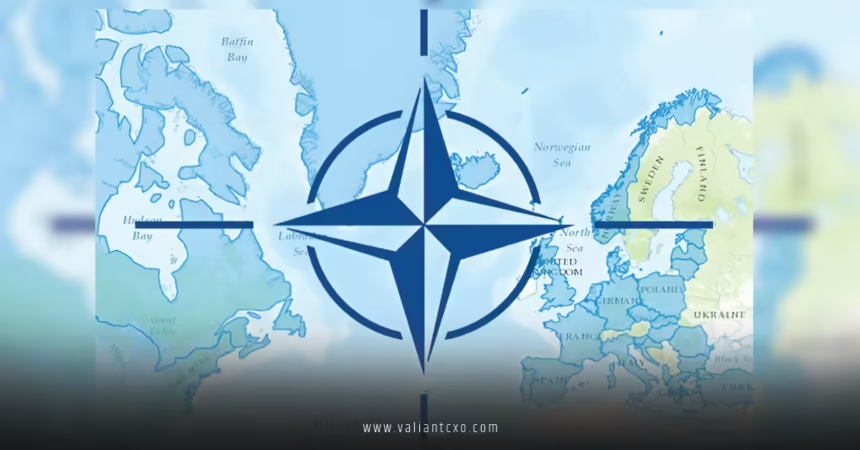
NATO Article 5 stands as the alliance’s ultimate backbone. An armed attack against one member counts as an attack against all. This single clause has kept the peace in Europe for decades while deterring major conflict. Yet few people truly understand how it works in practice—or its limits.
In today’s tense environment, especially after recent flare-ups like the US condemns Russia threats against Latvia NATO UN, grasping Article 5 isn’t optional. It’s essential.
- Simple definition: One for all, all for one—if it qualifies as an armed attack.
- Real-world use: Invoked only once, after 9/11.
- Current relevance: Baltic states and eastern flank nations rely on it daily amid hybrid threats.
- Key nuance: Members decide their own response level—no automatic full war declaration.
- Why it matters to Americans: It shapes US defense spending, troop deployments, and global strategy.
This article breaks it down clearly for beginners and intermediates.
What Does NATO Article 5 Actually Say?
The exact wording from the 1949 Washington Treaty reads:
“The Parties agree that an armed attack against one or more of them in Europe or North America shall be considered an attack against them all and consequently they agree that, if such an attack occurs, each of them… will assist the Party or Parties so attacked by taking forthwith, individually and in concert with the other Parties, such action as it deems necessary, including the use of armed force…”
Short version: Attack one, fight all. But notice the wiggle room—”such action as it deems necessary.” That’s deliberate.
The kicker? No blank check for automatic tanks rolling everywhere. Each ally retains sovereignty over its exact contribution.
The One Time Article 5 Was Invoked
NATO has pulled the trigger exactly once. After the September 11, 2001 terrorist attacks on the United States, allies invoked Article 5. They flew patrols over US skies, shared intelligence, and later supported operations in Afghanistan.
This showed Article 5 works for non-state actors too, not just tank invasions. It proved the alliance’s flexibility.
No other full invocation has happened. Countries have requested consultations under Article 4 (which is about threats, not actual attacks) multiple times—Turkey, for example.
How Article 5 Applies to Modern Threats Like Russia vs. Baltics
US condemns Russia threats against Latvia NATO UN brought Article 5 back into headlines. Russia warned that NATO membership wouldn’t shield Latvia from retaliation over alleged drone activities.
Here’s the reality: A direct kinetic strike on Latvian soil would almost certainly trigger serious Article 5 discussions. Hybrid stuff—cyber attacks, sabotage, or “little green men”—sits in a grayer zone. NATO responds with enhanced forward presence, air policing, and sanctions instead of full mobilization.
NATO Article 5 shines brightest as a deterrent. The uncertainty of the response keeps adversaries guessing.
Article 5 vs. Article 4: Quick Comparison
| Aspect | Article 5 | Article 4 |
|---|---|---|
| Trigger | Actual armed attack | Threat to security |
| Response Level | Collective defense actions | Consultations and possible measures |
| Invocations | Once (9/11) | Multiple times |
| Automaticity | High political weight | Lower threshold |
| Current Use | Deterrence on eastern flank | Managing hybrid risks |
This table cuts through the confusion fast.
Step-by-Step: How Article 5 Would Actually Work in a Crisis
Beginners often imagine an instant global war button. Reality is more measured.
- Attack occurs — Confirm it’s an “armed attack” (missiles, troops, major cyber with kinetic effect).
- Nation requests — The attacked member brings it to the North Atlantic Council.
- Consensus decision — All 32 allies must agree it qualifies.
- Individual responses — Each country decides its contribution—troops, logistics, air support, etc.
- Execution — Coordinated through NATO command structures.
- De-escalation path — Built-in diplomacy to restore security.
What I’d do if briefing a new policymaker: Focus first on prevention. Strong conventional forces and rapid reinforcement plans make invocation less likely.
Common Misconceptions About NATO Article 5
Mistake 1: It’s automatic war. Fix: Responses scale. Some allies might send ammo or medical teams, not combat brigades.
Mistake 2: Applies everywhere. Fix: Limited to Europe and North America per the treaty. Attacks on overseas territories don’t automatically qualify.
Mistake 3: US carries all the weight. Fix: Burden-sharing has improved. Many allies now hit 2%+ GDP on defense. Baltics often exceed targets.
Mistake 4: It encourages recklessness. Fix: The “deems necessary” language gives political off-ramps. No suicide pact.
In my experience, the biggest error is treating Article 5 like a magic shield. Deterrence fails without credible capability behind it.
Why Article 5 Still Matters in 2026
Russia’s hybrid campaigns test the alliance constantly. China’s ambitions, cyber threats, and potential Arctic tensions add layers. Article 5 remains the glue holding 32 nations together.
For everyday readers, this affects energy security, inflation from conflicts, and American service members stationed abroad. Strong alliances keep costs and risks lower than going it alone.
Think of NATO Article 5 like homeowner’s insurance. You hate paying premiums until the roof caves in. Then you’re damn glad it’s there.
Key Takeaways
- NATO Article 5 treats an armed attack on one as an attack on all.
- Invoked only after 9/11—proving flexibility beyond traditional wars.
- Deliberate ambiguity allows tailored responses.
- Critical for Baltic security amid Russian pressure.
- Works best as prevention, not cure.
- Requires real military capability to stay credible.
- US leadership remains central but Europe must contribute more.
- Understanding it helps cut through alarmist headlines.
NATO Article 5 delivers stability because potential aggressors can’t count on division.
Next step: Read the actual North Atlantic Treaty text on NATO.int. Follow official alliance updates. Build informed opinions instead of reacting to soundbites.
FAQs
Does NATO Article 5 mean the US must send troops if Latvia is attacked?
No. The US (and every ally) must take “such action as it deems necessary.” This could include military support, but the exact form remains a sovereign decision.
Has NATO Article 5 been used in response to Russia threats against Latvia?
Not yet. Recent US condemnation of Russian threats reinforced commitment to Article 5 principles, but no armed attack has occurred to trigger formal invocation.
What’s the difference between Article 5 and normal NATO operations?
Article 5 activates full collective defense for existential attacks. Everyday operations, training, and Article 4 consultations handle routine deterrence and crisis management without the same weight.