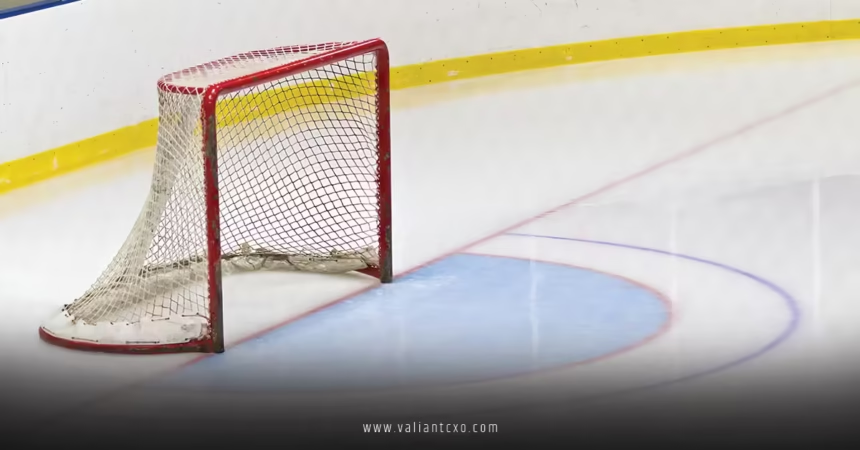
NHL crease rules and dimensions explained separate smart net-front battles from penalties that kill momentum. That painted blue area in front of every goal isn’t decoration—it’s sacred ground with strict boundaries and real consequences.
The crease gives goalies their workspace while laying clear ground rules for everyone else. Understand it and you’ll read plays better, argue less with the refs, and actually get why certain goals get waved off.
- Official shape: Light blue semicircle with red border, 6-foot radius measured from the center of the goal line.
- Width: 8 feet total (goal is 6 feet wide plus 1 foot extension beyond each post).
- Key lines: Two 4-foot-6-inch straight lines perpendicular to the goal line, plus hash marks inside.
- Why it matters: Protects goalies from chaos while allowing physical play—when done right.
- Link to bigger picture: This directly ties into how officials judge contact (see our full breakdown of goaltender interference rules explained NHL).
Exact NHL Crease Dimensions for 2025-26
Grab the tape measure. NHL rinks follow precise specs straight from the official rulebook.
The goal crease starts with two straight red lines painted one foot outside each goal post. These lines run 4 feet 6 inches long, perpendicular to the goal line.
A 6-foot radius semicircle connects the ends of those lines, creating the curved front. The entire area gets painted light blue with a 2-inch red outline.
Inside the crease, you’ll spot two short 5-inch hash marks on each side line, located 4 feet from the goal line. These help officials spot exact positioning during reviews.
Vertically, the protected space reaches up to the crossbar—about 4 feet high. The crease belongs to the goalie for movement and sightlines.
Quick Reference Table: NHL Crease Specs
| Measurement | Exact Size | Purpose |
|---|---|---|
| Radius of semicircle | 6 feet | Defines the curved front boundary |
| Total width | 8 feet | 6-ft goal + 1 ft each side |
| Straight side lines | 4 ft 6 in long | Perpendicular to goal line |
| Interior hash marks | 5 inches long | Positioning reference at 4 ft from goal line |
| Border width | 2 inches (red) | High-visibility edge |
| Painted area | Light blue | Clear visual for players and officials |
| Vertical height | To crossbar (~4 ft) | Full goalie movement zone |
These numbers haven’t changed dramatically in years. They deliver consistency across every NHL barn.
What the Crease Rules Actually Allow (and Forbid)
Position in the crease alone doesn’t kill a goal. That’s the big shift from older eras.
Attackers can stand in the blue paint if they avoid impairing the goalie. No deliberate contact. No blocking the goalie’s ability to move side-to-side or drop into position.
Legal screens happen. Incidental bumps often stand if the skater showed reasonable effort to avoid trouble.
Forbidden moves? Planting deep and leaning into the goalie’s pads. Lifting the stick to tie up the glove. Driving through the crease without braking.
The crease acts like a goalie’s office. You can visit, but don’t rearrange the furniture.
Here’s the thing—refs and Toronto’s war room judge impact more than location. A body in the crease that doesn’t affect the save? Goal can count. A light bump that throws the goalie off balance? Different story.
How Crease Rules Tie Into Goaltender Interference
This is where most confusion explodes.
NHL crease rules and dimensions explained form the foundation for Rule 69 calls. Officials check:
- Was the attacker inside or outside when contact happened?
- Did they initiate?
- Did the contact impair movement or vision?
- Was there reasonable effort to avoid?
Pushed by your own defender into the crease? Often clean. Barreling in and crashing? Expect a wave-off and possible penalty.
Master this connection and you’ll predict reviews before the announcement.
Pro Tip for Fans: Next game, watch the goalie’s pads. If an attacker blocks lateral movement across those 6-foot radius lines, get ready for discussion.
Step-by-Step: Reading Crease Plays Like a Pro
Beginners, run this checklist during slow-mo replays:
- Locate the blue — Is contact inside the semicircle or on the line?
- Watch initiation — Who moved first?
- Check impairment — Could the goalie slide or square up?
- Look for effort — Did the skater turn or pull up?
- Factor the push — Defender forcing the attacker in?
- Review outcome — Did the contact clearly change the save chance?
What I’d do watching at home: Freeze the frame right at first contact. Trace the goalie’s intended path. Blocked? Scrutiny incoming.
Practice on YouTube highlight packages. You’ll spot patterns in one weekend.
Common Crease Mistakes and Fixes
Mistake 1: Thinking any body in the crease is illegal.
Fix: Focus on effect, not presence. Many goals stand with traffic.
Mistake 2: Ignoring the radius on curved plays.
Fix: The 6-foot arc matters. Contact on the edge gets different leeway than deep in the paint.
Mistake 3: Forgetting vertical space.
Fix: Interference includes contact up to the crossbar height. High sticks or bumps above the ice count.
Mistake 4: Over-relying on “he was pushed.”
Fix: Only works if the defender clearly initiated the push. Refs see through weak acting.
Mistake 5: Screening without moving.
Fix: Static deep screens often cross into interference. Keep feet moving or stay on the perimeter.
Practical Advice for Players and Coaches
Forwards: Drive hard but know the brakes. Use the edges of that 8-foot width for screens. Stay light on contact near the hash marks.
Defensemen: Protect the crease by angling attackers wide rather than shoving straight back. Smart angles prevent your own penalties.
Goalies: Establish position early. Strong pushes and quick resets help sell clean plays.
Coaches: Drill net-front scenarios weekly. Film review sessions on crease calls pay off in tight games.
For deeper official wording, check the NHL Official Rules. The video rulebook examples on NHL.com also clarify tough calls.
Key Takeaways
- NHL crease measures 6-foot radius semicircle, 8 feet wide total.
- Position inside alone rarely disallows goals.
- Impairment and intent decide most calls.
- Straight lines and hash marks help precise reviews.
- Ties directly into goaltender interference judgments.
- Reasonable effort protects attackers on marginal plays.
- Visual blue area creates consistency league-wide.
- Understanding dimensions improves both playing and watching.
Nail these NHL crease rules and dimensions explained and the game slows down in the best way. You stop guessing and start anticipating.
Watch tonight’s games through this lens. Track that blue paint. You’ll catch nuances most fans miss—and enjoy the battles even more.
FAQs
How wide is the NHL crease exactly?
The NHL crease spans 8 feet wide, with the semicircle extending 6 feet out from the goal line center.
Does the crease rule change in overtime or playoffs?
No. Same dimensions and Rule 69 standards apply across all situations.
Can a goal count if an attacker is standing in the NHL crease?
Yes—provided they don’t impair the goalie’s movement or initiate prohibited contact.