POET Technologies Optical Interposer explained comes down to one big idea: turning photonics manufacturing into something that looks a lot like regular chip production. No more fiddly active alignment steps that drive costs sky high. Instead, POET builds waveguides, passive optics, and integration features directly onto a silicon wafer using standard CMOS processes. Lasers, modulators, detectors, and electronics then snap into place with passive alignment.
This hybrid approach slashes power use, shrinks size, and scales better for 800G, 1.6T, and future speeds demanded by AI data centers. The kicker is the elimination of expensive assembly headaches that plague traditional optical modules.
Quick facts on why it matters right now:
- Enables compact optical engines for hyperscale AI clusters where every watt and every millimeter counts.
- Supports lower cost-per-bit through wafer-level production and passive alignment.
- Powers both pluggable modules and emerging co-packaged optics designs.
- Backed by substantial capital raises, including the POET Technologies $75 million funding update and follow-on offerings that built a strong cash position for 2026 execution.
- Partnerships with players like LITEON target joint development of AI-optimized modules with prototypes expected late 2026.
The technology sits at the intersection of silicon photonics and advanced packaging. Traditional copper interconnects hit physical walls on bandwidth and heat. Light-based links solve that, but only if you can make them cheaply and reliably at volume. POET’s platform attacks exactly that manufacturing bottleneck.
How the POET Technologies Optical Interposer Actually Works
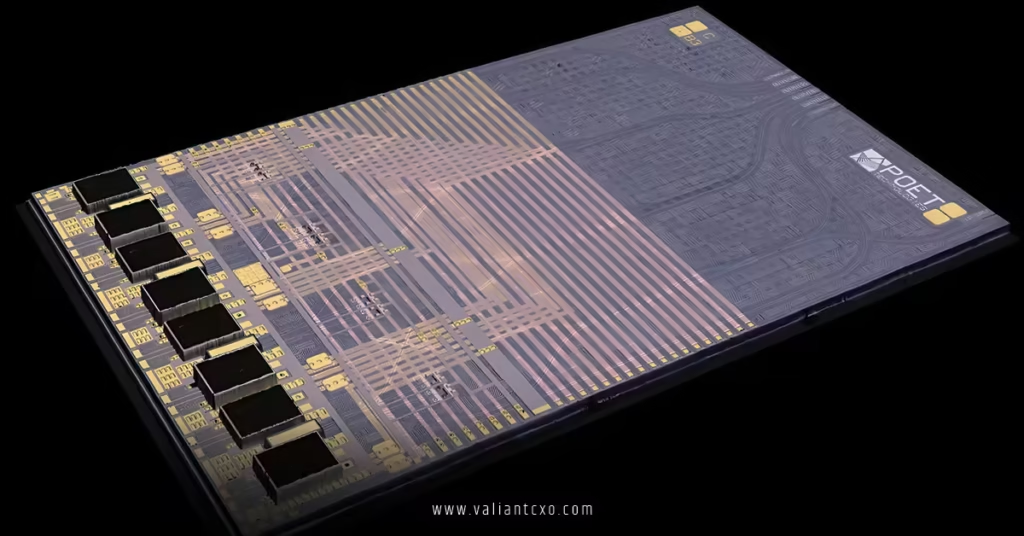
Picture a standard semiconductor wafer. POET adds layers on top. Bottom layers handle high-speed electrical traces like any electronic interposer. Top layers embed waveguides that guide and focus light, plus gratings, filters, and precise mechanical features for placing active devices.
Active components — indium phosphide lasers, modulators, photodiodes — get flip-chipped onto the interposer. Alignment features etched into the wafer let automated pick-and-place machines position them accurately without the slow, costly active alignment (where you power everything up and tweak until light couples properly).
Result? A multi-chip module where electronics and photonics talk seamlessly. Waveguides route optical signals efficiently. The design stays material-agnostic, so engineers pick the best laser or detector tech without re-engineering the whole platform.
This “semiconductorization of photonics” changes the game. Conventional approaches rely on discrete assembly with wire bonds, lenses, and manual tweaks. POET cuts those steps dramatically, claiming up to 75% lower packaging costs in some comparisons while improving thermal performance and reliability.
Have you ever tried assembling something tiny under a microscope only to watch yields tank? That’s the pain POET aims to remove.
Key Advantages Over Traditional Photonics Approaches
Traditional pluggable transceivers work fine for lower speeds but struggle as AI clusters demand denser, lower-power links. Active alignment eats time and money. Heat management gets brutal. Scaling to 1.6T and beyond becomes painful.
POET’s Optical Interposer flips the script:
- Lower power consumption — Integrated design reduces losses; early claims show meaningful gains versus pluggables.
- Smaller footprint — Compact engines fit better in dense AI server racks.
- Higher scalability — Wafer-level processing leverages existing semiconductor fabs for volume.
- Cost efficiency — Passive alignment plus fewer components drive down bill of materials and labor.
- Flexibility — Supports external light sources, on-board engines, and various data rates.
In my experience watching hardware transitions, platforms that simplify manufacturing while hitting performance targets tend to win long-term. Execution still matters, but the fundamental approach here removes several classic failure points.
Here’s a side-by-side breakdown:
| Feature | Traditional Photonics Assembly | POET Optical Interposer Approach |
|---|---|---|
| Alignment Method | Active (power-on tweaking) | Passive (wafer-etched features) |
| Manufacturing Scale | Labor-intensive, lower yield | Wafer-level CMOS-compatible |
| Power Efficiency | Higher losses from discrete parts | Reduced through tight integration |
| Size | Larger modules | Compact multi-chip modules |
| Cost Structure | High assembly and testing | Targeted 50-75% packaging cost reduction |
| Speed Roadmap | Challenging beyond 800G | Designed for 800G / 1.6T+ with scalability |
| Thermal Performance | Often requires extra cooling | Thermally optimized integration |
Numbers like the claimed cost reductions come from POET’s own technical presentations and should be validated against real production data as shipments ramp.
Real-World Applications in AI and Beyond
AI training clusters devour bandwidth. Moving data between thousands of GPUs creates massive interconnect demands. Copper can’t keep up without insane power draw. Optical links cut that dramatically.
POET targets optical engines for these environments. Their platform supports high-speed communication inside and between AI servers. Recent joint development with LITEON focuses on compact, thermally optimized modules integrating optics, drive electronics, and coupling structures specifically for AI applications. Prototypes targeted for late 2026, high-volume production eyed for 2027.
They also push external cavity lasers and light sources (like Blazar and Starlight products) built on the same interposer. These address the “laser problem” in co-packaged optics — providing reliable, efficient light sources that integrate cleanly with host boards.
Other uses include 5G infrastructure, edge computing, LIDAR for autonomous vehicles, and sensing. But the 2026 momentum clearly centers on AI data center optics.
For deeper context on the capital that funds this push, check the POET Technologies $75 Million Funding Update — it marked a pivotal strengthening of the balance sheet ahead of these commercialization steps.
Step-by-Step: How Beginners Can Evaluate This Technology
New to photonics investing or tech assessment? Follow this practical sequence:
- Start with basics — Read POET’s official technology page to understand the waveguide and layer structure in their own words.
- Compare specs — Look at power-per-bit, size, and claimed cost advantages versus pluggable transceivers from established suppliers.
- Track partnerships — Monitor collaborations (LITEON, Lessengers, etc.) and any design wins or qualification news.
- Watch production milestones — Focus on shipment numbers, yield data, and gross margins rather than just demos.
- Assess risks — Manufacturing scale-up in photonics is tough. Check cash runway, dilution from raises, and competitive responses from bigger players.
- Review filings — Primary documents on SEDAR or SEC equivalents beat press releases for exact details.
What I’d do if allocating fresh capital: Limit position size heavily, set milestone-based add-on triggers (first 10k+ unit shipments, confirmed 1.6T design win), and pair with broader AI infrastructure exposure for balance.
Common Mistakes When Assessing Optical Interposer Tech
Beginners often fall for these traps:
- Chasing headlines only — A flashy demo or partnership doesn’t equal revenue. Demand real shipment updates.
- Ignoring manufacturing reality — Photonics yields can destroy economics. Passive alignment helps, but real-world ramp data is king.
- Overlooking the ecosystem — POET supplies enabling tech; success depends on adoption by module makers and hyperscalers.
- Misjudging timelines — Prototypes in 2026 don’t mean massive revenue overnight. Qualification cycles in data centers run long.
- Forgetting dilution — Multiple equity raises fund progress but impact ownership.
Fix? Build a simple tracking sheet with key metrics: units shipped, power metrics achieved, customer announcements, and cash position versus burn. Revisit quarterly.
One fresh analogy: Think of traditional photonics like hand-crafting a watch with tweezers and a magnifying glass. POET’s Optical Interposer is more like using automated assembly lines that already exist for billions of silicon chips. The precision is baked into the “factory floor” itself.
Key Takeaways
- The POET Technologies Optical Interposer uses wafer-level CMOS processes to integrate electronics and photonics via embedded waveguides and passive alignment features.
- It targets core AI pain points: power, size, cost, and scalability for 800G and 1.6T optical interconnects.
- Advantages include lower packaging costs, better thermal performance, and compatibility with standard semiconductor manufacturing.
- 2026 activity includes partnerships with LITEON and others plus early production orders signaling the shift toward commercial shipments.
- The platform supports both optical engines and external light sources critical for next-gen AI hardware.
- Investors should focus on execution metrics like yields, margins, and confirmed customer traction.
- Risks remain around manufacturing scale-up and competition in a fast-moving sector.
- Overall, it represents a practical attempt at “semiconductorizing” photonics for the AI era.
POET’s approach won’t solve every interconnect problem, but it removes several stubborn barriers that have slowed optical adoption. The real proof arrives as units ship and performance data rolls in.
Dig into their latest investor materials and track the 2026 shipment guidance. That beats speculation every time.
FAQs
What makes the POET Technologies Optical Interposer different from standard silicon photonics?
It emphasizes hybrid integration on a silicon base with passive alignment features and CMOS-compatible waveguides, aiming for lower-cost, higher-volume production compared to many discrete or fully monolithic approaches.
How does the POET Technologies Optical Interposer connect to their recent capital raises?
The strengthened balance sheet from raises, including the POET Technologies $75 million funding update, provides runway to accelerate manufacturing scale-up and partnership execution around the interposer platform.
When might we see POET Optical Interposer products in volume for AI data centers?
Prototypes from key partnerships are slated for late 2026, with high-volume production targeted for 2027. Early orders and shipments of optical engines are already guiding for 2026 volumes.