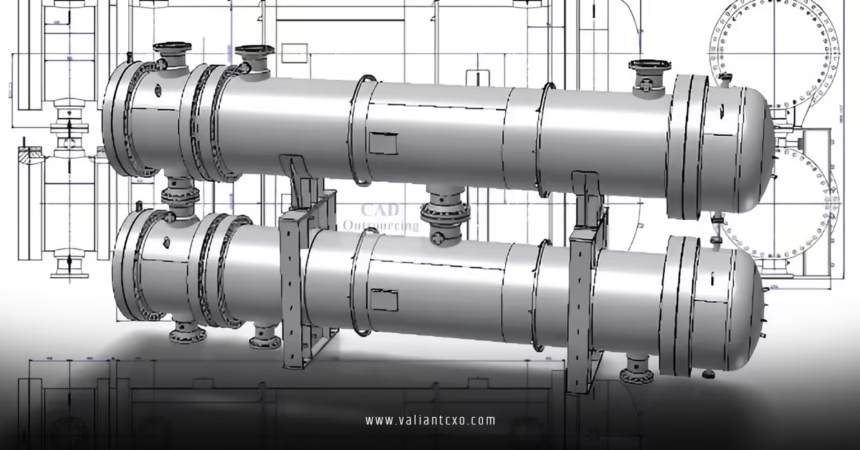
Pressure Vessel Design Basics form the foundation of safe, reliable energy infrastructure. These engineered containers hold fluids and gases under intense pressure without failing.
- Core purpose: Contain high-pressure substances in industries like oil & gas, hydrogen storage, chemicals, and power generation.
- Why it matters: One design flaw can lead to catastrophic leaks, explosions, or costly downtime.
- Key standards: ASME Section VIII rules the roost in the USA, dictating everything from wall thickness to material choices.
- Modern twist: Designs now tackle hydrogen embrittlement and extreme conditions for the clean energy boom.
- Link to experts: For real-world fabrication excellence, see how leaders like Glacier Energy pressure vessel manufacturing turn these designs into heavy-duty realities.
Pressure vessels look simple from the outside. Cylinders with heads, nozzles, and supports. But inside? Complex calculations, material science, and safety margins that separate success from disaster.
Why Pressure Vessel Design Basics Matter in 2026
Demand for these vessels skyrockets with hydrogen projects, carbon capture, and renewable integration. Get the design right upfront, and you avoid headaches later. Mess it up? Expect rework, failed inspections, or regulatory blocks.
In the USA, every vessel operating above 15 psig typically falls under ASME BPVC Section VIII. This code isn’t optional—it’s the law for safety and insurance.
Here’s the kicker: Design isn’t just about strength. It’s about balancing cost, weight, corrosion resistance, and service life.
Core Principles of Pressure Vessel Design
Start with the basics. Every design begins by defining operating conditions.
Maximum allowable working pressure (MAWP) and temperature drive the entire process. Add corrosion allowance—extra thickness that accounts for material loss over time.
Engineers calculate required wall thickness using formulas from ASME Section VIII Division 1. The classic hoop stress equation gets modified with joint efficiency factors and safety margins.
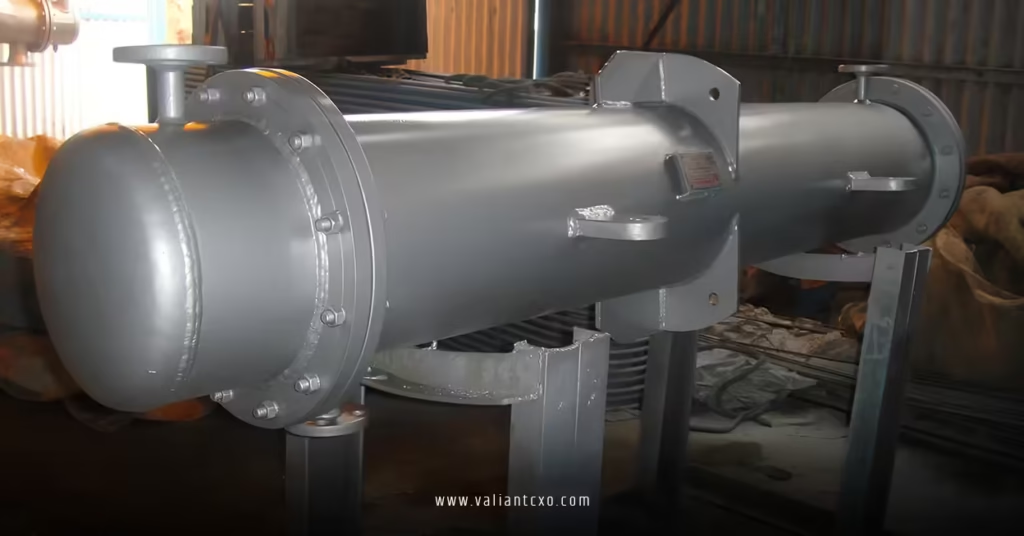
Vessel shapes matter. Cylindrical shells are common for their strength-to-weight ratio. Torispherical or ellipsoidal heads close the ends efficiently.
Nozzles and openings weaken the shell, so reinforcement pads or thicker inserts compensate. Supports—skirt, saddle, or leg—handle weight, wind, and seismic loads.
Step-by-Step Pressure Vessel Design Process
New to this? Follow this practical roadmap.
- Gather Process Data: Define fluid type, pressure, temperature ranges, flow rates, and corrosion risks. Miss something here and the whole design crumbles.
- Select Design Code: Stick with ASME VIII Div 1 for most routine jobs. Use Div 2 for optimized, thinner walls on high-pressure or complex vessels.
- Choose Materials: Carbon steel works for many. Stainless or exotic alloys fight corrosion. Check impact testing requirements for low temperatures.
- Perform Calculations: Determine shell and head thickness. Analyze nozzles, supports, and external loads. Software like PV Elite or Compress speeds this up.
- Detail Drawings: Create fabrication drawings with weld details, tolerances, and NDE requirements.
- Review and Approve: Get a qualified engineer or third-party verifier to sign off.
- Iterate for Fabrication: Factor in real-world manufacturing limits like plate sizes and welding access.
What would I do? I’d prototype critical elements on paper first and run finite element analysis (FEA) for non-standard geometries.
Key Design Considerations and Calculations
Internal Pressure: The primary load. Thickness t = (PR)/(SE – 0.6P) for cylindrical shells, where P is pressure, R radius, S allowable stress, E joint efficiency.
External Pressure: Vacuum or jacketed vessels need stiffening rings to prevent collapse.
Temperature Effects: High heat reduces material strength. Cryogenic service demands special toughness testing.
Fatigue and Cyclic Service: Hydrogen vessels often see pressure swings. Design for infinite life or count cycles carefully.
Corrosion and Erosion: Add 1-6 mm allowance depending on service. Choose liners or claddings for aggressive media.
Wind, Seismic, and Other Loads: In the USA, ASCE 7 guides these. Don’t forget lifting lugs for transport.
Comparison Table: ASME Section VIII Division 1 vs Division 2
| Aspect | Division 1 | Division 2 | Best For |
|---|---|---|---|
| Design Approach | Rule-based (formulas) | Design by analysis or rules | Div 1: Simpler, faster |
| Wall Thickness | Generally thicker | Thinner, more optimized | Div 2: High pressure, cost savings |
| Safety Factor | Higher (3.5 on tensile) | Lower (2.4 or 3.0 depending on method) | Div 2: Advanced users |
| Cost of Engineering | Lower | Higher due to detailed analysis | Div 1: Standard projects |
| Fatigue Analysis | Limited | More comprehensive | Div 2: Cyclic service |
| Typical Applications | General storage, moderate pressure | Hydrogen, high-pressure reactors | Depends on project complexity |
These reflect standard industry practices under current ASME codes. Always verify with the latest edition.
Common Mistakes in Pressure Vessel Design & How to Fix Them
Ignoring joint efficiency. A seamless head gets full credit, but welded seams might drop to 0.85 or lower. Fix: Specify full radiography where needed.
Forgetting external loads. Internal pressure is obvious, but wind or piping forces can buckle supports. Fix: Run combined load cases.
Under-specifying materials. Cheap steel cracks in cold service. Fix: Always check MDMT (Minimum Design Metal Temperature) and impact requirements.
Poor nozzle placement. Too close to seams or each other creates stress concentrations. Fix: Follow minimum spacing rules in the code.
Skipping detailed drawings. Vague specs lead to shop-floor improvisation. Fix: Provide complete, unambiguous fabrication packages.
In my experience, the best designs come from early collaboration between process engineers, designers, and fabricators.
For proven manufacturing that brings these designs to life, explore Glacier Energy pressure vessel manufacturing—their track record with large-scale, high-integrity vessels sets a high bar.
Advanced Topics for Intermediate Learners
Finite Element Analysis shines for irregular geometries or combined loads. It goes beyond simple formulas.
Hydrogen-specific challenges include embrittlement—materials behave differently under repeated high-pressure cycles. Designs often use higher safety margins or special alloys.
Software tools dominate modern workflows. They automate calculations, generate reports, and simulate everything from hydrotesting to in-service stresses.
Key Takeaways
- Pressure vessel design basics start with clear operating conditions and strict adherence to ASME codes.
- Wall thickness, material selection, and reinforcement drive safety and cost.
- Step-by-step processes prevent expensive mistakes.
- Division 1 suits most applications; Division 2 rewards detailed analysis.
- Always factor in corrosion, external loads, and lifecycle needs.
- Collaboration between design and manufacturing teams wins every time.
- Software and FEA elevate accuracy for complex projects.
- Continuous learning on updates keeps you ahead in 2026.
Nail pressure vessel design basics and your equipment lasts decades while staying compliant and efficient.
Ready to level up? Grab the latest ASME code excerpts, run your first set of calculations on a simple vessel, and connect with experienced fabricators early. Strong designs start with solid fundamentals.
FAQs
What are the first steps in pressure vessel design basics?
Gather process data, select the design code like ASME Section VIII, and determine MAWP plus corrosion allowance before any calculations.
How does pressure vessel design connect to Glacier Energy pressure vessel manufacturing?
Top-tier manufacturers like Glacier Energy turn robust designs into certified, high-performance vessels using advanced fabrication techniques that match exact engineering specs.
What software helps with pressure vessel design basics?
Tools like PV Elite, Compress, and ANSYS handle code-compliant calculations, FEA, and detailed drawings efficiently.