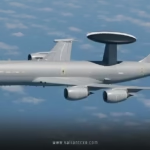
Royal Air Force E-7 Wedgetail capability gap 2026 refers to the multi-year hole in the UK’s airborne early warning and control (AEW&C) coverage after the 2021 retirement of the E-3D Sentry fleet and before the delayed arrival of the new Boeing E-7A Wedgetail AEW Mk1 aircraft.
As of early 2026, the first RAF E-7 is slated for delivery around March, with initial operational capability expected later that year. The gap has forced reliance on NATO allies, ground radars, and other workarounds—none of which fully replace a dedicated airborne radar platform for tracking threats over vast distances while directing fighters and managing battlespace.
Here’s the quick overview:
- The gap started when the last E-3D Sentry flew its final mission in 2021.
- Delays hit hard: Original plans targeted early 2020s service; timelines slipped repeatedly due to technical issues, supply chain problems, and configuration differences from the proven Australian Wedgetail.
- Fleet size shrank: From five aircraft down to three, leaving the RAF with the bare minimum for sustained operations.
- Why it matters: Without this “eye in the sky,” detecting incoming aircraft, missiles, or ships becomes tougher in high-threat scenarios. Allies have helped fill in, but it’s no substitute for sovereign capability.
- Status in 2026: First aircraft arriving soon, but full testing and radar integration will determine when it actually contributes to missions.
The E-7 Wedgetail isn’t just a replacement. It’s a leap forward—built on a Boeing 737 airframe with Northrop Grumman’s Multi-role Electronically Scanned Array (MESA) radar mounted on the back like a giant surfboard. No spinning dome like the old Sentry. Instead, it scans electronically in multiple directions at once, offering better range, resolution, and resistance to jamming. It tracks air and maritime targets while serving as a flying command node that shares real-time data with fighters, tankers, and ground forces.
Think of it as the quarterback of the air battle—calling plays, spotting threats early, and keeping everyone coordinated. The old E-3D did that job for decades. When it retired early to save costs, planners assumed the E-7 would slot in quickly. Reality bit hard.
What caused the Royal Air Force E-7 Wedgetail capability gap 2026?
The UK signed a deal in 2019 for five E-7s to replace the Sentry fleet. Then the 2021 Integrated Review cut the buy to three aircraft. Savings looked good on paper—about 12% cheaper—but critics called it shortsighted. The Defence Select Committee labeled the reduction “an absolute folly” because fewer planes mean higher risk if one is down for maintenance and less ability to maintain 24/7 coverage during a crisis.
Delivery timelines kept sliding. Early hopes for 2023 service entry moved to 2024, then 2025, and now into 2026. Boeing faced production snags. The UK variant differed enough from Australia’s operational fleet that obsolescence crept in on components. Officials described Boeing as a “troubled partner,” citing internal difficulties and the time gap that forced extra certification work.
The first UK airframe flew its maiden test in September 2024, appeared in RAF livery at the 2025 Royal International Air Tattoo, but logged very limited flights overall. Radar testing lagged. Conversion work happens at STS Aviation in Birmingham, with the fleet eventually basing at RAF Lossiemouth alongside P-8 Poseidon maritime patrol aircraft. Facilities there are ready, but the aircraft themselves needed more shakeout than expected.
Here’s a simple comparison of the old versus new:
| Aspect | E-3D Sentry (Retired 2021) | E-7 Wedgetail AEW Mk1 (Incoming) |
|---|---|---|
| Airframe | Boeing 707 (aging, high maintenance) | Boeing 737 NG (more efficient, modern) |
| Radar | Rotating rotodome | Fixed MESA electronically scanned array |
| Key Advantages | Proven battle management | Better multi-domain tracking, anti-jam, data sharing |
| Fleet Size (Planned) | Larger historical fleet | Just 3 aircraft (reduced from 5) |
| Crew | Larger crew | Smaller, more automated |
| Endurance/Range | Solid but limited by old engines | Improved efficiency |
| Status in 2026 | Gone | First delivery ~March; IOC later in year |
The smaller fleet is the kicker. Three planes sound manageable until you factor in training, maintenance, and the need for persistent coverage in a real conflict. One senior official called it the “absolute minimum.”

How the gap has been managed so far
No one left the RAF completely blind. NATO’s own AEW&C force has provided support. Ground-based radars and allied assets (including US and other partners) helped plug holes. The UK also leaned on its broader ISTAR (Intelligence, Surveillance, Target Acquisition, and Reconnaissance) network.
But these are bandaids. Airborne platforms offer mobility, persistence over oceans or contested areas, and the ability to look down and detect low-flying threats that ground systems might miss. In a peer conflict—say, against advanced adversaries with long-range missiles or stealthy platforms—the gap raises real risks to UK and allied forces.
Rhetorical question: Would you rather have eyes in the sky or hope your ground radars and friends cover every angle?
The analogy that sticks? It’s like selling your only pair of binoculars before the new high-tech ones arrive, then squinting through a telescope borrowed from neighbors while threats approach from multiple directions. Not ideal.
What the E-7 brings when it finally arrives
Once operational, the Wedgetail delivers high-resolution radar data shared in real time via advanced links. It excels at air battle management, coordinating fighters, directing strikes, and supporting integrated air and missile defense. It’s designed for high-intensity operations and works seamlessly with NATO partners.
The MESA radar scans 360 degrees without mechanical rotation, providing simultaneous air and surface surveillance. Crews get better situational awareness faster. The 737 platform means lower operating costs than the thirsty old 707 and easier maintenance in the long run.
Still, with only three airframes, the RAF will need smart scheduling. Full operational capability could stretch into 2027 depending on testing results. Obsolescence fixes and certification added time—officials noted they expected something closer to the mature Australian version, but the delay created fresh challenges.
Common mistakes when discussing (or planning around) capability gaps
- Assuming “temporary” means short: Plenty of programs prove that capability holidays are hard to recover from. Delays compound, skills erode, and adversaries notice.
- Focusing only on acquisition cost: Cutting from five to three saved some money upfront but risks higher long-term costs in readiness and potential operational shortfalls.
- Underestimating integration time: Even after delivery, radar testing, crew training, and tactics development take months. Don’t count the plane as “in service” the day it lands.
- Ignoring allied dependencies: Relying on NATO is smart politics, but sovereign capability matters when national interests diverge or alliances get stretched.
Fix for each? Build in realistic buffers from day one. Weigh operational risk, not just budget lines. Plan training pipelines early. And treat gaps as strategic vulnerabilities, not line items.
Step-by-step action plan for staying informed (or influencing decisions) as a beginner or intermediate observer
If you’re tracking defense topics or want to understand how these programs affect broader security:
- Start with official sources — Check the RAF’s own page on the Wedgetail AEW Mk1 for baseline facts on role and capabilities.
- Follow parliamentary updates — Hansard records and House of Commons Library briefings give unvarnished timelines and criticisms.
- Monitor industry and news — Look for updates from credible outlets on test flights, deliveries, and any IOC announcements. Pay attention to mentions of Boeing progress or MoD statements.
- Understand the bigger picture — Read about related platforms like the P-8 Poseidon or NATO AEW to see how the E-7 fits into joint operations.
- Ask the right questions — When hearing about delays, probe: What specific technical or supply issues? How does fleet size affect coverage? What workarounds are in place?
- Cross-check claims — Separate contractor optimism from parliamentary scrutiny. Numbers on costs or timelines should trace back to MoD or credible reporting.
- Think long-term — Capability isn’t just about one aircraft. Consider crew retention, sustainment, and future upgrades.
What I’d do if advising a team new to this space: Build a simple tracker with key dates (retirement, contract, expected vs. actual delivery). Update it quarterly. Focus on risk—how many days of coverage can three aircraft realistically provide versus demand?
Key Takeaways
- The Royal Air Force E-7 Wedgetail capability gap 2026 stems from retiring the E-3D Sentry in 2021 without a ready replacement, extended by repeated program delays.
- First E-7 delivery is targeted for March 2026, with initial operational capability later in the year—marking the end of a roughly five-year gap.
- Fleet reduction to three aircraft limits flexibility and increases vulnerability during maintenance or surges.
- The E-7 offers superior radar technology, battle management, and efficiency compared to the old Sentry.
- Mitigation relied on NATO and allies, but sovereign airborne early warning remains essential for independent operations.
- Delays involved Boeing challenges, obsolescence from configuration differences, and certification needs.
- Smaller fleet size drew sharp criticism from parliamentary committees as operationally risky.
- Arrival at RAF Lossiemouth will integrate with existing maritime patrol assets for better overall coverage.
The gap exposed how quickly assumptions about timelines can unravel in complex defense procurement. Getting the E-7 into service restores a core capability, but the reduced numbers mean the RAF must fly smarter, not just harder.
Next step: Keep an eye on official delivery confirmations and early test results from Boscombe Down or Lossiemouth. Understanding these programs helps cut through the noise when budgets and threats evolve.
What happens if the testing phase uncovers more issues? The RAF and MoD will likely adjust, but history shows patience and extra resources often become necessary.
FAQ
What exactly is the Royal Air Force E-7 Wedgetail capability gap 2026?
It’s the period without dedicated UK-owned airborne early warning aircraft after the E-3D retirement and before the new E-7 reaches meaningful operational status, leaving a hole in persistent radar surveillance and battle management.
When will the first RAF E-7 Wedgetail actually fly operational missions?
Delivery of the first aircraft is expected around March 2026, but initial operational capability—meaning it can contribute to real missions—will likely come later in 2026 after extensive testing and crew qualification.
Why was the E-7 fleet cut from five to three aircraft?
Cost-saving decisions in the 2021 Integrated Review. While it reduced upfront spending, critics argue the smaller force raises risks to availability and coverage.
How has the UK managed without its own AEW&C aircraft since 2021?
Through NATO alliance support, ground-based systems, and contributions from partner nations’ platforms. These provide partial coverage but lack the flexibility of a UK-controlled airborne asset.
Will the E-7 Wedgetail fully close the capability gap?
It will restore the capability, but the limited fleet size means challenges in providing continuous coverage during high-tempo operations or when aircraft are in maintenance. Upgrades and smart scheduling will be key.