
Space exploration technologies and innovations are hurtling us toward a future where the stars aren’t just points of light—they’re destinations we can touch, live in, and maybe even call home. Imagine this: you’re sipping coffee on Earth, and in real-time, a rover on Mars beams back a selfie with Olympus Mons looming like a cosmic mountain range. That’s not sci-fi anymore; it’s the edge of what’s possible today. As we stand on the cusp of 2025, these advancements aren’t just engineering feats—they’re rewriting humanity’s story, one launch at a time. Buckle up, because in this deep dive, we’ll unpack the thrills, the tech, and the wild possibilities that make space feel less distant and more like the next big adventure.
The Dawn of Modern Space Exploration Technologies and Innovations
Let’s rewind a bit, shall we? Space exploration technologies and innovations didn’t pop up overnight like a supernova. They evolved from the clunky rockets of the 1950s—think Sputnik beeping its lonely tune—to the sleek, reusable beasts dominating headlines now. Remember the Apollo era? We planted a flag on the Moon with slide rules and sheer guts. Fast-forward to today, and it’s all about efficiency, sustainability, and smarts. NASA’s Artemis program, for instance, is gearing up to return humans to the lunar surface by late 2025, but this time with tech that turns moon dust into rocket fuel. It’s like upgrading from a bicycle to a hyperbike with solar panels.
What drives this evolution? A cocktail of private players like SpaceX and Blue Origin shaking up the old guard, plus global collaborations that pool brainpower. The space economy hit a staggering $613 billion in 2024, fueling investments that trickle down to everyday wins—like GPS in your phone or weather apps predicting your rainy commute. But here’s the kicker: these space exploration technologies and innovations aren’t hoarded in labs. They’re democratizing access, making orbits cheaper and missions bolder. Why does that matter to you, the curious reader? Because soon, space won’t be for astronauts only; it’ll inspire solutions to Earth’s toughest puzzles, from climate tracking to disaster response.
Diving deeper, consider the role of miniaturization. Satellites that once needed truck-sized boosters now fit in your backpack—CubeSats, they’re called. These pint-sized powerhouses swarm in constellations, snapping Earth from every angle. Proliferated satellite networks like Starlink aren’t just beaming internet to remote villages; they’re the backbone of real-time data flows that supercharge climate models and agriculture. It’s a reminder: space exploration technologies and innovations thrive on scale. More eyes in the sky mean sharper insights on the ground.
Revolutionary Propulsion Systems in Space Exploration Technologies and Innovations
Ah, propulsion—the beating heart of any space jaunt. Without it, we’re stuck dreaming instead of doing. Space exploration technologies and innovations in this arena are exploding (pun intended) with options that slash travel times and fuel guzzles. Gone are the days of chemical rockets belching fire like overcaffeinated dragons. Enter electric propulsion: ion thrusters that sip xenon gas like a fine wine, spitting out ions at blistering speeds for months on end. NASA’s Dawn mission proved this in the 2010s, zipping between asteroids on a whisper of power. But 2025? We’re seeing upgrades like Hall-effect thrusters hitting efficiencies over 60%, meaning longer missions without the weight penalty.
Ever wonder why Mars feels so far? It’s not just distance; it’s the slog. Traditional rockets take six to nine months—soul-crushing for crews. That’s where nuclear thermal propulsion steps in, a darling of space exploration technologies and innovations. NASA and DARPA are testing systems that could halve that trip to three months, using nuclear heat to supercharge hydrogen exhaust. Picture a campfire in space: controlled fission warms propellant, blasting it out for twice the oomph of chemicals. Lockheed Martin predicts these will enable “increased efficiency, reduced fuel consumption, and longer mission durations.” It’s not without risks—radiation shielding is a beast—but the payoff? Humans hopping to Mars like it’s a weekend getaway.
Electric and Ion Thrusters: The Efficient Workhorses
Zoom in on electric propulsion, a cornerstone of space exploration technologies and innovations. These aren’t your Hollywood fireballs; they’re subtle, steady pushes. Pulsed plasma thrusters, for example, fire mini-explosions of ionized gas every few seconds, ideal for fine maneuvers in orbit. Recent tweaks, like those from Georgia Tech researchers, incorporate rotating magnetic fields to wring more thrust from less propellant. Why geek out over this? Because it means satellites last years, not months, cutting space junk and costs. Imagine deploying a fleet to monitor hurricanes—cheaper launches mean more data, saving lives below.
Analogy time: Think of chemical rockets as sprinting a marathon; you’ll burn out fast. Electric ones? Steady joggers crossing the finish line fresh. In 2025, we’re seeing hybrids blending both for launch-then-cruise efficiency. SpaceX’s Starship might integrate ion assists for deep-space legs, turning behemoths into marathoners.
Nuclear Propulsion Breakthroughs: Powering the Next Frontier
Nuclear propulsion isn’t new—Eisenhower dreamed it up in the ’50s—but space exploration technologies and innovations are finally cracking it. The DRACO project (Demonstration Rocket for Agile Cislunar Operations) aims for a 2027 demo, using low-enriched uranium to heat propellant without the bomb vibes. Benefits? 40% faster Mars transits, per World Economic Forum experts. Skeptical? Fair. Safety hawks worry about meltdowns, but designs pipe heat away from the core, like a cosmic thermos.
This tech ripples Earthward too. Efficient nukes could inspire cleaner power plants, ditching fossil fools. As we eye crewed Mars bases, nuclear propulsion isn’t a luxury—it’s the ticket to making multi-planetary life real. What if your grandkids vacation on Phobos? These innovations pave that path.
Cutting-Edge Spacecraft Designs Driving Space Exploration Technologies and Innovations
Spacecraft aren’t just tin cans anymore; they’re smart, adaptable homes on wheels (or thrusters). Space exploration technologies and innovations here focus on modularity and resilience, turning fragile probes into rugged explorers. Take reusable designs: SpaceX’s Falcon 9 lands like a falcon (duh), slashing costs by 90%. But 2025 brings Starship’s full reusability, hauling 100 tons to orbit for pennies compared to Shuttle days.
Habitats are the real game-changer. Inflatable modules from Bigelow Aerospace expand like party balloons in vacuum, offering roomy digs for lunar outposts. NASA’s ESCAPADE mission, launched November 2025 on Blue Origin’s New Glenn, deploys twin probes to Mars’ magnetosphere with ultra-light designs that sip power from solar sails. It’s poetry: less mass means more science.
Modular and Reusable Craft: Building Blocks for the Stars
Modularity in spacecraft? It’s Lego for grown-ups. Assemble payloads on the fly, swap parts mid-mission via robotic arms. Relativity Space’s 3D-printed engines, iterated in days not years, exemplify this. Why does it excite? Flexibility. A Mars lander could detach a rover, then reconfigure for sample return—all autonomous, thanks to onboard AI.
Reusable tech democratizes space. Startups like Rocket Lab launch smallsats weekly, fueling constellations for global broadband. It’s a virtuous cycle: cheaper access breeds more innovations, like self-healing hulls from polymer composites that mend micrometeorite pokes.
Advanced Habitats for Long-Duration Missions
Living in space? Brutal. Zero-G wrecks bones; radiation fries cells. Space exploration technologies and innovations counter with BioSuits—skintight exoskeletons from MIT that massage muscles and shield against rays, like a personal force field. Or consider closed-loop life support: recycling urine to water with 95% efficiency, per ISS upgrades.
2025’s World Space Week spotlighted sleep pods and hydroponic farms, turning habitats into greenhouses. Analogy: It’s evolving from camping tents to eco-domes. For Artemis bases, these mean sustainable stays, not pit stops.
Communication Marvels in Space Exploration Technologies and Innovations
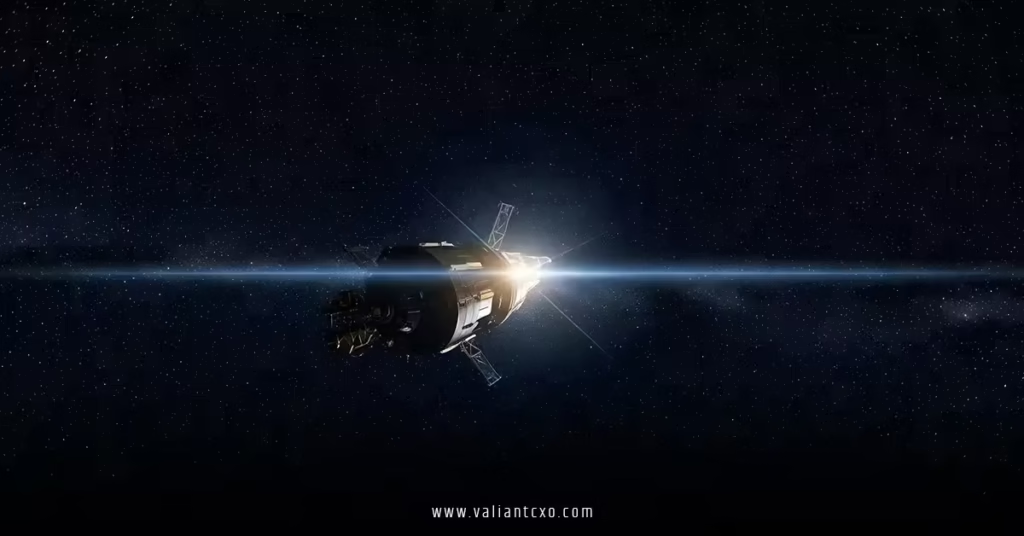
Lost in space? Not with today’s comms. Space exploration technologies and innovations have ditched radio waves for lasers, beaming data at light speed—literally. NASA’s Deep Space Optical Communications demo in 2025 smashed records, transmitting 267 megabits per second from 140 million miles away. That’s HD video from Psyche asteroid, no lag.
Why lasers over radio? Bandwidth. Radios top out at megabits; optics hit gigabits. BlueHalo’s orbital tests in March 2025 proved long-haul viability, eyeing military and science apps.
Laser and Optical Comms: Light-Speed Links
Optical comms are the fiber optics of space—secure, compact, high-throughput. General Atomics’ air-to-space demo linked drones to sats seamlessly. For explorers, it means instant Earth check-ins, vital for emergencies.
Challenges? Clouds block lasers, so hybrids with radio backups rule. Still, as constellations proliferate, these form resilient nets, like a cosmic internet.
AI-Enhanced Networks: Smarter Than Ever
AI weaves through comms too, predicting blackouts and routing data dynamically. Lockheed’s trends forecast AI/ML optimizing proliferated constellations for zero-downtime global coverage. Rhetorical nudge: What if your Mars rover “phones home” via self-healing AI? That’s the future of space exploration technologies and innovations.
AI and Robotics: The Brains Behind Space Exploration Technologies and Innovations
Robots aren’t sidekicks; they’re stars. In 2025, space robotics hit strides with autonomous swarms scouting craters or 3D-printing repairs. AZoRobotics calls it pivotal, from lunar hoppers to orbital welders.
AI crunches petabytes, spotting anomalies humans miss—like Perseverance’s rock-zapping laser guided by neural nets. Stanford notes space tech’s everyday ties: AI in sats powers your banking security.
Burst of insight: These aren’t cold machines; they’re extensions of us, probing where we can’t. Ethical angle? As autonomy grows, we ponder: Who calls the shots—code or commander?
Sustainable Innovations: Space-Based Solar Power and More
Sustainability? Space exploration technologies and innovations lead. Space-based solar power (SBSP) beams microwave energy from orbit, untapped by night or clouds. Davos 2025 hailed it transformative, with prototypes beaming kilowatts by decade’s end.
In-space manufacturing churns tools from asteroid metals, closing loops. StartUs Insights lists it top trend, enabling factories in zero-G for perfect crystals. Earth benefits: Pharma drugs purer, tech tinier.
Metaphor: Space as a forge, hammering sustainability from cosmic ore.
The Future Horizon: Emerging Space Exploration Technologies and Innovations
Peering ahead, space exploration technologies and innovations promise wonders. Artemis builds lunar gateways by 2028, staging Mars leaps. Nuclear-electric hybrids could whisk crews to Jupiter in years, not decades.
Quantum sensors for gravity mapping, bio-printed organs for rad protection—it’s a torrent. WeForum’s 12 techs include advanced Earth observation, feeding AI climate fixes. Challenges loom: Debris, equity. Yet optimism reigns; as National Geographic quips, orbital hotels and Mars walks await.
What role for you? Innovate, advocate—space needs dreamers.
Conclusion
We’ve journeyed through the electrifying world of space exploration technologies and innovations—from propulsion that shrinks solar systems to comms that bridge light-years. These aren’t abstract; they’re tools reshaping our planet and beyond, blending audacious engineering with human grit. As 2025 unfolds with missions like ESCAPADE and Artemis strides, remember: the cosmos calls. Dive in, question boldly, and who knows? Your spark might ignite the next big leap. The stars aren’t waiting—they’re inviting.
Frequently Asked Questions (FAQs)
1. What are the most exciting space exploration technologies and innovations for beginners to follow in 2025?
If you’re new to this, start with reusable rockets like Starship—they’re slashing costs and enabling frequent launches. Pair that with AI-driven rovers, making solo Mars treks feasible. These space exploration technologies and innovations blend accessibility with wow-factor.
2. How do propulsion advancements in space exploration technologies and innovations impact Mars missions?
Propulsion like nuclear thermal cuts travel from months to weeks, reducing crew stress and radiation exposure. It’s a game-changer for sustainable colonization, turning red planet dreams into timelines.
3. Can space exploration technologies and innovations help solve Earth’s environmental issues?
Absolutely—satellite constellations track deforestation in real-time, while space-based solar power could provide clean energy 24/7. These innovations export orbital smarts to ground-level green wins.
4. What role does AI play in modern space exploration technologies and innovations?
AI isn’t just crunching data; it’s piloting robots, predicting solar flares, and optimizing orbits. In space exploration technologies and innovations, it’s the unsung hero enabling autonomous deep-space ops.
5. When can we expect human settlements enabled by space exploration technologies and innovations?
Lunar bases by 2030 via Artemis, Mars outposts by 2040 with nuclear propulsion. Space exploration technologies and innovations are accelerating this, but international teamwork is key.