Ever wondered what it takes to live and work aboard the International Space Station for months on end? The SpaceX Crew-11 mission delivered exactly that kind of adventure—blending cutting-edge science, international teamwork, and an unexpected twist that made headlines worldwide. Launched in the summer of 2025, this mission showcased the reliability of SpaceX’s Crew Dragon spacecraft while highlighting the unpredictable realities of human spaceflight.
If you’re curious about how a routine rotation turned into the first medical-driven early return in ISS history, keep reading. We’ll cover everything from launch to splashdown, the crew’s contributions, and the link to the NASA astronaut Mike Fincke medical event ISS January 2026 that reshaped the mission’s end.
Launch and Arrival: Kicking Off SpaceX Crew-11
The SpaceX Crew-11 mission blasted off on August 1, 2025, at 11:43 a.m. ET from Launch Complex 39A at NASA’s Kennedy Space Center in Florida. A Falcon 9 rocket carried the Crew Dragon capsule named Endeavour—a veteran spacecraft that had already flown Demo-2, Crew-2, Crew-6, Crew-8, and even the private Axiom Mission 1.
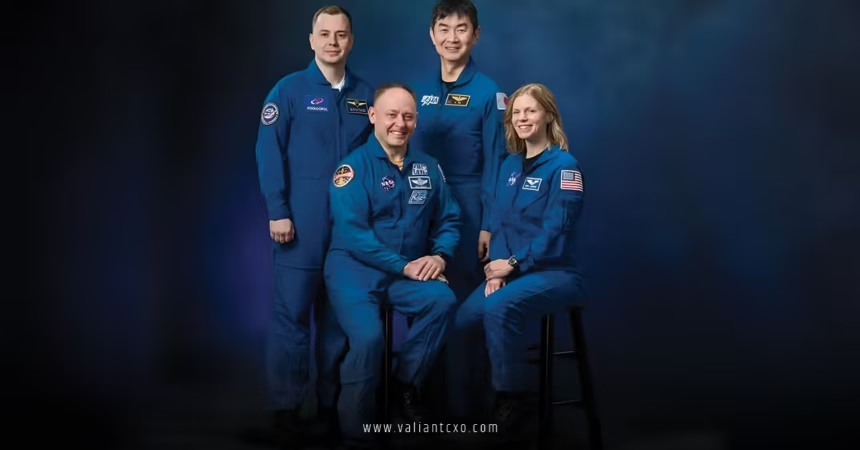
Docking autonomously with the ISS occurred smoothly the next day, August 2, at 2:27 a.m. ET. On board were four experienced spacefarers ready for a long-duration stay:
- NASA astronaut Zena Cardman (mission commander)
- NASA astronaut Mike Fincke (pilot and later Expedition 74 commander)
- JAXA astronaut Kimiya Yui (mission specialist)
- Roscosmos cosmonaut Oleg Platonov (mission specialist)
This multinational crew joined Expedition 73 before transitioning to Expedition 74, where Fincke took command. Picture four people from different space agencies living in a football-field-sized lab orbiting Earth at 17,500 mph—it’s a testament to global cooperation in space.
Key Objectives and Scientific Achievements During SpaceX Crew-11
What did the crew actually do up there? Plenty. The SpaceX Crew-11 mission focused heavily on research that bridges life in low-Earth orbit with future deep-space goals, especially NASA’s Artemis program.
Crew members logged over 850 hours on experiments, including:
- Bone health studies — Testing ways to bolster bone resilience against microgravity’s effects, crucial for Moon and Mars missions.
- Earth observation — Monitoring climate, disasters, and environmental changes from above.
- Technology demos — Simulating lunar South Pole scenarios to prepare for Artemis landings.
- Human health research — Investigating how long-duration flights impact vision, cardiovascular systems, and more.
They also captured JAXA’s new HTV-X1 cargo spacecraft in October 2025, delivering thousands of pounds of supplies and hardware. Think of it as restocking a remote research outpost—except this one floats in space.
Daily life involved maintenance, robotics work with Canadarm2, and welcoming a Soyuz crew in November 2025, including NASA astronaut Chris Williams. The mission emphasized how the ISS serves as a stepping stone for humanity’s return to the Moon and eventual trips to Mars.
The Unexpected Turn: Linking to the NASA Astronaut Mike Fincke Medical Event ISS January 2026
No mission is without surprises, and SpaceX Crew-11 faced one on January 7, 2026. NASA astronaut Mike Fincke experienced a medical event requiring immediate crew attention. Thanks to quick onboard response and ground support from NASA flight surgeons, his condition stabilized rapidly.
What followed became historic. Advanced diagnostics like detailed imaging aren’t available on the ISS, so NASA prioritized safety. They decided on an early return for the entire Crew-11 team—marking the first time in the station’s 25+ years that a medical concern (not a technical failure) prompted a full crew departure ahead of schedule.
Originally planned for a longer stay (potentially into February or April 2026), the mission wrapped up early. This ties directly to the NASA astronaut Mike Fincke medical event ISS January 2026, an incident Fincke later described personally. He emphasized it wasn’t an emergency but a cautious call for Earth-based evaluations. Fincke shared gratitude for his crewmates, NASA, SpaceX, and medical teams, noting he’s now on a solid path to full recovery after post-flight checks in Houston.
This event underscores a key truth: even with top-tier training and tech, space remains unforgiving. The ISS medical suite handles a lot—ultrasound, meds, even minor procedures—but some issues demand hospital-level tools back home.
Return and Splashdown: Wrapping Up SpaceX Crew-11
On January 14, 2026, the Crew Dragon Endeavour undocked at 5:20 p.m. ET. After a roughly 10-hour journey, the capsule splashed down off San Diego’s coast on January 15 at around 3:41 a.m. ET (12:41 a.m. PT). Recovery teams from SpaceX quickly assisted the crew aboard the ship Shannon.
The four astronauts—Cardman, Fincke, Yui, and Platonov—spent 167 days in space total, with 165 docked to the ISS. They left a reduced crew of three to maintain operations until the next rotation arrived.
Fincke later reflected on the “amazing” mission while acknowledging spaceflight’s human side. His transparency helps normalize that astronauts, despite superhuman training, face real health challenges like anyone else.

Why SpaceX Crew-11 Matters for the Future of Space Exploration
Beyond the headlines, SpaceX Crew-11 proved the Commercial Crew Program’s maturity. SpaceX’s reusable systems—Falcon 9 booster landing back at LZ-1—and the veteran Endeavour capsule demonstrated reliability for routine ISS access.
The mission advanced Artemis prep, expanded international partnerships, and added valuable data on long-duration effects. Even the early return offers lessons: better onboard diagnostics, expanded medical protocols, and contingency planning for future stations or deep-space flights.
Incidents like the NASA astronaut Mike Fincke medical event ISS January 2026 remind us why safety always trumps schedule. NASA’s decision to bring everyone home early protected the crew and preserved mission integrity.
Conclusion: A Mission of Milestones and Lessons Learned
The SpaceX Crew-11 mission blended triumph and caution—from a flawless launch and groundbreaking science to a historic, medically driven early return. It highlighted human ingenuity, international collaboration, and the fragile line between routine and risk in orbit. Mike Fincke’s recovery and the crew’s safe splashdown turned a challenging end into a positive outcome, reinforcing trust in NASA’s processes.
Whether you’re a space enthusiast or just fascinated by human achievement, SpaceX Crew-11 shows exploration’s real stakes—and rewards. As we aim for the Moon, Mars, and beyond, missions like this pave the way, one careful step (or orbit) at a time.
Here are three high-authority external links for more information:
- Official NASA overview of the mission: NASA’s SpaceX Crew-11 Mission
- SpaceX mission page with timeline: SpaceX Crew-11 Mission
- NASA update on the astronaut’s statement: NASA’s SpaceX Crew-11 Astronaut Update
FAQs
Who were the astronauts on the SpaceX Crew-11 mission?
The crew included NASA astronauts Zena Cardman (commander) and Mike Fincke (pilot), JAXA’s Kimiya Yui, and Roscosmos’ Oleg Platonov.
When did SpaceX Crew-11 launch and return?
Launch occurred on August 1, 2025, with docking the next day. The mission returned early on January 15, 2026, due to a medical concern linked to the NASA astronaut Mike Fincke medical event ISS January 2026.
What caused the early end of SpaceX Crew-11?
A medical event experienced by Mike Fincke on January 7, 2026, led NASA to opt for an early return to access advanced diagnostics unavailable on the ISS.
What science did SpaceX Crew-11 conduct?
The crew performed bone health research, Earth observations, lunar simulation tests, and captured a new JAXA cargo vehicle, contributing over 850 hours to ISS experiments.
How is Mike Fincke doing after the NASA astronaut Mike Fincke medical event ISS January 2026?
Fincke reports he’s doing very well, undergoing standard post-flight reconditioning at NASA’s Johnson Space Center, with reassuring results from evaluations.