
The Starship launch schedule isn’t a simple calendar you can print and stick on the fridge. It’s a living, shifting plan built around test results, hardware readiness, and regulators who ultimately hold the keys to the pad.
If you’re trying to make sense of when Starship flies next—and how missions like the SpaceX Starship Flight 13 launch date fit into the bigger picture—you’re in the right place.
Quick summary of the Starship launch schedule
Before diving into the weeds, here’s the fast, skimmable version:
- The Starship launch schedule is dynamic, not fixed; dates often move as tests reveal new work.
- Every launch depends on hardware readiness, ground infrastructure, and FAA licensing.
- SpaceX aims for a high flight cadence to iterate quickly, especially from Starbase in Texas.
- Official updates on the Starship launch schedule always come from SpaceX channels and regulatory filings, not rumor threads.
- Individual missions—like the one tied to the SpaceX Starship Flight 13 launch date—slot into a broader roadmap that includes cargo flights, NASA Artemis support, and long-term Mars plans.
How the Starship launch schedule is actually built
Here’s the thing: Starship’s schedule isn’t about picking dates first and forcing the rocket to comply. It’s the other way around.
1. Hardware and test milestones
SpaceX sets its Starship launch schedule around a series of technical gates:
- Construction and integration of the Super Heavy booster and Starship upper stage
- Cryogenic proof tests of the tanks
- Static fires of Raptor engines (booster and ship)
- Full wet dress rehearsals (WDRs) simulating launch without liftoff
If any of those steps show a problem—valve issues, engine anomalies, structural concerns—the schedule shifts. That’s normal for a rapidly evolving system.
In practice, what usually happens is:
- A tentative launch window is penciled in.
- Tests either confirm or kill that window.
- A new window appears once fixes are verified.
2. Regulatory approvals (especially FAA)
The FAA Office of Commercial Space Transportation has a massive say in the Starship launch schedule. Each integrated flight test needs an approved license that considers:
- Public safety
- Environmental impact
- Risk from debris and overpressure events
No license, no launch. It doesn’t matter how “ready” the rocket looks.
As Starship heads toward later flights—like those around the SpaceX Starship Flight 13 launch date—regulators will be watching past performance closely. Any anomaly on earlier missions can temporarily slow the schedule while corrective actions are reviewed.
3. Mission objectives and complexity
Not every Starship flight has the same goals, and that changes the schedule.
Some missions focus on:
- Reaching orbit and surviving reentry
- Testing heat shields, flaps, or landing burns
- Demonstrating propellant transfer or other on-orbit maneuvers
More ambitious missions generally:
- Need more ground testing
- Require additional simulation work
- Bring new software and hardware revisions
That’s why a simple repeat ascent might be scheduled closer together, while a complex demo—like one influencing the SpaceX Starship Flight 13 launch date—can stretch out.
Where Starship launches from—and why location matters
The Starship launch schedule is tightly tied to geography. Right now, the main stage is:
Starbase, Boca Chica, Texas
Starbase is the primary Starship hub. It hosts:
- Vehicle assembly and integration
- The main orbital launch mount and tower
- A dedicated tank farm and ground support systems
The surrounding environment and nearby communities mean SpaceX has to operate within constraints defined by:
- Environmental reviews
- Safety zones over land and water
- Noise and debris considerations
All of that feeds back into how often Starship can safely launch and how the schedule unfolds over a year.
Future expansion: Kennedy Space Center and beyond
SpaceX has also prepared Starship infrastructure at Kennedy Space Center (KSC) in Florida. As that comes online, you can expect:
- Potentially higher launch cadence
- Different mission profiles from each coast
- More flexibility to swap missions between sites if needed
From an overall Starship launch schedule perspective, multiple pads mean less single-point failure and more chances to fly.
How to read and interpret the Starship launch schedule as an outsider
You’re not in mission control, but you don’t need to be blind. Here’s how to read the tea leaves without falling for hype.
Watch for phases, not single dates
Instead of obsessing over a specific day, think in phases:
- Phase 1: Assembly and early testing; lots of static fire and tanking activity
- Phase 2: Full WDRs and rehearsals; launch window discussion ramps up
- Phase 3: Official launch window announced; weather and last-minute checks dominate
When you hear chatter about the SpaceX Starship Flight 13 launch date or any other flight, ask yourself: Which phase are we in? That answer tells you how firm the schedule really is.
Track official signals first
The most reliable signals in the Starship launch schedule are:
- Posts from SpaceX’s official X account
- Updates on the Starship section of SpaceX’s site
- FAA licensing and environmental documents
Space news outlets then translate those into more digestible coverage with context.
Expect frequent “slips” to be normal
Unlike mature systems with decades of operational experience, Starship is still young. Shifting a launch by days, weeks, or even longer isn’t failure—it’s part of the learning curve.
The mistake is thinking the schedule should look like a commercial airline timetable. It’s more like a test pilot program for a brand-new aircraft.
Where the SpaceX Starship Flight 13 launch date fits into the schedule
Let’s talk specifically about how a mission like the SpaceX Starship Flight 13 launch date fits into the broader Starship launch schedule.
By the time SpaceX hits double-digit flights:
- The focus has shifted toward repeatability and reliability, not just “can it fly once?”
- Iterations between flights might be more targeted tweaks than sweeping redesigns.
- NASA, commercial partners, and internal SpaceX projects are watching cadence closely.
The SpaceX Starship Flight 13 launch date will be one node on a progression where each flight aims to:
- Reduce risk
- Gather focused test data
- Prepare for real operational missions (like cargo, lunar landers, and eventually Mars setups)
Think of the schedule as a long chain. Flight 13 is one link, but it’s held in place by everything that happens before it—and everything it enables after.
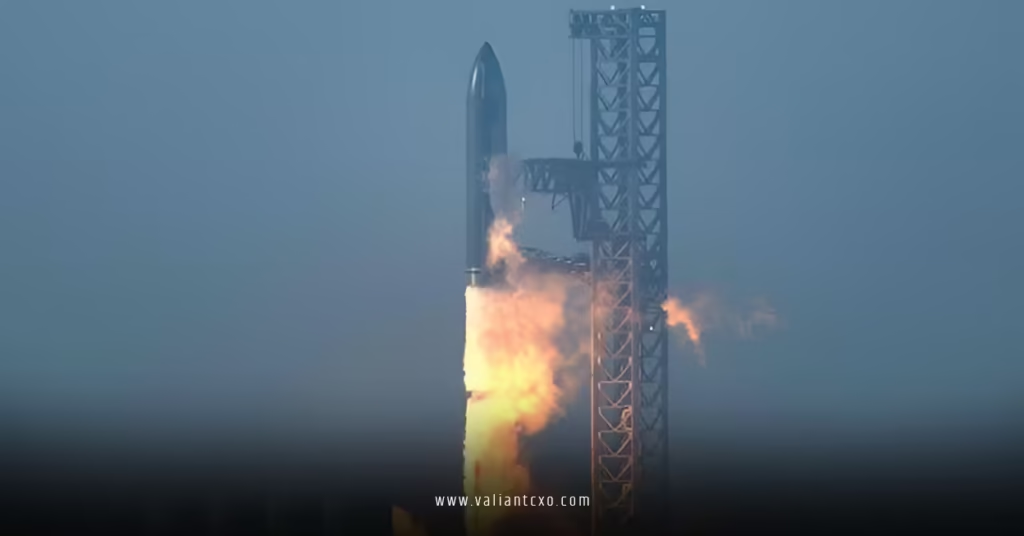
Typical structure of the Starship launch schedule (yearly view)
To make this concrete, here’s how a hypothetical year of Starship activity might be structured. This isn’t tied to specific dates, but it shows the pattern.
- Early year:
- Vehicles for the next 1–2 flights near completion
- Pad upgrades and system improvements following prior flights
- New license or amended license work beginning with the FAA
- Mid-year:
- Several test campaigns at Starbase (cryogenic tests, static fires)
- Launch attempts spaced weeks to months apart
- Debrief cycles after each flight folding into the next launch’s prep
- Late year:
- Pushing in additional flights as hardware and regulators allow
- More complex demonstrations (orbital refueling tests, advanced reentry profiles)
- Strategic positioning for the following year’s NASA or commercial milestones
Where it gets interesting is when big program milestones—like a NASA Artemis test mission—need to align with this rolling Starship launch schedule. That’s when slips on one flight can cascade into downstream missions.
Action plan: how to stay on top of the Starship launch schedule
If you want to follow the Starship launch schedule like a pro, here’s a simple system that actually works.
1. Follow the primary sources
Your non-negotiables:
- SpaceX official channels (website and X account)
- FAA commercial launch license listings
- NASA updates for missions that depend on Starship
These tell you what’s real, what’s planned, and what’s delayed.
2. Layer in reputable space news coverage
Next, pick one or two trusted space and science news outlets. Use them to:
- Get explanations of what each Starship test is trying to prove
- Understand why a particular slip in the Starship launch schedule matters
- Keep track of patterns over time (launch frequency, test results, etc.)
3. Build a personal “launch readiness checklist”
Before you mark up your calendar for any Starship mission—whether it’s an early test or something like the SpaceX Starship Flight 13 launch date—run through a quick checklist:
- Has SpaceX posted a public launch window?
- Has the FAA approved the relevant license or updated an existing one?
- Have recent static fires and WDRs completed successfully?
- Is weather for the window generally favorable?
If the answer to those is mostly “yes,” you’re looking at a window worth taking seriously.
4. Plan with flexibility
If you’re traveling or scheduling content around the Starship launch schedule:
- Assume last-minute scrubs are possible
- Book with flexible cancellation where you can
- Treat early dates as aspirational, not guaranteed
That mindset saves both money and frustration.
Common misconceptions about the Starship launch schedule
Let’s clear a few things up, because these trip people constantly.
“Once SpaceX announces a date, it’s locked in.”
Not even close. Any Starship launch date—even when announced—is still subject to:
- Weather
- Range availability
- Late-stage technical findings
Take official dates seriously, but don’t treat them as immovable.
“More delays mean the program is failing.”
Not in a test-heavy program like this. Delays usually mean:
- Issues were found
- Teams chose to fix them before risking a full flight
That’s good engineering discipline, even if it’s annoying for spectators.
“If hardware looks ready on the pad, launch must be imminent.”
Visible pad readiness can be misleading. Behind the scenes, you still need:
- Software checks
- Regulatory signoff
- Range coordination
The Starship launch schedule always sits at the intersection of visible progress and invisible approvals.
Starship launch schedule: why it matters beyond the hype
So why should you care about this schedule beyond watching a big rocket fly?
Because the Starship launch schedule is a proxy for:
- How fast we can iterate toward fully reusable heavy lift
- How realistic NASA’s Artemis timelines are with Starship in the loop
- When large-scale cargo and infrastructure for Moon and Mars missions become real possibilities
When flights become frequent, uneventful, and routine—that’s when everything downstream (cheaper access to orbit, more ambitious missions, deeper space infrastructure) gets unlocked.
Every line on the Starship launch schedule is a step toward that reality, even if the path looks messy up close.
Key Takeaways
- The Starship launch schedule is built around test milestones, hardware readiness, and regulatory approvals—not fixed dates.
- Launches from Starbase (and future pads like KSC) unfold in phases: build, test, rehearse, launch, then iterate.
- Official schedule information always comes from SpaceX, FAA licensing, and relevant mission partners like NASA.
- Individual missions—such as those near the SpaceX Starship Flight 13 launch date—fit into a larger roadmap toward high-cadence, reusable heavy lift.
- Date slips are normal in a developmental program and usually reflect teams choosing safety and reliability over rushed timelines.
- If you’re planning travel or coverage, use a personal readiness checklist and build in flexibility to handle scrubs and delays.
- Long term, a stable, high-frequency Starship launch schedule is what will make regular Moon missions and serious Mars campaigns financially and technically feasible.
FAQs about the Starship launch schedule
1. How often does SpaceX plan to launch Starship once the system is mature?
SpaceX has publicly signaled ambition for a very high cadence—potentially dozens of Starship launches per year once the system is fully operational—but the actual Starship launch schedule will depend on pad availability, vehicle production, and regulatory clearances.
2. How does a mission like the SpaceX Starship Flight 13 launch date affect future launches?
Each Starship flight feeds data into the next, so a mission around the SpaceX Starship Flight 13 launch date could validate hardware, software, and procedures that unlock more complex or more frequent missions later in the schedule.
3. Where should I look first when the Starship launch schedule changes suddenly?
Start with SpaceX’s official X account and website for any updated launch windows or scrub notices, then check FAA regulatory information and reputable space news outlets for context on why the Starship launch schedule shifted.